

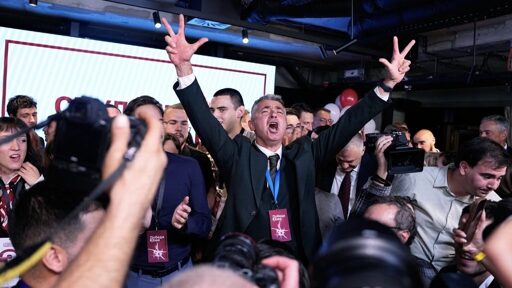

On October 25, an election list formed after two years of student-led protests in Serbia toppled Aleksandar Vučić and the Serbian Progressive Party (SNS). The announcement was met with street celebrations that continued throughout the night, recognizing the outcome as a chance to break with 12 years of the former president’s anti-people policies.
Election turnout surged to almost 70% of registered voters. The Student List secured roughly 53% of the vote and the SNS came in second with close to 39%. The two options are set to be the only forces in parliament except for minority representatives.
“These results have shown that a genuinely homegrown – even if heterogeneous – movement can articulate social discontent with SNS rule, provided it makes a decisive break with the baggage of the pro-Western opposition,” the Party of the Radical Left (PRL) wrote in a reaction on Monday.
The Students List ran on a platform titled “Serbia or the Mafia,” consisting of anti-corruption promises and plans to tackle the political establishment’s capture of the media sector. It also included a call for more transparency in public procurement and recruitment in the public sector. The platform promised to limit import monopolies, lower drug prices, and make healthcare more accessible.
From the Novi Sad canopy collapse to the ballots
Sunday’s results were made possible by months of demonstrations and public assemblies triggered by the canopy collapse in Novi Sad in November 2024. Sixteen people died in the event. In the aftermath, students across the country threw their energy into a campaign demanding accountability for the tragedy.
From the beginning, protesters insisted the Novi Sad disaster was a consequence of the SNS’s way of doing politics, marked by widespread corruption, nepotism, and disregard for the public interest. During his tenure as prime minister and president, Vučić attempted to cast himself as a supporter of multilateralism and a political figure critical of the West, yet his actions exposed this as a more rhetorical than anything else.
These actions included supporting extractive deals with British-Australian mining company Rio Tinto – which the European Union included on its strategic projects list despite risks posed to communities in Jadar and mass mobilizations against the project – as well as the launch of a drone factory in cooperation with Israeli arms producer Elbit Systems. In fact, despite the former SNS leader’s efforts to present him as neutral, Serbia’s involvement in arms trade to Israel has been such to warrant notes of particular concern by UN Special Rapporteur Francesca Albanese.
Locally, Vučić’s rule was marked by violent crackdowns on activists and campaigns, from the most recent student campaigns to Palestine solidarity. There was no substantial reaction to these reports from other European countries or the EU.

Aleksandar Vučić (center) with Bulgarian Prime Minister Rumen Radev and Albanian Prime Minister Edi Rama in June 2026. Rama is also facing a major wave of protests demanding his resignation. Source: Aleksandar Vučić/Facebook
On the other hand, while very heterogeneous in character, the student movement aligned itself clearly against the Gaza genocide. Some local groups made solidarity with Palestine a central issue in their mobilizations. They also mobilized against projects associated to US interests, including the redevelopment of the former General Staff complex – a Belgrade landmark damaged in the 1999 NATO bombardment of the city – into a luxury hotel by Jared Kushner, the son-in-law of US President Donald Trump. This project was also brokered while the SNS was in power.
Progressives within Student List face difficult task ahead
The student campaign grew in significance through decentralized plenums and consultations across the country. This approach was not abandoned even during the formation of election lists – leading to a roster of new candidates, previously largely unknown to the public. University staff and other education workers who had supported the mobilization from the early days figured prominently on this list.
The success of the Student List represents an extraordinary achievement, especially considering the movement faced obstructions at every turn. These included police violence and institutional intimidation over the past two years, as well as schedule provisions that jeopardized voting rights in the diaspora.
“The progressive elements within the Student List and the movement now face a difficult task: to resist the forces of the establishment within their own ranks,” the PRL emphasized after the election.
Earlier on, the party and other progressive voices expressed “critical support” for the Student List, recognizing the elements of social justice incorporated in its platform – but also noting aspects belonging to a technocratic vision of governance.
Read more: Albania’s protests show no signs of backing down
“When it comes to the published program, the measures set out in the ‘Serbia or the Mafia‘ plan are not enough to eradicate the structural injustice that has taken root in Serbia over thirty years of privatization, ‘structural adjustment’ to the Euro-Atlantic regime, and the weakening of public institutions – and their systematic incapacitation from carrying out their mandated functions and protecting the public interest against the arbitrary power of capital,” the PRL stated in September.
Despite such reservations, the hope embedded in the movement surrounding the Student List is clear. The PRL observed: “Beyond the mass politicization of students and the raising of awareness on many key social issues – and despite pressure from ‘opposition’ politicians who would rather keep all these topics quiet […] we consider the following to be progressive developments: the construction of a directly democratic movement that antagonizes both the government and the parliamentary opposition in practice […] open communication and cooperation with trade unions, which gave rise to the first mass protest-based May Day commemoration in many years […] and cooperation with informal labor and professional collectives, which gave rise to a new organization – the Social Front.”
From BT News via This RSS Feed.