

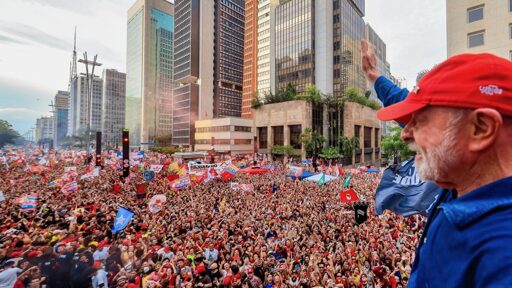

The week before October 25 in Brazil was frenetic. It appeared that every one of the over 200 million Brazilians had a political opinion about the presidential election. The country was fundamentally polarized. Polls showed that the vote was going to be tight, with most polls favoring the challenger Flávio Bolsonaro, son of the former president Jair Bolsonaro, and the standard bearer of the far right of a special type. But the incumbent Luiz Inácio Lula da Silva, known as Lula and president of Brazil from 2003 to 2011 and then since 2023, would not allow the polls to stop him. He traveled the length and breadth of the country, holding massive and energetic rallies to mobilize people to vote. In the first round, 21% of the voters did not turn out in a process that is otherwise compulsory (and a large section who did vote left the presidential section either unmarked or spoiled). Only 2.2 million ballots separated Bolsonaro (who won 47% in the first round) from Lula of the 158.7 million registered voters. To win between October 4 (first round) and October 25 (second round), Lula had to either attract people who had voted for Bolsonaro or those who had not voted or spoiled their ballots. No other candidate had turned around such a deficit in Brazil’s modern history. But Lula did it.
Streets
In the three weeks between the first and second rounds, Lula and his team motivated millions of people onto the streets in the large cities of Brazil, but also in several smaller, but significant towns. These enormous mobilizations created a sense that Lula would overcome the mathematical disadvantage presented by the voting numbers after the first round. All psephological analyses showed that Bolsonaro would cruise through in the second round, which would have indicated the impossibility for Lula. But the left did not rest on this handicap but went on the offensive.
In the first round, Bolsonaro finished 2.22 million votes ahead, but in the runoff, Lula finished with 4.43 million votes ahead. The margin moved by 6.66 million votes. These votes came from the large cities: the 319 cities with more than 100,000 inhabitants, home to 57% of Brazil’s population, delivered 3.89 of the 6.66 million of the turnaround. Lula’s vote grew more in municipalities that are more evangelical, richer, whiter, more schooled, and more urban. This meant that he ate substantially into Bolsonaro’s base, which was something that surprised even the Lula team. The key to the turnaround was the mass mobilizations driven by the social movements, with the Landless Rural Workers’ Movement (MST) in the lead.
Advances
Across his three terms, Lula has presided over an extraordinary advance in the social conditions of the Brazilian people. Bolsa Família, increases in the minimum wage, the expansion of public universities, and support for family farming brought food, income, and opportunity into households that the ruling class had long treated as disposable. These achievements changed millions of lives and established that poverty could be confronted through public action. Yet the political formula that made these advances possible has reached its limits. Lula sought to improve the lives of the poor while accommodating the power of finance, agribusiness, and the dominant sections of Brazilian capital. During his first two terms, favorable international conditions created room for this accommodation. But redistribution without a corresponding transformation of economic power left the foundations of inequality intact, allowing the beneficiaries of the old order to retain the means to obstruct change and reverse its gains.
In his third term, fiscal restrictions, expensive credit, and dependence on conservative parliamentary forces have narrowed the space for reform. Social programs remain indispensable, but they cannot by themselves overcome insecure employment, household indebtedness, inadequate public services, or the concentration of land and wealth. The exhaustion lies in a governing strategy whose compromises increasingly obstruct the fulfilment of its promises. Lula’s personal authority cannot indefinitely bridge the distance between popular expectations and the concessions demanded by the powerful. A renewed project will require the organized strength of workers, peasants, and residents of the urban peripheries, the very people who form Lula’s base, with an agenda of agrarian reform, public investment, industrial development, and democratic control over finance. The movements that filled the streets must acquire greater power to shape the government’s direction. Defeating the far right opens that possibility, but securing the social gains of the Lula years will require confronting the structures that continually threaten them.
Defeat of Trump
US President Donald Trump, his vice president JD Vance, and members of the Brazilian diaspora in Miami put an immense amount of effort into defeating Lula. Brazil, which makes up half the landmass of South America, and is the largest economy in Latin America, stands out against the wave of far-right governments that now dominate the Americas. Interference in the Brazilian elections is now an acknowledged fact, with Meta cutting off Lula’s accounts at a crucial stage of the contest and other reports of funding and social media intervention.
Trump had hoped that Bolsonaro would win in Brazil so that he can then strengthen his Shield of the Americas process that began in Miami in March 2026. This process was presented by Trump as an institutional form to coordinate security but also for the suffocation of the popular movements and the left. Lula’s victory has blocked Trump’s path to exercise the Monroe Doctrine. It has also meant that Trump will not be able to so easily access the critical minerals in Brazil or to dominate the new oil find in the basin of the Amazon delta.
Despite the obstacles faced by Lula, his victory has been able to show that the far right is not invincible.
Vijay Prashad is an Indian historian and journalist. He is the author of forty books, including Washington Bullets, Red Star Over the Third World, The Darker Nations: A People’s History of the Third World, The Poorer Nations: A Possible History of the Global South, and How the International Monetary Fund Suffocates Africa, written with Grieve Chelwa. He is the executive director of Tricontinental: Institute for Social Research, the chief correspondent for Globetrotter, and the chief editor of LeftWord Books (New Delhi). He also appeared in the films Shadow World (2016) and Two Meetings (2017).
This article was produced by Globetrotter.
From BT News via This RSS Feed.