

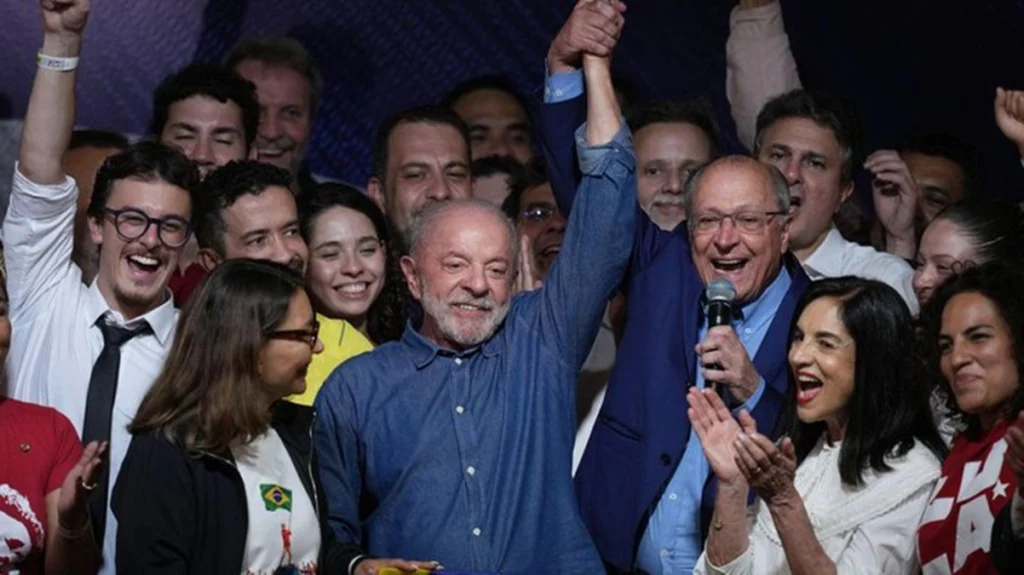
Progressive Leader Defeats Flavio Bolsonaro in Runoff, Blunting Washington’s Push for Regional Allies.
On Sunday, the unexpected reelection of Brazilian President Luiz Inacio Lula da Silva represents a setback for U.S. President Donald Trump’s plans to consolidate his influence in Latin America, at a time when the rightward shift of several countries seemed to be clearing his path.
RELATED:
Trump’s Grip on Senate at Stake in 10 Key Midterm Races
The Workers’ Party leader prevailed with nearly 52% of the vote over far-right Senator Flavio Bolsonaro, son of former President Jair Bolsonaro (2019-2022), and became the first candidate to win a runoff after finishing second in the first round.
As Trump has yet to comment on the results, which Flavio has refused to recognize, Lula’s victory frustrates the possibility that Washington could add Latin America’s largest economy to its bloc of regional allies.
The setback for the MAGA leader comes just days before midterm elections in which polls indicate Democrats could wrest control of Congress from him.
A Limit on Regional Momentum
In his second term, Trump announced he would revive the Monroe Doctrine, a 19th-century policy he invokes to assert U.S. primacy in Latin America.
When he returned to the White House, his regional allies were few, among them Javier Milei in Argentina, Nayib Bukele in El Salvador, and Daniel Noboa in Ecuador.
Rightward shifts in Honduras (Nasry Asfura), Bolivia (Rodrigo Paz), Chile (Jose Antonio Kast), Peru (Keiko Fujimori), and Colombia (Abelardo de la Espriella) broadened that bloc. On repeated occasions, Trump boasted of having contributed to those victories.
The axis of Trump’s foreign policy toward Latin America is the “Shield of the Americas,” an alliance supposedly aimed at fighting drug trafficking but which in reality seeks to consolidate U.S. hegemony. Flavio Bolsonaro had promised to join that new U.S. geopolitical instrument.
Washington also seeks to counter China’s growing influence in Latin America, although a Flavio victory would hardly have altered Brazil’s economic ties with the Asian giant, given the weight of the agro-industrial sector in the Bolsonarist coalition and its dependence on the Chinese market.
Currently, Lula’s presidency in Brazil and Claudia Sheinbaum’s presidency in Mexico emerge as the main counterweights to Trump’s domination project.
This story is extremely important:
A whistleblower revealed that Brazil’s far-right Bolsonaro family dynasty met with Meta to discuss US plans to interfere in Brazil’s election, to prevent Lula from winning.
Lula’s Facebook and Instagram accounts were censored a few days before… pic.twitter.com/lB8pkvssqY
— Ben Norton (@BenjaminNorton) October 15, 2026
A Calculated Caution
Despite what was at stake in Brazil, Trump avoided expressly supporting Flavio Bolsonaro, unlike what happened in Colombia, where he openly backed De la Espriella. His presence, however, was felt, and Lula’s campaign denounced interference from Washington.
Lula himself declared in his victory speech that the result demonstrates that in Brazil “we do not accept being anyone’s backyard.”
A Flavio victory would have meant “100 percent alignment with Trump in his culture war and security policy,” explained Benjamin Gedan, director of the Latin America Program at the Stimson Center think tank.
The Republican was “clearly excited about this possibility,” but an explicit endorsement could have “hurt” the candidate, he added.
Trump, however, had already taken a stand through his actions. In 2025, his administration imposed high tariffs on Brazil in response to the trial against Jair Bolsonaro, who was sentenced to prison for attempting a coup d’etat against Lula in 2023.
In May, Trump received presidential candidate Flavio Bolsonaro in the Oval Office, an unusual gesture since he was not a head of state. Flavio asked him to designate the First Capital Command (PCC) and the Red Command as terrorist organizations.
The White House agreed to that request four days later, a decision Lula opposed out of fear that the measure would open the door to U.S. interventionism.
Washington also opened a trade investigation against Brazil over alleged unfair practices, revoked the visa of the Brazilian ambassador and suspended its consular services two days before the first round — in which Bolsonaro defeated Lula — citing security reasons.
That involvement also exposes Washington to the region’s political changes. For Oliver Stuenkel, a researcher at the Carnegie center, ideological alliances are a fragile bet in a scenario marked by frequent alternations in power.
“The kind of ideological interventionism that the Trump administration is carrying out in the region is counterproductive. In the medium and long term, it will strengthen anti-American forces,” he said.
Lula’s reelection thus forces Washington to deal with a Brazil that does not share its agenda and highlights the limits of its strategy for Latin America.
teleSUR/ JF
Source: EFE
From teleSUR English via This RSS Feed.
And it should be highlighted that it took a militant level of solidarity and organizing, particularly thanks to lawmaker Janones’ efforts and the “Lula Army” campaign. They understood the stakes and brought the campaign to get out the vote online and in the streets as well.
None of this, “is he too old”, “is he left wing enough” “is he moderate enough” that certain charlatans and newsmedia want to hem and haw about directly before the election to effectively depress the vote. The time for that kind of discussion is before and during the candidate selection process.