

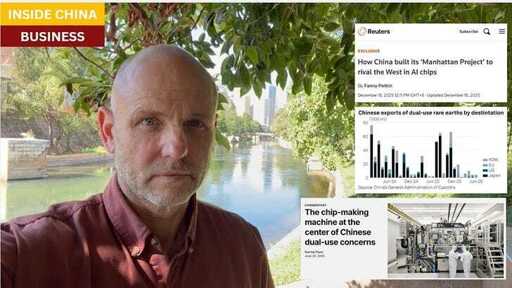
Bullets:
ASML is a Dutch company, who builds EUV (Extreme Ultraviolet) and DUV (Deep UV) lithography machines for advanced chipmaking.
After pressure during the first Trump Administration, the Netherlands restricted ASML’s exports of EUV machines to China.
The Chinese developed a domestic industry to manufacture EUV and DUV equipment, and have recently achieved breakthroughs in prototypes and tools for both.
But China also moved against ASML’s supply chains for the EUV devices. They discovered that a German company relied on Chinese rare earth materials to make coating materials for ASML, and put that company on its own export controls lists.
Inside China / Business is a reader-supported publication. To receive new posts and support my work, consider becoming a free or paid subscriber.
Report:
Good morning.
The most advanced chips used in computing, and Artificial Intelligence, come from Deep Ultraviolet or Extreme Ultraviolet lithography machines. We are linking to several pieces, which explain those machines in easy-to-understand ways.
Lots of nuggets in those reports. For example, that the mirrors inside those machines are so smooth, that were they blown up at scale to the size of Germany, the largest bumps would be just one millimeter. Extreme ultraviolet beams draw transistors into silicon wafers “with a precision equivalent to shooting an arrow from Earth” and hitting an apple on the moon. Five nanometers is how long a fingernail grows in five seconds. And on it goes.
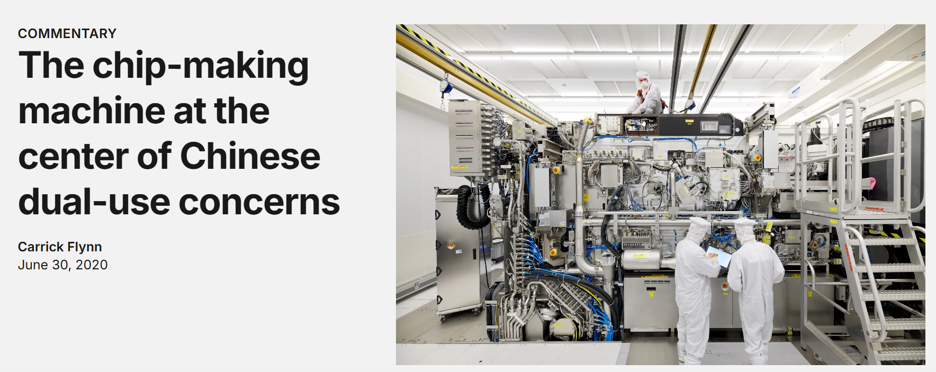
These machines go for nine figures, but demand for them far outstrips supply. They’re made by ASML, and at the time of this piece in 2020, ASML was the only company who could make them. ASML is a Dutch company. And their machines are so valuable, and so critical to the semiconductor race, that the US government pushed the government in the Netherlands for an export ban of ASML machines to China.
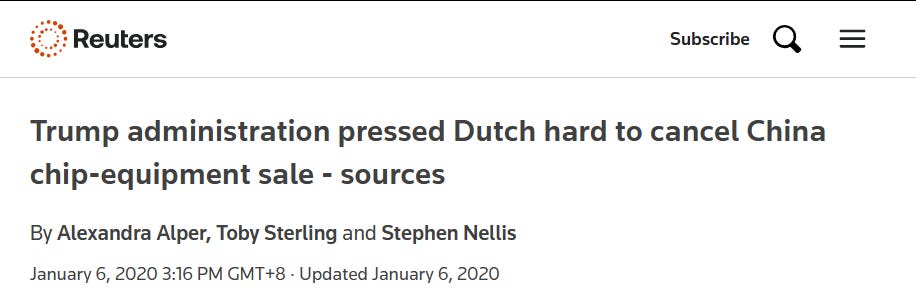
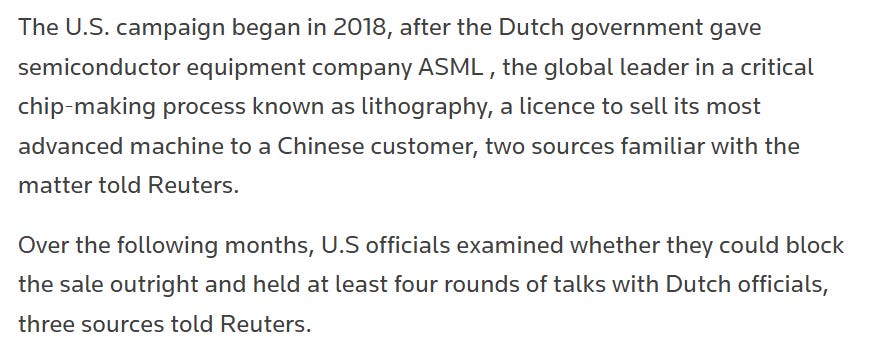
The sale of that equipment to China was a national security risk to both countries, according to a US intelligence report. The Dutch government agreed, and canceled a $150 million shipment to China.
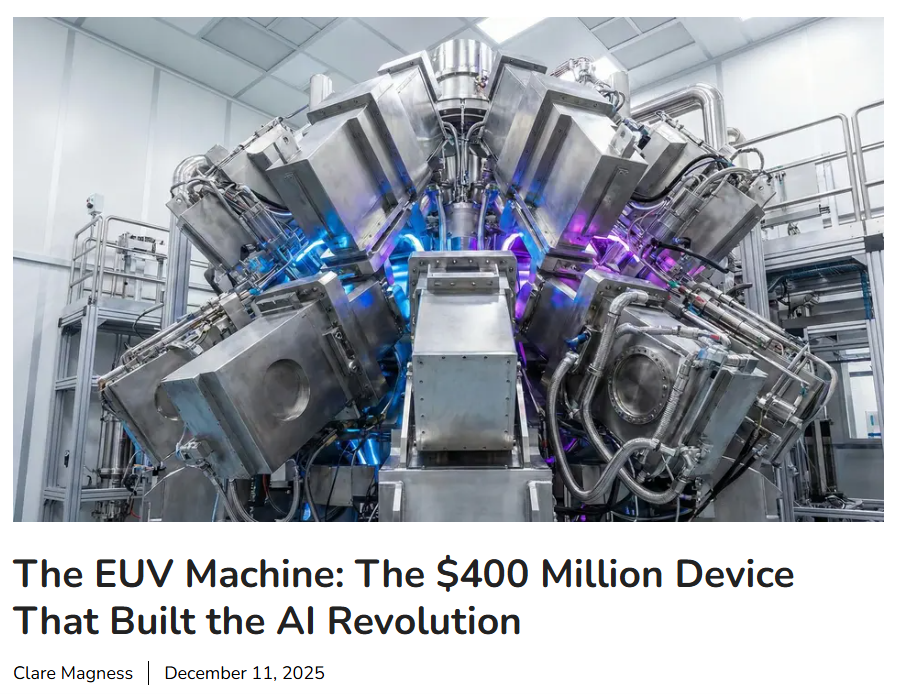
Fast forward to today, and everything is different. The machines cost a lot more, for one, and are even more advanced. And China reacted to the export bans on the latest-generation gear from ASML in two predictable ways, and in ways we’ve seen many times before.
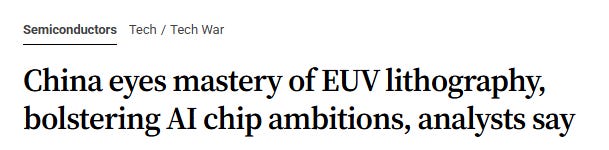
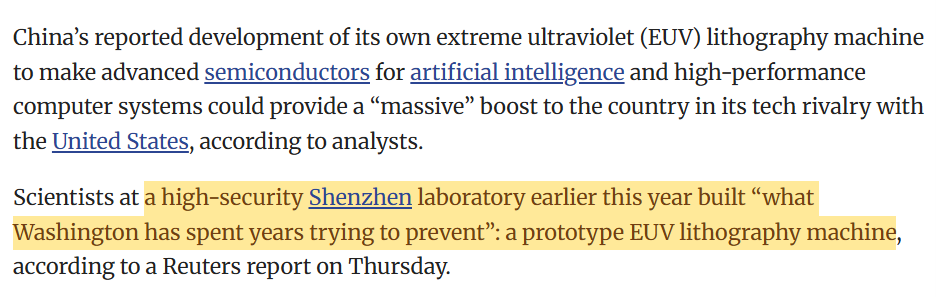
First, they built their own domestic EUV lithography industry. Last year, a company in Shenzhen “built what Washington spent years trying to prevent”: a prototype EUV lithography machine. A group of engineers who previously worked at ASML built a large prototype which is still in testing, and not yet producing semiconductor chips commercially.
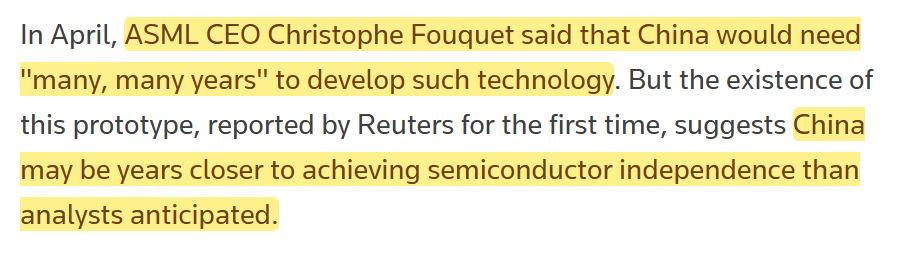
And there’s a movie we’ve seen a few times: the top people in the industry insist that China is many years behind, then a headline a few months later flips their world upside down. Industry analysts now figure mass production in China might happen around 2030, which less than half the time those same analysts thought it would be just a year ago.
This is China’s version of the Manhattan Project, and the final objective is “Delete America” – which is already underway in other industries too. Everything needs to be entirely made-in-China.
Then came news from Shanghai, where another company brought its EUV machine to a big exhibition there. Ninety percent of their parts were domestically sourced, with most of the core components designed in-house. China is still cut off from the global supply chains of the most advanced equipment, and ASML is barred from selling its most advanced machines to China.
There are major challenges on the Chinese side, in making the jump from building Extreme Ultraviolet Machines, to mass-producing advanced semiconductors. It took ASML decades to get there. Twenty years of partnership with Cymer, in the United States, and with Trumpf, a laser maker in Germany, were keys to the light-source technology. Those ultra-fine mirrors also come from a company in Germany, called Zeiss. And without Zeiss, ASML’s machines wouldn’t exist.
And that brings us to the second way that China has responded. Again, ASML is a Dutch company, but is reliant on key suppliers from other countries to assemble their machines. These data are from ASML’s annual report, from last year. The company sold 535 systems: 48 of those were EUV—Extreme Ultraviolet. Another 279 were Deep Ultraviolet, and many of the DUV’s were sold here, to companies in China. Last year, ASML sales of DUV to China were more than $10 billion.
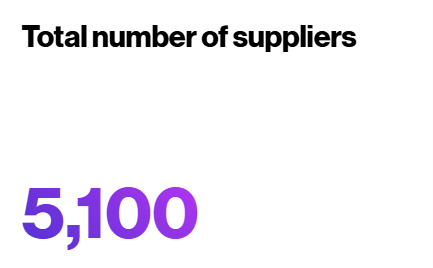
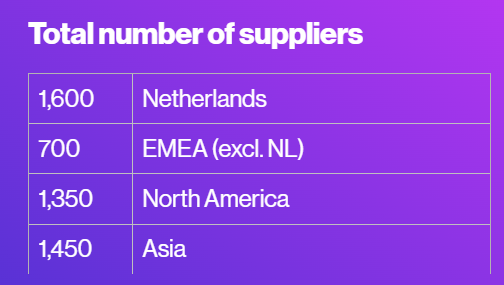
But this is the vulnerability for ASML. The company has 5,100 suppliers, with just 1,600 of them in-country. ASML has over 1,400 suppliers in Asia:
That’s the problem now for ASML, and especially for the governments who put on a ban on ASML’s exports of the EUV machines. The story gets complicated here and we’ll make it short and post the links in-script and below.
The EU is in a bad spot, and are under pressure to lift sanctions on Yusha Group, who is accused of shipping European antenna gear to a Russian company, which is under sanction by the United States:
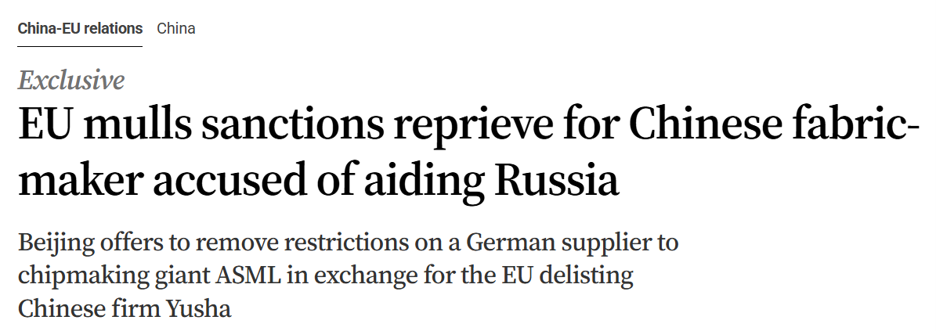
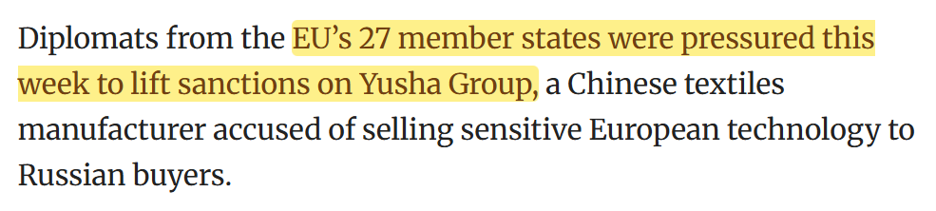
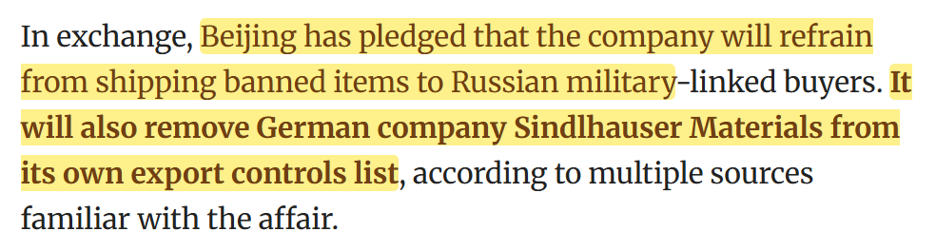
If the EU drops their sanctions on Yusha, Beijing agrees to no longer allow that company—Yusha—to sell to military customers in Russia. But that’s a sideshow: the what’s important here is that news on Sindlhauser. China also agrees to remove Sindlhauser Materials—a German company—from their export controls list.
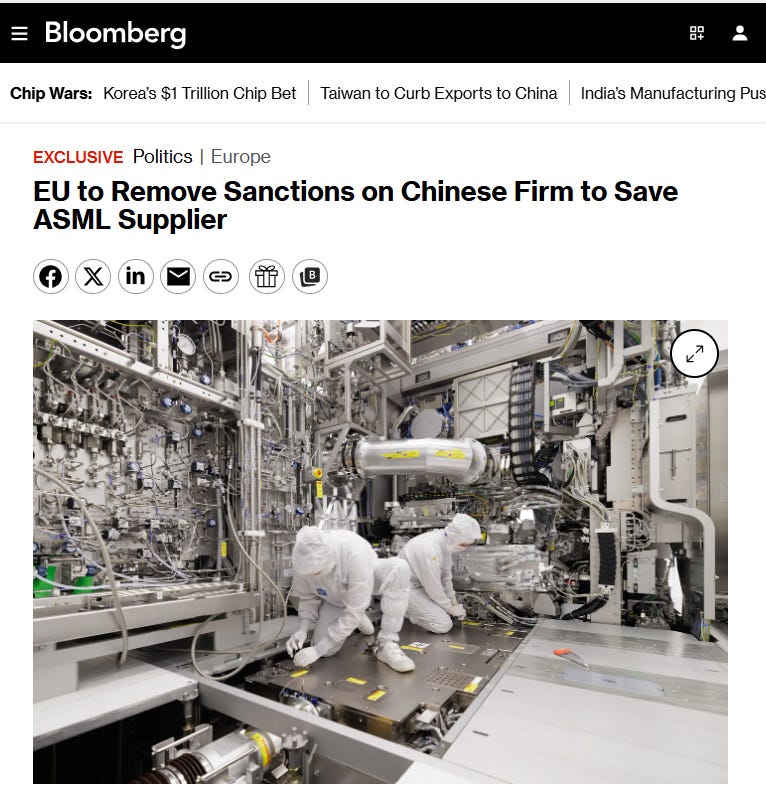
Back in July, Sindlhauser was one of 14 companies sanctioned by China, and were cut off from Chinese rare earth elements. Sindlehauser is a key supplier, in turn, to ASML. The discussions between the EU and China on those points derive from that problem: Sindlhauser is completely dependent on Chinese raw materials to build advanced coating technologies, and ASML is dependent on Sindlhauser, who is months away from going out of business completely if Chinese sanctions remain in place:
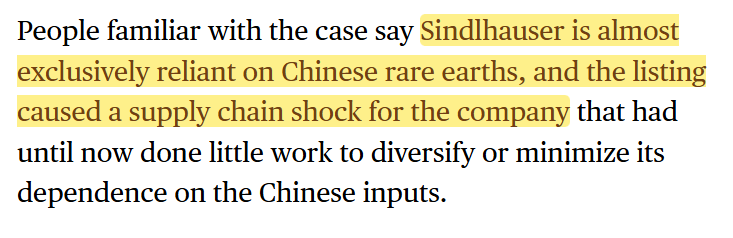
When the company was added to the Chinese export control list, the reaction was panic, and nobody had any idea if and how the company can stay in business. The German government in Berlin and in Bavaria got busy, trying to find workarounds, at exactly the same time every weapons maker in the world is also scrambling to find those same rare earth materials, that the Chinese have cut off. Brussels was also “aware of the company’s situation” and was reaching out to Beijing to talk about it.
But that’s the point. China obviously identified this weakness in ASML’s supply chain a long time before anyone in Germany, or in the Netherlands, or in Brussels learned about it the hard way. The Ministry of Commerce put on these rules over two years, that required the buyers of Chinese rare earth metals and magnets to be completely transparent—who is buying them, and why, and what are the final products they’re going into.
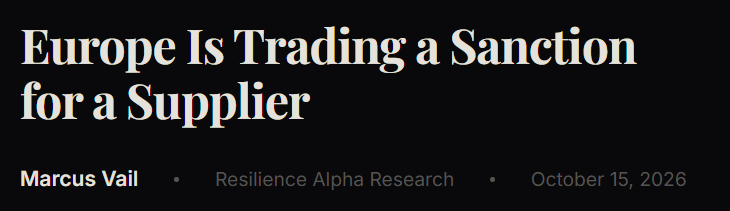
Policymakers and regulators—and intelligence officials–in Washington and Europe were focused on only the top line—sales of the completed product, those five hundred or so fully assembled machines. But in China they looked instead across the thousands of suppliers for the tens of thousands of parts and pieces that go into each one, and discovered that – once again – the supply chains for ASML, in this case, run through China’s rare earth mines and refineries.
So China’s export bans on Sindhauser—just three months ago—caused an existential crisis at that company, and a massive supply chain problem at ASML, and diplomatic issues in Europe.
And we’ve used the metaphor before, that when regulators in the West prevent their companies from selling China any bread, China answers by cutting off shipments of flour.
Be Good.
Resources and links:
The chip-making machine at the center of Chinese dual-use concerns
https://www.brookings.edu/articles/the-chip-making-machine-at-the-center-of-chinese-dual-use-concerns/
The EUV Machine: The $400 Million Device That Built the AI Revolution
https://www.whatjobs.com/news/the-euv-machine-the-400-million-device-that-built-the-ai-revolution/
Trump administration pressed Dutch hard to cancel China chip-equipment sale - sources
https://www.reuters.com/article/us-asml-holding-usa-china-insight/trump-administration-pressed-dutch-hard-to-cancel-china-chip-equipment-sale-sources-idUSKBN1Z50HN/
China eyes mastery of EUV lithography, bolstering AI chip ambitions, analysts say
https://www.scmp.com/tech/tech-war/article/3337100/china-eyes-mastery-euv-lithography-bolstering-ai-chip-ambitions-analysts-say
How China built its ‘Manhattan Project’ to rival the West in AI chips
https://www.reuters.com/world/china/how-china-built-its-manhattan-project-rival-west-ai-chips-2025-12-17/
Start-up unveils prototype ‘heart’ of EUV lithography amid China chipmaking push
https://www.scmp.com/tech/big-tech/article/3370966/start-unveils-prototype-heart-euv-lithography-amid-china-chipmaking-push
China talks up EUV progress, but gap with ASML remains wide
https://www.koreaherald.com/article/10910205
ASML 2025 Annual Report
https://investor.asml.com/annual-reports/2025
China adds 14 European entities to export control list, hitting back at EU sanctions
https://www.scmp.com/economy/global-economy/article/3361732/china-adds-eu-entities-export-control-list
China bans rare earth exports to 14 European companies
https://www.spglobal.com/energy/en/news-research/latest-news/metals/072426-china-bans-rare-earth-exports-to-14-european-companies
EU mulls sanctions reprieve for Chinese fabric-maker accused of aiding Russia
https://www.scmp.com/news/china/article/3371832/eu-mulls-sanctions-reprieve-chinese-fabric-maker-accused-aiding-russia
EU to Remove Sanctions on Chinese Firm to Save ASML Supplier
https://www.bloomberg.com/news/articles/2026-10-14/eu-set-to-lift-sanction-on-chinese-firm-to-save-asml-supplier
Europe Is Trading a Sanction for a Supplier
https://resiliencealpha.com/issue-07.html
Inside China / Business is a reader-supported publication. To receive new posts and support my work, consider becoming a free or paid subscriber.
From Inside China / Business via This RSS Feed.