

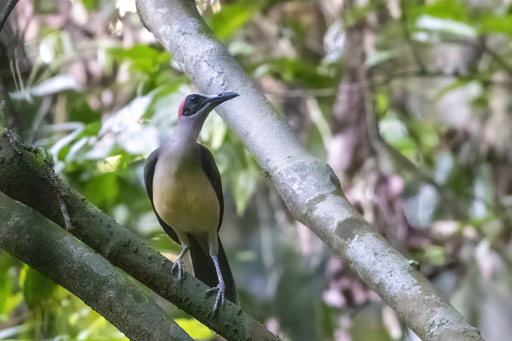
When ecologist Jean Semeki installed camera traps along a forest trail in the Luki Biosphere Reserve in the west of the Democratic Republic of Congo to survey its mammals, he and his colleagues weren’t prepared for what they’d find when they downloaded the images. Alongside video footage of inquisitive apes — members of the reserve’s remnant population of endangered central chimpanzees (Pan troglodytes troglodytes) — were videos of a strange, long-legged bird, hopping across the leaf litter. It was a grey-necked picathartes (Picathartes oreas). “When I first saw the video, I couldn’t believe my eyes,” said Semeki’s co-author, Hugues Dethier, when he analyzed the camera trap data. “I asked my colleague Guillaume Baltus to take a look, and he confirmed the identification.” Picathartes are large slender grey and white birds with vivid blue and red patches on their bald heads. They’re known to lead secretive lives in the understory of rainforests in Cameroon, Equatorial Guinea, Gabon and the Republic of Congo — the DRC’s northern neighbor, building their cup-shaped nests from mud on the walls of caves and rocky overhangs. But until now, they weren’t known to live this far south. Camera trap image of a grey-necked picathartes in the Luki Biosphere Reserve, Democratic Republic of Congo. Image courtesy of Hugues Dethier et al. The discovery, reported recently in the journal Ostrich, extends their previous range by nearly 400 kilometers (249 miles). For a species already considered by the IUCN to be near threatened with extinction due to its small…This article was originally published on Mongabay
From Conservation news via This RSS Feed.