


Charles Fox
Special to ICT
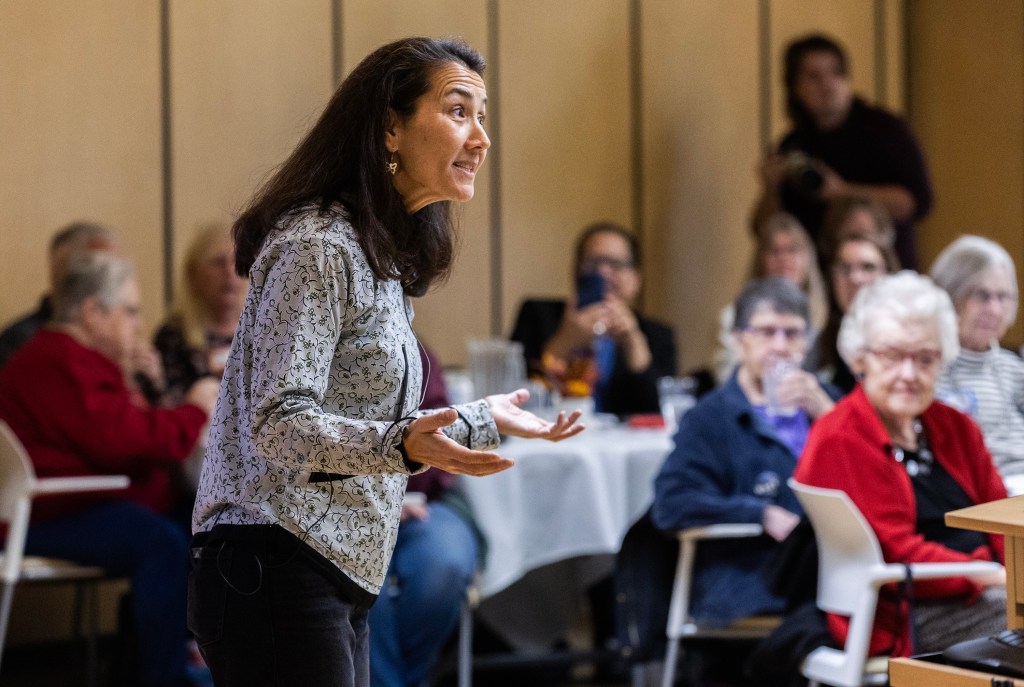
ANCHORAGE, Alaska — From the moment Mary Peltola walked into the Anchorage Senior Activity Center, it was clear she was on familiar ground.
She greeted the receptive crowd with smiles and handshakes, and gave a big hug to Cal Williams, who was playing piano in the corner of the large meeting room. She joked that perhaps he could augment her speech with musical “flourishes.”
About 250 people packed the room to listen and ask questions about the former congresswoman’s positions on a range of topics, from fishing and healthcare to Canadian tariffs and affordability, as part of her “Fish, Family, Freedom” campaign for the U.S. Senate.
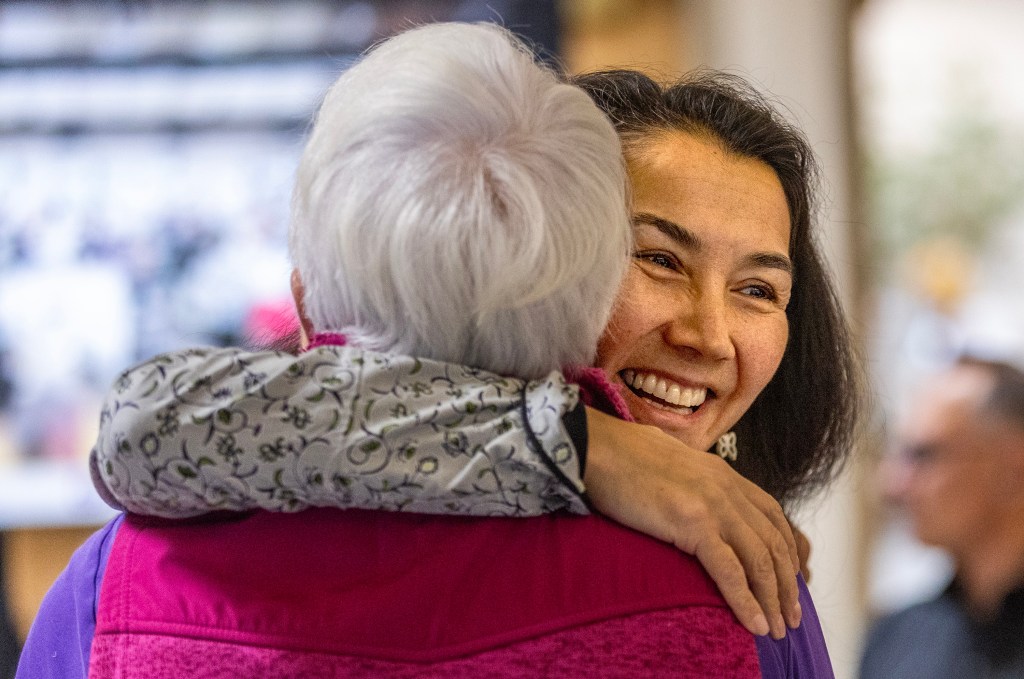
Mary Peltola, right, a Democratic candidate for the U.S. Senate from Alaska, knew many of the people who showed up to hear her speak on Oct. 8, 2026, at the Anchorage Senior Activity Center in the final days of campaigning before the Nov. 3, 2026 election. She is running against incumbent Republican Sen. Dan S. Sullivan. Credit: Charles Fox/Special to ICT
Her message was aimed not just at the mostly senior citizens who turned out for the Bartlett Club Community Forum — many of whom she said she’d known for 30 years — but also at younger people and future generations.
“We’re worried about our kids and our grandkids living here and having the same rich life that we have enjoyed, the same high quality of life that we have enjoyed for so long,” said Peltola, 53, a mother and grandmother, told the crowd on Thursday, Oct. 8. “It just is getting harder and harder.”
Peltola, Yup’ik, is working to unseat incumbent Republican Sen. Dan S. Sullivan, who is seeking his third, six-year term in office. Two other candidates are also on the ballot under Alaska’s complicated election system, which allows the top four candidates in the nonpartisan primary to advance to the general election.
The tight race between Peltola and Sullivan is among the most closely watched in the country for its potential to help determine the balance of power in Congress.
Peltola is also being watched across Indian Country as one of three women — including Peggy Flanagan, White Earth Nation, in Minnesota, and N’Kiyla “Jasmine” Thomas, Chickasaw, in Oklahoma — hoping to become the first Native woman or women elected to the upper chamber of Congress.
The Alaska race has already drawn both President Donald Trump and Vice President JD Vance to the state to stump for Sullivan, with Trump appearing at a rally Oct. 13 in Wasilla, Alaska, and Vance at an airport hangar in Fairbanks on Oct. 5.

President Donald Trump listens as U.S. Sen. Dan Sullivan, R-Alaska, speaks at a campaign rally at the Curtis D. Menard Memorial Sports Center on Oct. 13, 2026, in Wasilla, Alaska. Sullivan is facing Democratic challenger Mary Peltola in the Nov. 3 election. Credit: AP Photo/Lindsey Wasson
The race is further complicated by the presence of another Dan Sullivan on the ballot — retired schoolteacher Daniel J. Sullivan Jr. The Trump administration filed suit Friday, Oct. 23, in an attempt to block the certification of Peltola if she wins the race with the second Sullivan on the ballot.
Trump has called Daniel J. Sullivan a “sham” attempt to defeat the incumbent senator. Daniel J. Sullivan appeared on the primary election ballot as a registered Republican, but will appear on the general election ballot without party affiliation after the Alaska Republican Party rejected his candidacy. Perennial Republican candidate Gerald Heikes is also on the ballot.
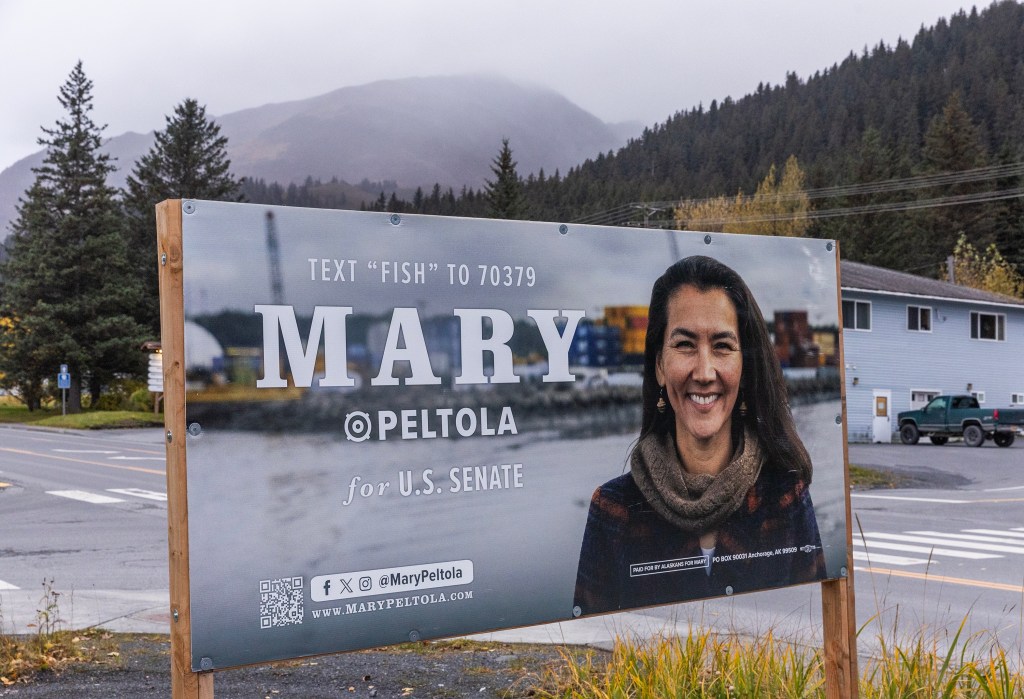
A billboard in Seward, Alaska, on Oct. 9, 2026, supports the campaign of Mary Peltola, a former congresswoman who is running for the U.S. Senate from Alaska in the Nov. 3, 2026 election. She is hoping to unseat incumbent Republican Sen. Dan S. Sullivan. Credit: Charles Fox/Special to ICT
The Peltola campaign, meanwhile, says it has more than 15,000 volunteers out canvassing and knocking on doors to get out the vote. Peltola said she visited 50 communities in the past month, which is not an easy feat in Alaska where a majority of communities can only be reached by plane.
“No one from the Lower 48 is coming to save us,” Peltola said in a statement on her campaign website, “but I know this in my bones: there is no group of people more ready to save ourselves than Alaskans.”
‘Power to the people’
A sampling of Native voters and others across Alaska by ICT in early October brought mixed reactions about the race. Some voters strongly support Peltola, while others lean solidly toward Sullivan — reflecting the findings in polls that have put the race too close to call for either candidate.
Roben Itchoak, a social studies teacher at the Shishmaref School in the Bering Strait School District, encouraged people across Alaska to cast their ballots.
“I teach about democracy and being in a republic,” Itchoak said, “so I greatly honor and appreciate that the power is to the people, and having the right to vote is one of the greatest rights we could ever have.”
Itchoak said her grandmother was born in 1921 and wasn’t acknowledged as a U.S. citizen until 1924; her grandfather was born in 1899.
“I think Alaska has a long history of being blessed with representatives and senators in Washington, D.C., that have really worked for everybody,” Itchoak said. “I want every person to vote for who they think is right for them.”
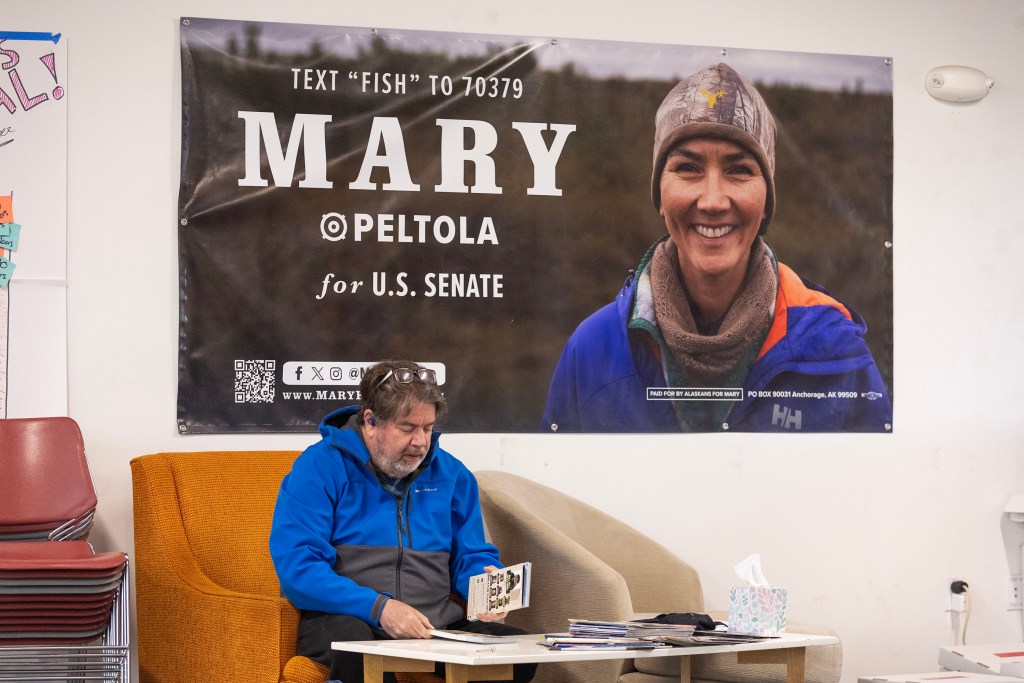
Jerry Karaganis organizes fliers on Oct. 10, 2026, before going out to distribute them for Mary Peltola, a candidate for the U.S. Senate in Alaska, at her campaign headquarters in Anchorage. Credit: Charles Fox/Special to ICT
Others who spoke to ICT cited corruption at the federal level and affordability as key elements in helping them decide on a candidate. Some said they were working actively to encourage Alaskans to vote.
Jerry Karaganis spoke to ICT while picking up literature from Peltola’s headquarters in Anchorage to distribute at a get-out-the-vote event.
“I’m just so incredibly fed up with the corruption at the federal level and Congress’s complete unwillingness to serve as the check on bad behavior that they should be, and so desperate to help flip the Senate,” Karaganis said.
“It’s exciting that Alaska could be kind of a linchpin for the whole country,” he said, “and to see more and more attention and more and more money coming into Alaska to impact the election.”
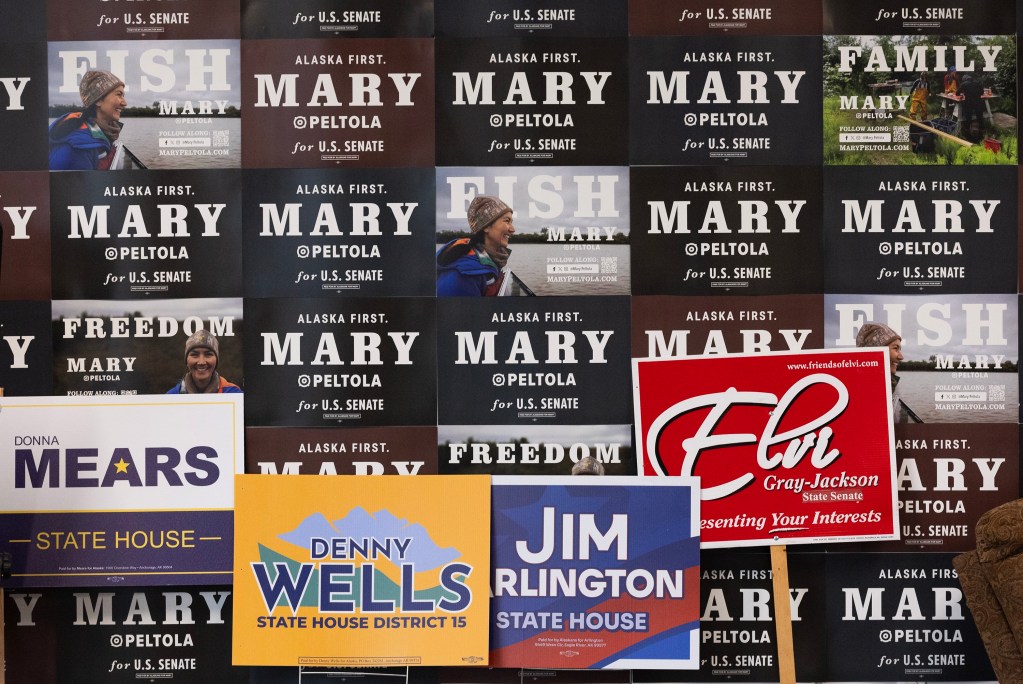
A wall inside the campaign headquarters for Mary Peltola in Anchorage, Alaska, on Oct. 10, 2026, features signs for her candidacy for the U.S. Senate and others in the Nov. 3 general election. Credit: Charles Fox/Special to ICT
Camille Curry was in the audience for Peltola’s talk at the Anchorage Senior Activity Center and said she has been out four times to knock on doors to encourage people to vote.
“I definitely plan to support Mary,” Curry said. “We need a big change at the federal level and Mary is part of my mental health plan to change our country at the federal level.”
Marie Motschman, 70, Athabascan and Yup’ik, also turned out at the senior center to hear Peltola.
“We know Mary to be a very heartfelt woman who cares deeply about the issues that are important to Alaskans, not just villages or rural Alaska,” she said. “She is the one person who will logically approach the issues like fisheries, education … I think she’ll be a very logical voice to help keep others grounded.”
Angela Krenselewski, 61, who has cerebral palsy, is worried about support for people with disabilities. “I am concerned about my mom and my oldest sister and me who have disabilities,” she said.
As for her choice of candidate?
“I’d say Mary Peltola,” she said, “‘cause Dan Sullivan ain’t doing good.”
But Sullivan has his supporters, too.
“We’re not a big fan of Peltola,” said Rosanna Angus of Ketchikan, who spoke to ICT in Carlisle, Pennsylvania, while overseeing efforts to repatriate a relative. “She acts big, but she’s not … Dan Sullivan is for the veterans.”
Vanessa Walluk, of Anchorage, said the question for her is whether she’ll vote at all.
“Most of what I’ve heard through people I know is, it hasn’t been very good information about Peltola,” she said. “So if I do vote, I don’t think it’ll be for Peltola.”
‘An untenable situation’
The friendly atmosphere for Peltola at the Anchorage Senior Activity Center contrasted with the barrage of negative campaign ads from several political action committees that have dominated the race, prompting Peltola to start her speech to the crowd with an apology.
“I’d like to start out my talk by really apologizing to Alaskans for having suffered through an entire year of really horrible attacks.” Peltola said, asking for forgiveness for the bitter campaign.
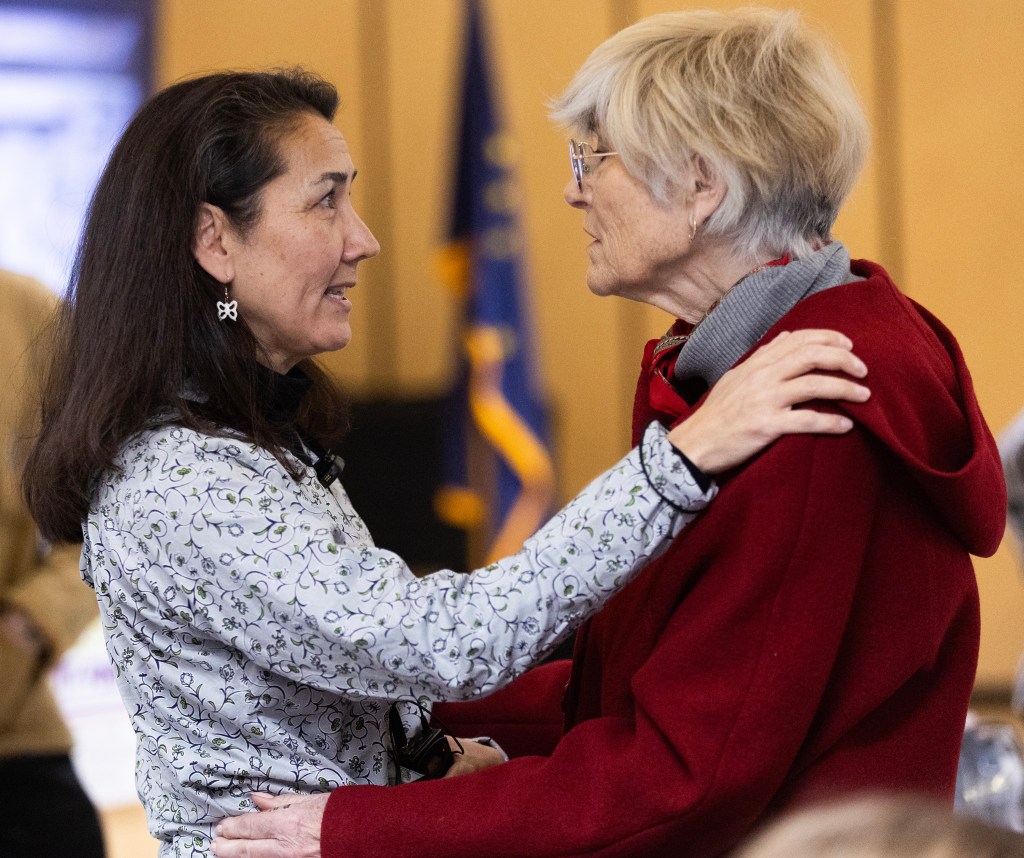
Mary Peltola, Yup’ik, a Democratic candidate for U.S. Senate from Alaska in the 2026 general election, greets a woman before speaking at the Anchorage Senior Activity Center on Oct. 8, 2026. She is running against incumbent Republican Sen. Dan S. Sullivan. Credit: Charles Fox/Special to ICT
But it was affordability that remained a dominant theme throughout the 70-minute program, particularly in a vast state where some supplies and fuels can be difficult to get to consumers, and where high prices for healthcare and other services are forcing some young people and families to leave the state.
“Alaskans are paying the highest price for our healthcare in the United States, which means we’re paying the highest price in the world, and that’s if you can get the care because we have so few providers,” Peltola said. “The trend is going the wrong direction.”
Petrol said the state has lost two health clinics, and another five are “on the chopping block.” At the same time, some subsidies for health plans under the Affordable Care Act were cut and thousands of Alaskans have been kicked off Medicaid, she said.
“They cannot afford the exorbitant cost of health insurance,” she said. “This is an untenable situation. I feel like Alaskans have had it up to here. I feel like Americans have had it up to here, and there is an appetite to correct what has been done in the last few years.”
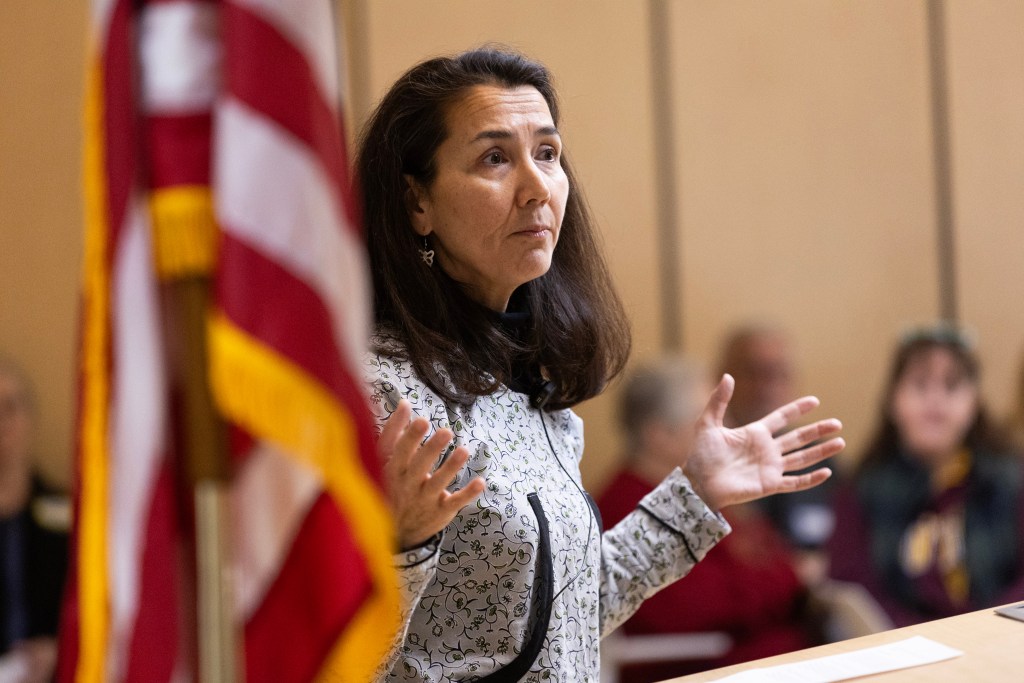
Mary Peltola, a former U.S. representative running for the U.S. Senate from Alaska in the Nov. 3 election, speaks before the Anchorage Senior Activity Center on Oct. 8, 2026. Credit: Charles Fox/Special to ICT
Peltola also hit the incumbent senator, Sullivan, for voting repeatedly to allow the war with Iran to be extended, a war she blames for the high prices that are crippling some areas of the state.
In Shungnak, for example, gasoline costs more than $26 per gallon, and in Kaktovik, a 60-tablet container of Advil is $68. In her hometown of Bethel a half gallon of oat milk costs over $20, she said, noting later that she priced the oat milk after finding that traditional dairy products were not on the store shelves at all. In remote areas of the state, where heating fuel and diesel currently range from $9 to $12 per gallon, families often must choose between heat or food.
“We are being priced out of petroleum at this point,” Peltola said. “We have a Senate that’s going along with an administration acting like we can’t afford schools, we can’t afford Social Security, we can’t afford everything. But we can afford to pay hundreds of millions of dollars, billions of dollars, on a war in Iran. None of that makes any sense to me.”
Tariffs, too, are inflating prices in Alaska, she said.
“A gentleman came up to me and he said, ‘I run the local air carrier, the air taxi here in Cordova,’” she said. “He said he ordered $10,000 worth of parts from Canada, and they called and told him that the tax alone would be over $10,000.”
Despite avoiding direct answers to questions related to transgender rights and veteran’s healthcare, Peltola was thorough in her response to questions about the fishing industry. She began fishing with her father at a young age, and captained her own boat at age 14.
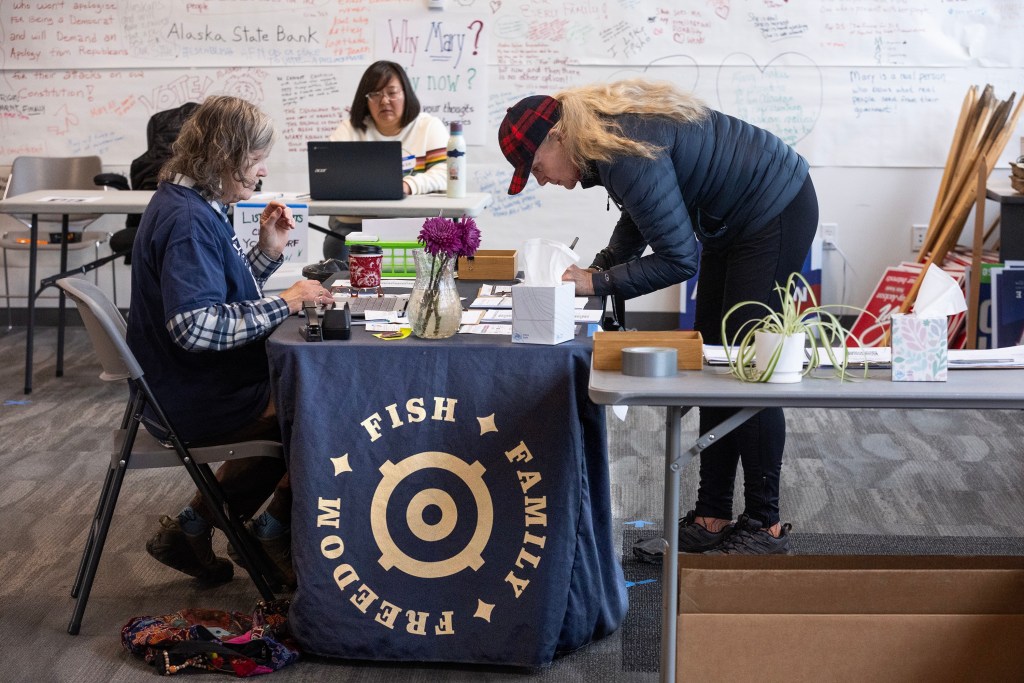
A voluntee signs up on Oct. 10, 2026, to distribute literature for Mary Peltola, a former U.S. congresswoman now running for the U.S. Senate in Alaska at the campaign headquarters in Anchorage. Credit: Charles Fox/Special to ICT
She told the crowd the story of the blackfish, a fish celebrated in oral histories and Alaska Native cultural songs.
“Where I’m from, 80 percent of our diet is fish. Half of that 80 percent is salmon,” she said. “Our generic word for fish is our generic word for food, neqa. There is a real relationship that people have with salmon.”
She said she learned quickly to treat the catch with respect.
“One of the things that children learn at a young age is you don’t ever say anything negative or disrespectful or derogatory towards your catch because the other fish will hear, and they will not go to your net,” she said. “And this is like one of the early songs that we learned, the ‘Blackfish Song.’ … It’s about how respectful you are toward your catch.”
Peltola served as executive director of the Kuskokwim River Inter-Tribal Fish Commission, in the Alaska House of Representatives and as a tribal judge.
She became the first Alaska Native to serve in Congress when she was elected to the U.S. House in a 2022 special election after the death of 88-year-old Republican Rep. Don Young. She was re-elected to a full term later that year, but lost her bid for re-election in 2024 to Republican Nick Begich III
‘Beyond traditional Republican issues’
Sullivan, 61, an attorney and Marine Corps veteran, was first elected to the U.S. Senate in 2014, after defeating incumbent Sen. Mark Begich, a Democrat.
Sullivan grew up in Ohio but ended up in Alaska, where he clerked for a judge on the Alaska Supreme Court. He then worked as an attorney in Anchorage before moving to Washington, D.C., to work in the George W. Bush administration, where he served as assistant secretary of state for economic, energy and business affairs from 2006-2009.
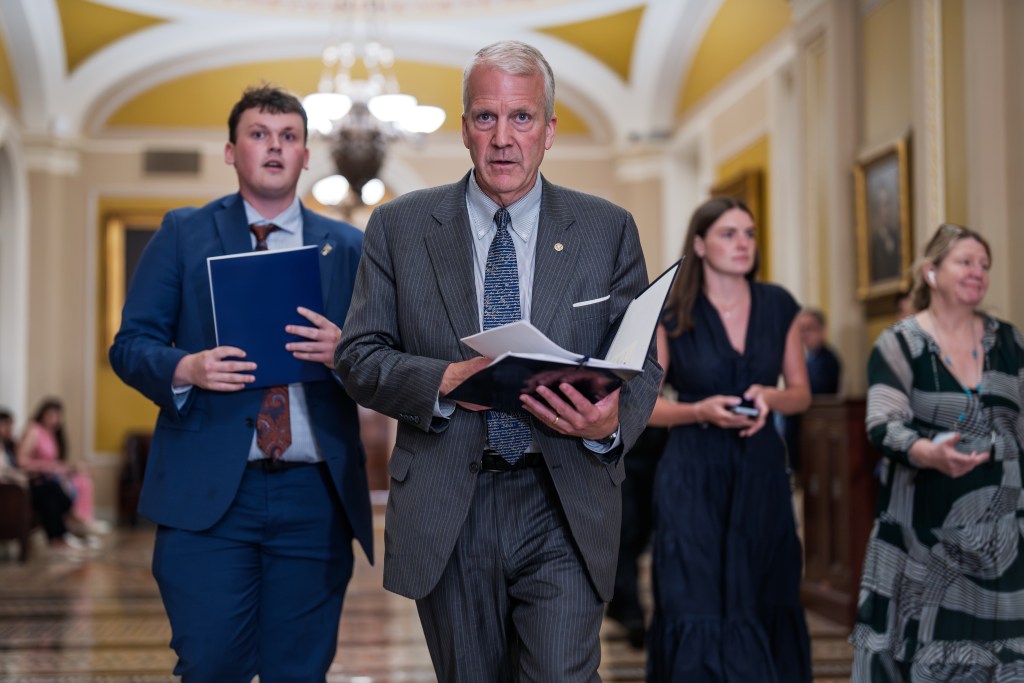
Sen. Dan Sullivan, R-Alaska, heads to a closed-door meeting with fellow Republicans, at the Capitol in Washington, D.C., on June 2, 2026. Sullivan is facing Democratic challenger Mary Peltola in the Nov. 3, 2026 election. Credit: Photo/J. Scott Applewhite
Sullivan was appointed by Alaska’s then-Gov. Sarah Palin in 2009 as Alaska attorney general, and in 2010 was appointed by the subsequent governor, Sean Parnell, as commissioner of the Alaska Department of Natural Resources.
He stepped down in 2013 to run for the U.S. Senate, and was sworn into office in January 2015. His wife, Julie, is Athabaskan. He now serves on the Senate Armed Services, Commerce, Veterans Affairs and Environment and Public Works committees.
His campaign did not respond to questions from ICT about the election, but his campaign website outlined his positions on key issues.
“Dan’s leadership extends beyond traditional Republican issues,” his campaign notes. “His Save Our Seas (SOS) Act and SOS 2.0 Act, signed into law by President Trump, are the most comprehensive ocean cleanup legislation in history. From his time as Alaska’s Attorney General, he has also been a leading voice on combatting our nation’s scourge of domestic violence and sexual assault. His Pro-Bono Work to Empower and Represent (POWER) Act has enabled thousands of survivors of these heinous crimes to access legal services to help them break out of the cycle of violence.”
Sullivan has addressed issues facing fisherman, including working to ensure that Alaska fishermen are eligible for federal fuel cost subsidies. He also introduced a bill that would expand land allotments to Alaska Native Vietnam-era veterans, according to his Senate website.
Alaska’s final U.S. Senate debate devolves into mudslinging between Peltola, Sullivan
“While serving their country during the Vietnam War era, many Alaska Native veterans missed the deadline to apply for their legally entitled land allotment — an injustice that we are still working to fix nearly 70 years later,” Sullivan said in a statement posted on the website Oct. 8. “I’ve been working on this issue since I came into office.”
On Oct. 20, his office joined with U.S. Sen. Lisa Murkowski and Congressman Nick Begich III, both Alaska Republicans, in announcing $249 million in federal funding to complete the Port MacKenzie Rail Extension in Alaska.
A contentious debate on Oct 15 marked the third and likely final time that Peltola and Sullivan shared a stage ahead of the Nov. 3 general election.
‘Honor of a lifetime’
Back at the Anchorage Senior Activity Center as her speech came to a close, Peltola drew a winning 50/50 ticket, posed for a group photograph, and then headed quickly back to her waiting car to go to her next campaign stop.
As she stepped into the vehicle, ICT approached with a question: What would it mean to be the first Native woman elected to the U.S. Senate?
She paused to answer.
“As an Alaskan, it would be the honor of a lifetime,” she said, “and certainly that holds true for being an Alaska Native.”
As for her message to Alaska Natives?
“Make sure we get out and vote,” she said. “Make sure our votes are counted … We’re all in it for a better quality of life for all of our kids.”
This article contains material from The Associated Press.
The post Will Mary Peltola make history? Alaska race tightens for U.S. Senate appeared first on ICT.
From ICT via This RSS Feed.