

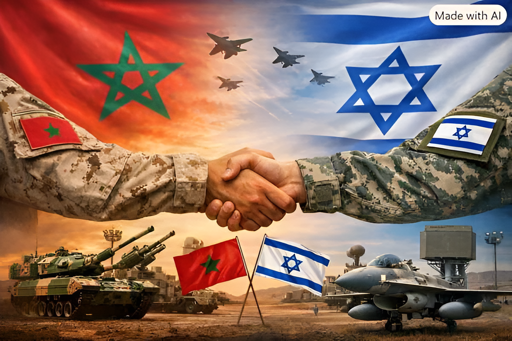
With extraordinary speed, the State of Israel is consolidating its influence in North Africa through gas contracts, agricultural investments, exploration projects, and increasing military cooperation. With Morocco as a platform and the United States as its backer, this advance could alter the regional balance, deepen dependencies, and strengthen Israel’s position of power against the Palestinians and Sahrawis. Behind the pronouncements of prosperity and security lies something much larger: who will control the region’s resources and strategic decisions, and who will pay the price.
Israel is rapidly consolidating its presence in North Africa through a combination of energy agreements, agricultural investments, university cooperation, and arms sales. Morocco is its main platform for expansion in the Maghreb, while Egypt offers a crucial market for its gas. The result is a growing connection between business and political alliances that affects regional balances and the Palestinian and Sahrawi causes.
To understand this process, it’s necessary to look beyond diplomatic photo ops . A factory producing irrigation systems can open agricultural markets; a gas contract commits supplies for decades; a military acquisition generates needs for maintenance, spare parts, and training. When these relationships accumulate, influence acquires a material foundation that can outlast crises between governments.
Uneven progress, with Morocco as a platform
North Africa does not form a unified bloc against Israel. Egypt, for example, has maintained diplomatic relations since the 1979 peace treaty, while Morocco resumed official ties in 2020. Algeria and Tunisia reject normalization , and in Libya, attempts at rapprochement have met with strong resistance. Discussing Israeli expansion requires acknowledging these differences: there are, therefore, established platforms, opportunities, and obstacles.
The Libyan crisis perfectly illustrates these limitations. The revelation of a meeting held in Rome in August 2023 between Libyan Foreign Minister Najla Mangoush and her Israeli counterpart sparked angry protests and the Libyan minister’s immediate suspension. Arab Barometer later noted that its 2022 poll had recorded 92% opposition to normalization with Israel . Contacts between elites, therefore, do not equate to popular acceptance.
Morocco offers different terms due to a strategic decision by the monarchy. The shift in December 2020 was linked to the US recognition of Moroccan sovereignty over Western Sahara. The White House presented both moves as components of the same initiative. Rabat gained support for its main territorial claim, and Israel expanded its regional recognition under Washington’s patronage.
The exchange had consequences for two peoples excluded from those negotiations. Normalization progressed without resolving the Palestinian occupation, while US recognition supported Rabat’s claims to a territory that the United Nations continues to consider pending decolonization . The convergence among the three states was thus built on decisions that directly affected Palestinians and Sahrawis.
In July 2023, Israel took another step by also recognizing Moroccan sovereignty over Western Sahara, as confirmed by its diplomatic mission in Rabat. This rapprochement moved beyond trade and the exchange of delegations. For the Alawite monarchy, incorporating allies into this position strengthens its negotiating power; for Israel, supporting a partner’s priority helps consolidate its regional presence.
The motivations coincide, but they are not identical. Morocco seeks territorial support and technological advantages; Israeli companies pursue contracts and market access; the United States strengthens a network of allies and opportunities for its companies. From this overlap, lasting integration can emerge, even when disagreements exist. Business and state interests support each other without becoming completely indistinguishable.
Algeria views this rapprochement from the perspective of its rivalry with Rabat and its support for Sahrawi self-determination. In Tunisia, official and social rejection of normalization with the State of Israel makes it difficult to replicate the Moroccan approach. This expansion thus alters relations between neighbors: it can deepen pre-existing divisions and foster external alliances that hinder autonomous regional cooperation. This consequence is a risk, not an inevitable outcome.
Agriculture also creates influence
The establishment of businesses allows us to observe how this diplomatic openness translates into economic positions. In March 2023, Netafim, an Israeli company belonging to the Orbia group, inaugurated an irrigation equipment factory in Kenitra. The company announced a forecast of 200 jobs and expressly presented the facility as a gateway to expanding its operations in Morocco and throughout North Africa.
The interest is understandable in a region marked by water scarcity. Technology can improve agricultural yields, but it can also create lasting relationships of dependency on equipment and knowledge providers. The social question is who has access to these improvements: small producers who need to maintain their crops or large farms geared toward export markets. Technological modernization alone does not resolve this inequality.
Another example is Mehadrin, a company dedicated to agricultural production and marketing. According to Hespress, citing its CEO, the avocado cultivation project, undertaken with Moroccan partners, encompassed approximately 500 hectares and a joint investment of nearly nine million dollars over three years, starting in 2021. This is an announced investment, the execution of which should not be automatically confused with the total planned investment.
Gas and oil: from the Mediterranean to the Atlantic
In Egypt, the mechanism of influence operates on a much larger scale. The partners in the Israeli Leviathan field announced in August 2025 an agreement to supply 130 billion cubic meters of gas until 2040, or until the contracted quantities are fulfilled. Its potential value reached $35 billion. The project brings together the American company Chevron and the Israeli companies NewMed and Ratio.
Israeli authorization came in December 2025, after months of negotiation and US pressure. Egypt needs to meet its demand and hopes to utilize its liquefaction facilities, but this relationship increases its vulnerability to Israeli decisions and supply disruptions. The commercial benefits for the companies coexist with a political contradiction: maintaining strategic ties while the destruction of Gaza fuels social resentment.
On the Atlantic coast, NewMed and Adarco signed an agreement with Morocco in December 2022 to explore for gas and oil in the Boujdour Atlantique block, off the coast of Western Sahara. The announced agreement allocated 37.5% to each company and the remaining 25% to the Moroccan state-owned company ONHYM. The designation of these waters as Moroccan by the companies does not eliminate the question of territorial sovereignty.
There is a crucial point to clarify here: an exploration permit does not certify a commercial discovery or ongoing mining operations. NewMed’s annual report, published in March 2026, indicated that the license had expired on January 31st and that its partners were negotiating an extension to decide whether to drill or abandon the project. Presenting the project as a guaranteed extraction would transform a business expectation into a reality that this documentation has not yet confirmed.
Minerals and phosphates: resources in dispute
Sahrawi phosphates reveal another material connection. Western Sahara Resource Watch documented in March 2022 the arrival in Ashdod of a shipment from occupied Western Sahara. The organization estimated its volume at around 5,000 tons and stated that it did not know the importer’s identity. This incident confirms a commercial transaction, but it does not yet allow us to attribute control of Sahrawi mining to Israel.
There are also links between major groups in the sector. In October 2021, the Israeli company ICL and the Moroccan company OCP agreed to fund research programs at Ben-Gurion University and Mohammed VI Polytechnic University, with an initial joint contribution of $600,000. This is a scientific collaboration backed by mineral and fertilizer companies; however, it does not constitute evidence of Israeli extractive concessions over all Moroccan resources.
The importance of minerals extends beyond this bilateral relationship. In February 2026, the United States included Morocco among the countries with which it announced new agreements or cooperation frameworks on critical minerals. This rapprochement demonstrates US interest in regional supply chains. Of course, it does not, in itself, prove that Washington and Israel share every mining operation or manage a single extraction program.
Weapons, factories, and surveillance
Military cooperation offers the most compelling indicators of Israeli expansion. According to SIPRI (1), between 2021 and 2025 the United States provided 60% of the volume of Moroccan imports of major weapons, and Israel 24%, ahead of France with 10%. These are proportions of the indicator used by the institute to measure transfers, not percentages of the military budget or of all defense contracts.
The defense memorandum signed in November 2021 established a framework for intelligence, training, and industrial collaboration. Further developments include air defense systems and drones, as well as local production: in November 2025, the opening of a BlueBird factory in Benslimane was announced, intended to manufacture SpyX loitering munitions . These are devices that can hover over an area before being launched at a target.
The US dimension completes this framework. In 2023, the Israeli army announced its first active participation in the African Lion exercises in Morocco. In July 2026, AFRICOM and Moroccan forces signed a memorandum to develop a drone training and experimentation center in Tan-Tan. These processes are related by their actors and capabilities, although they do not constitute a single trilateral military structure.
This cooperation strengthens Rabat against its adversaries and can exacerbate the regional security dilemma: what one state presents as a deterrent, another may interpret as a threat . SIPRI identifies tensions between Morocco and Algeria as a driver of their military purchases. For Israel, supplying technology also consolidates markets and institutional relationships; for Washington, it strengthens an African ally. The supply of spare parts prolongs these ties for years after each acquisition.
Surveillance adds an internal dimension. Amnesty International documented attacks using Pegasus, the Israeli NSO’s spyware, against Moroccan journalist Omar Radi and attributed responsibility to Moroccan authorities. Rabat has denied the accusations regarding its use of the program. The controversy raises the question of how technologies marketed in the name of security can be used against journalists, activists, and the political opposition.
Universities, heritage, and resistance
The approach also seeks social integration through academic exchanges, tourism, and references to Moroccan Jewish heritage. The Israeli Ben-Gurion University listed agreements with the International University of Rabat and Mohammed VI Polytechnic University in its 2022 annual report. These networks can certainly facilitate research and mobility, but they can also lend legitimacy and continuity to contentious state relations.
Acceptance is far from automatic. Le Monde reported in July 2024 on a petition from 1,256 students and graduates of Mohammed VI Polytechnic University to sever ties with Israeli universities. This academic opposition reveals a divide between institutional normalization and social sectors in solidarity with Palestine. The future of this expansion will also depend on these resistances and the ability to transform agreements into shared social benefits.
The documented trend points to an established influence in strategic sectors, with varying paces depending on the country. Gas, agriculture, weaponry, and scientific cooperation allow for the expansion of relationships that will influence future decisions. Their scope will depend on actual investments, regional conflicts, and public responses. The central question is which powers gain decision-making capacity and who bears the costs of this transformation.
Footnote:
(1) SIPRI is the Stockholm International Peace Research Institute, an independent institution founded in Sweden in 1966. It investigates conflict, arms trade, military spending and disarmament; its databases are an international reference.
Sources Consulted :
– White House (2020): Normalization with Morocco and US recognition of the Sahara. Official document.
– Netafim (2023): Opening of its irrigation systems factory in Kenitra. Company press release.
– Hespress (2024): Mehadrin’s investments in avocados and water consumption in Morocco. Information.
– Reuters (2025): Israeli gas supply agreement with Egypt worth up to $35 billion. Information.
– NewMed Energy (2026): Annual Report; Status of the Boujdour Atlantique Exploration License. PDF Report.
– Adarco Energy: business holdings and oil and gas exploration project. Project description.
– Western Sahara Resource Watch (2022): Shipment of phosphates from Western Sahara destined for Israel. Investigation.
– ICL–OCP (2021): Joint funding for research and university cooperation. Press release.
– SIPRI (2026): Suppliers and volume of transfers of large arms to Morocco. PDF Report.
– Reuters/Euronews (2021): Memorandum of military cooperation between Israel and Morocco. Information.
– The Jerusalem Post (2025): BlueBird drone factory in Morocco. Information.
– AFRICOM (2026): Training, experimentation and drone center project in Tan-Tan. Official statement.
– Amnesty International (2020): Investigation into Pegasus and journalist Omar Radi. Investigation.
– Le Monde (2024): Moroccan university opposition to agreements with Israeli institutions. Report.
– Arab Barometer (2025): Social rejection of normalization in Libya. Analysis and survey.
– United Nations: Status of Western Sahara as a non-self-governing territory. Official fact sheet.
From Orinoco Tribune via This RSS Feed.