

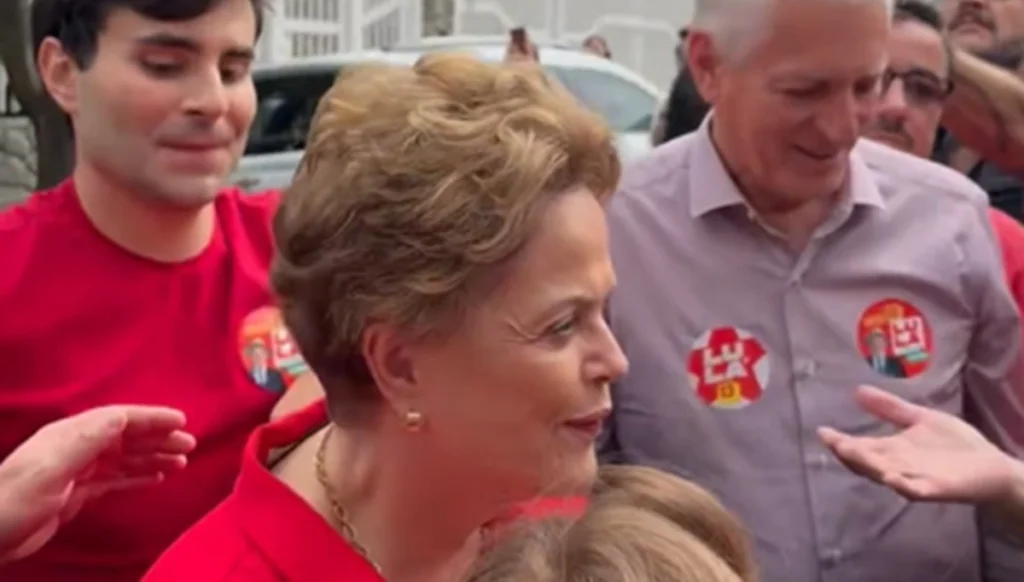
President of the BRICS New Development Bank received a warm welcome from Workers’ Party supporters.
On Sunday, former Brazilian President and current President of the BRICS New Development Bank Dilma Rousseff exercised her right to vote at Santa Marcelina School, located in the Pampulha region of Belo Horizonte.
RELATED:
Thousands of Brazilians Vote in Madrid in Presidential Runoff
The progressive leader arrived at the polling station during the presidential election runoff and was warmly welcomed by supporters of the Workers’ Party (PT).
During the day, she was accompanied by her great-nephew and federal deputy-elect, Pedro Rousseff; federal deputy Rogerio Correia; and federal deputy-elect Bella Gonçalves.
Activists gathered at the site expressed their support for the former president through fighting slogans such as “Dilma, warrior of the Brazilian people” and popular chants in support of her political career. Rousseff greeted the supporters and posed with them before heading to the ballot boxes.
SAFTU Statement of Solidarity with Brazil’s Workers and People
Brazilian workers, Indigenous Peoples, landless families and all those who have struggled for dignity and social justice must come out in their millions to defend the gains won through years of struggle.
Lula da… https://t.co/2hyNG2yfjW
— Zwelinzima Vavi (@Zwelinzima1) October 25, 2026
The welcome Rousseff received on Sunday differed substantially from the events of the first round of voting held Oct. 4. On that occasion, she faced a hostile atmosphere created by far-right groups, which forced her to leave the site as quickly as possible to prevent physical attacks by Bolsonaro’s supporters.
Currently, Rousseff resides in Shanghai, because of her responsibilities as head of the BRICS multilateral financial institution. However, she maintains her voter registration in the capital of the state of Minas Gerais.
Her in-person participation in the election reaffirms the commitment of the PT’s historic leaders to popular mobilization and the consolidation of democracy in Brazil.
In the first round, Flavio Bolsonaro received 56.1 million votes, or 47%, while Luiz Inacio Lula da Silva, garnered 53.8 million votes, or 45.16%. Abstention totaled 33.5 million, equivalent to 21.08% of registered voters, making this segment of the population the key battleground in the political contest in recent days.
At the closing rally of his campaign in Sao Paulo, Lula da Silva denounced ties between Rio de Janeiro criminal organizations and Flavio Bolsonaro, whom he described as a person “who does not have the political, moral or ethical qualifications to become president.”
teleSUR/ JF
Source: Brasil de Fato – EFE – teleSUR
From teleSUR English via This RSS Feed.