

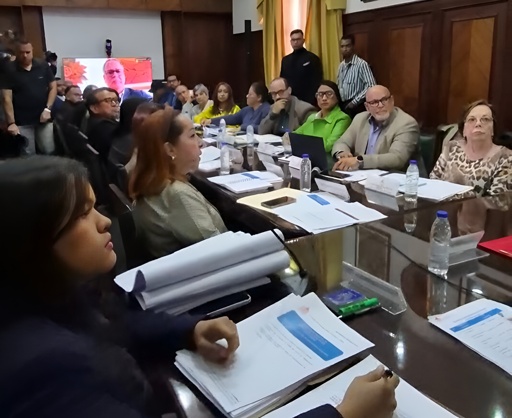
During its regular session on Thursday, Venezuela’s National Assembly swore in the 23 members of the Judicial Nominations Committee. The Judicial Nominations Committee is comprised of 11 National Assembly deputies and 12 civil society members.
National Assembly President Jorge Rodríguez presided over the formal swearing-in ceremony of the new Judicial Nominations Committee members, in compliance with the Constitution of the Bolivarian Republic of Venezuela.
He administered the customary oath to the citizens selected to form the committee, urging them to act with absolute probity, impartiality, and strict adherence to the constitutional framework.
“You swear to comply with the necessary clarity to meet the strict requirements established by the Constitution, so that we can have a Supreme Court that is at the service of all the people of Venezuela and not of political partialities or economic groups,” Rodríguez said to the members, who swore by raising their hands.
Rodríguez congratulated the members of the committee, as well as the members of “the preliminary selections committee for their hard work since before the occurrence of the double earthquake on June 24. Without any complaint, they dedicated themselves to the work after this National Assembly decided to start the process again due to the terrible consequences the double earthquake had on all of Venezuela. Well, that preliminary committee dedicated itself to a work, if you will, much more exemplary than the one it was carrying out before the earthquake. Congratulations, Deputy Alessandrello, and with this congratulations, I commend all the members of the preliminary committee who are now becoming part of the nominations committee.”
The members of the new nominations committee
Deputy Giuseppe Alessandrello, who had been presiding over the preliminary committee, highlighted that the 12 members from civil society, selected from 85 nominations, are predominantly women, emphasizing the commitment to gender parity and the active participation of professionals with outstanding academic, scientific, and union careers.
Alessandrello specified that “the work carried out by the preliminary committee was based on unanimous decisions.”
He added that this demonstrates that “we can indeed come to an agreement for the highest interests of the nation. Let us continue building the Venezuela of merit, participation, and law, a Venezuela where justice is not a privilege, but the guarantee of peace for all.”
Thereafter, he announced the names of the 12 members from civil society who have been selected to be part of the Judicial Nominations Committee:
- Rosmely Flores Parras (Lawyer, social communicator, and activist)
- Clara Inés Casanova de Valecillos (Lawyer and specialist in Criminal Sciences)
- María Luisa Chacón de Aldana (Psychiatrist and head of the Psychiatry Service at Hospital Vargas)
- Nancy Clara Castro de Navarro (Specialist in financial institutions and criminal sciences)
- Mairim Girlens Ramos (Lawyer)
- Irma del Valle Pazos Grau (Lawyer)
- Raquel Yadxani Sánchez Carrero (Lawyer and specialist in Legal Science)
- Mauro Manuel Herrera Gutiérrez (Cardiologist and head of Cardiology at Hospital Vargas)
- Anthony Gerard Pérez Negrón (Lawyer and professor at the Central University of Venezuela)
- Guillermo Tell Juan Pablo Aveledo Coll (Political scientist and academic at the Metropolitan University)
- Guillermo José Guzmán Mirabal (Lawyer and historian)
- Juan Domingo Alfonzo Paradisi (Lawyer specializing in Administrative Law)
The 11 deputies on the committee are:
- Giuseppe Alessandrello
- Pablo Pérez Álvarez
- Carlos Alberto Mogollón Gavidia
- María Gabriela Vega
- Gloria Mercedes Castillo de Durán
- Fernando Andrés Bastidas Calderón
- José Óscar Villarruel García
- Jonathan Gregorio García Debian
- Eliana Coromoto González Guache
- Luis Florido Barreto
- Félix Freites Cova
Formal establishment of the committee
On Friday, October 23, the Judicial Nominations Committee was formally established, as reported by LaIguana.TV. Deputy Giuseppe Alessandrello said that, following the formation of the committee, the preparation of the activity schedule will begin, as stipulated by the Law of the Supreme Court of Justice.
#23Oct || Desde el Palacio Federal Legislativo se realiza la Instalación del Comité de Postulaciones Judiciales. https://t.co/MczZA2GxJ7
— Asamblea Nacional 🇻🇪 (@Asamblea_Ven) October 23, 2026
Alessandrello specified that this schedule must establish the time for the call for applications, evaluations, and responses to challenges, then finalize the day for presenting the list of eligible candidates to the National Assembly. He noted that the committee must ensure true and just peace, as “the judiciary is the institution that will guarantee peace among us.”
The PSUV deputy added that the deadlines for presenting the list of eligible candidates and completing the work will be based on what is specified by law regarding the terms and periods that said committee must comply with.
Venezuelan Government Reports Progress on Amnesty Law and Judicial Reform
Legal deadlines
Article 264 of the Constitution lays out the selection sequence: the Judicial Nominations Committee conducts the first preselection; the Citizen Power (Offices of the Attorney General, Comptroller General, and Ombudsperson) conducts the second preselection; and the National Assembly makes the final selection. Under Articles 70–71 of the Organic Law of the Supreme Court of Justice, applications must remain open for at least 30 successive days. The names must be published the next working day after the application period closes; objections may be filed within the next 15 successive days, and the committee has eight days to rule on their admissibility, with a hearing scheduled within the following three days.
After completing its review, the Judicial Nominations Committee must preselect at least three candidates for each vacancy and send the list to the Citizen Power the next day. The Citizen Power has 10 successive days to conduct its second preselection, followed by five days for the National Assembly’s final selection, under Articles 73–74 of the Organic Law of the Supreme Court of Justice, as amended in Official Gazette No. 7,074. The law does not set any overall deadline for the committee to complete its review and choose its list.
As an estimate, if the process starts when the call for candidates is published and every stated period is used in full, the aforementioned stages add up to roughly 73 days, including the National Assembly’s final selection, plus any time the committee may take for its assessment. This is a possible timetable, not a legal maximum, and it could mean that by the first half of January 2027 Venezuela could have new Supreme Court justices.
(Últimas Noticias) with Orinoco Tribune content
Translation: Orinoco Tribune
OT/SC/SF
From Orinoco Tribune via This RSS Feed.