

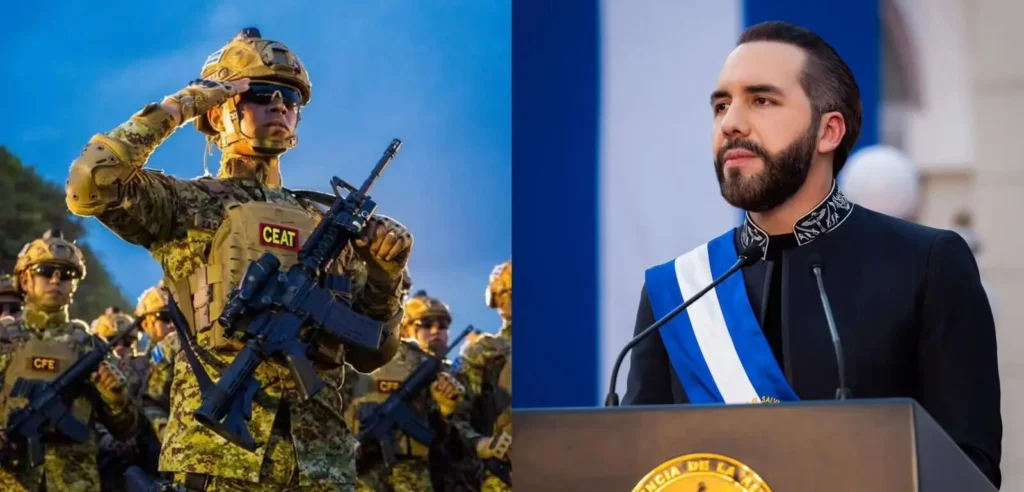
Haiti gang violence leaves four Salvadoran soldiers missing after an ambush near Port-au-Prince as El Salvador deploys troops for a rescue operation.
Related: Haiti Mobilizes Resources to Free Four Salvadoran Soldiers Kidnapped by Gangs
Haiti Gang Violence Leaves 4 Salvadoran Soldiers Missing
Haiti gang violence has escalated after four Salvadoran soldiers serving with the United Nations-backed Gang Suppression Force, known as the GSF, disappeared following an ambush near Port-au-Prince.
The four men are aviation technicians, not combat troops. They were supporting medical evacuation operations for the international mission.
The soldiers went missing on Sunday, October 18, after armed groups attacked their armored vehicle in the Santo area of Croix-des-Bouquets, northeast of the capital.
According to officials, attackers fired hundreds of rounds and used explosives against the vehicle. The vehicle caught fire, but the four Salvadorans managed to escape.
Contact with the men was lost shortly afterward. Authorities believe they survived the attack and were kidnapped by gangs operating in the area.
El Salvador’s President Nayib Bukele announced on Wednesday, October 21, that his government had launched a military operation to rescue the four men.
He demanded that Haitian gangs release the soldiers “alive and unharmed” and warned of a stronger response if they were not freed.
The Gang Suppression Force confirmed that a new Salvadoran contingent arrived in Port-au-Prince on Thursday to support search and security operations.
The mission said its personnel were operating in close coordination with the Haitian National Police and other partners in the Plaine du Cul-de-Sac area.
The incident is the first major attack against the GSF since the mission began operations in Haiti in April 2026.
Haiti Gang Violence Extends Beyond the Capital
United Nations | Gang Suppression Force
The disappearance of the Salvadoran soldiers comes amid a sharp deterioration in Haiti gang violence across the country.
The United Nations reported that 1,123 people were killed and 440 injured between July 15 and October 12 in incidents linked to armed groups.
The UN said security operations accounted for 52 percent of those killed or injured, or 808 people. Among them were 148 people with no links to gangs.
The figures show that civilians continue to pay a heavy price in the conflict between armed groups and security forces.
Gang violence is no longer concentrated only in Port-au-Prince. Armed groups are expanding their attacks into rural areas, worsening displacement and complicating preparations for elections.
The UN warned that the spread of violence into the countryside could deepen the humanitarian emergency and make it harder for authorities to restore basic services.
Haiti has not held national elections since 2016. The country has been governed through a political transition since the assassination of President Jovenel Moïse in July 2021.
Presidential and legislative elections had been scheduled for December 13, 2026. However, the Provisional Electoral Council postponed the vote without setting a new date.
The postponement has prolonged political uncertainty and raised questions about who will govern Haiti after the current transition.
Former President Michel Martelly, who led Haiti from 2011 to 2016, formally registered his presidential candidacy on Friday, October 23.
Martelly is running under the Debloke coalition. His candidacy remains subject to validation by the Provisional Electoral Council.
He has been sanctioned by the United States and the European Union over alleged links to drug trafficking and armed groups. Martelly has denied the allegations.
His registration adds another layer of uncertainty to elections that were already postponed and questioned amid rising violence.
Haiti Gang Violence Deepens Humanitarian Emergency
UN Office for the Coordination of Humanitarian Affairs | UNICEF
The humanitarian impact of Haiti gang violence is becoming increasingly severe.
The United Nations estimates that nearly 1.5 million people have fled their homes, including more than 740,000 children.
The displacement represents approximately one-quarter of Haiti’s population and has overwhelmed shelters, health centers and local communities.
The UN says the Haitian economy is expected to contract for the seventh consecutive year.
The country’s 2026 humanitarian response plan requires $880.3 million. As of October 16, it had received only 49.1 percent of the needed funding.
The UN estimates that 6.4 million people need urgent humanitarian assistance.
The funding gap has limited access to food, clean water, medical care, shelter and protection services for displaced families.
The Gang Suppression Force remains understaffed. The mission had 1,563 personnel as of October 12, far below the 5,500 authorized by the UN Security Council.
The Security Council extended the GSF’s mandate until March 31, 2027.
The mission was created to support the Haitian National Police in restoring security and dismantling criminal networks.
However, the kidnapping of the Salvadoran soldiers has exposed the risks facing international personnel and the difficulty of operating in gang-controlled territory.
Search operations in the Plaine du Cul-de-Sac have included air support and coordination with Haitian police units.
The GSF reported that the operations have left at least seven suspected gang members dead and four mission personnel injured.
Haiti’s government said the release of the abducted soldiers is an “absolute priority” and that all necessary resources are being mobilized.
The government held a meeting at the prime minister’s office to assess the interventions and determine measures to strengthen operations.
Bukele Escalates Military Response in Haiti
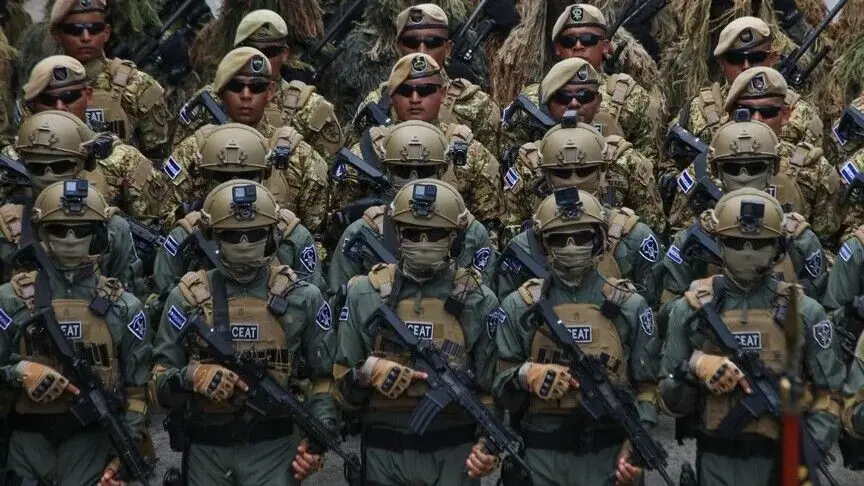
El Salvador Presidency | Associated Press
El Salvador has responded to the crisis by deploying additional troops to Haiti.
The Associated Press reported that 100 Salvadoran special forces soldiers arrived on Thursday, with another 100 expected later that day.
A security source cited by AFP said about 200 Salvadoran soldiers arrived in Port-au-Prince between Thursday and Friday.
Reports also indicated that at least six aircraft—three Salvadoran and three US—landed in the Haitian capital carrying elite personnel.
El Salvador already had approximately 450 military personnel in Haiti before the latest deployment, according to Haitian media.
Bukele has combined military pressure with public warnings directed at Haitian gang leaders.
He described the gangs as “satanic” and said that “God will grant us victory.”
The Salvadoran president also said that the four missing men were not combatants but aviation technicians whose role was to carry out medical evacuations and save lives.
According to The Wall Street Journal, the Bukele government is seeking to open a discreet channel of contact with Haitian gangs to negotiate the soldiers’ release before ordering a broader military response.
The reported approach reflects the difficulty of conducting rescue operations in areas where armed groups maintain strong territorial control.
The incident has also become a test of Bukele’s foreign and security policy.
El Salvador has built its international reputation around its hard-line anti-gang strategy at home, which began with a state of exception declared in 2022.
The Salvadoran Legislative Assembly recently approved the 56th extension of that emergency regime.
The government says the measure has allowed it to dismantle gangs and restore public safety.
Human rights organizations, including Socorro Jurídico, have raised concerns about due process, arbitrary detention and deaths in state custody.
The organization says at least 30,000 detainees are innocent and that more than 500 people have died in custody.
Bukele has rejected those claims and defended the policy as necessary to confront criminal organizations.
Geopolitical Context
The crisis surrounding the missing Salvadoran soldiers has implications for regional security and the future of international intervention in Haiti.
Haiti’s collapse has become one of the most serious security and humanitarian crises in the Americas.
Armed groups control large parts of Port-au-Prince and have expanded their influence into rural areas, weakening the state’s capacity to govern.
The Gang Suppression Force was created by the UN Security Council to support Haitian police, but its limited deployment has restricted its impact.
The kidnapping of foreign personnel could prompt a review of the mission’s security protocols and accelerate the deployment of additional troops.
It could also increase pressure on countries contributing personnel to expand their participation in the mission.
El Salvador’s growing role in Haiti reflects a broader shift in regional security politics. Bukele has positioned himself as a regional reference in the fight against gangs, despite criticism from human rights organizations.
The crisis could strengthen that role, but it also exposes El Salvador to the risks of a prolonged military commitment abroad.
For the United States, Haiti remains a strategic concern because of its proximity, migration pressures and the risk that instability could spread across the Caribbean.
The US has supported the international mission and has been involved in efforts to strengthen Haitian police capacity.
The postponement of elections adds another layer of instability. Without a clear political transition, armed groups may continue to fill the vacuum left by weak state institutions.
The immediate priority remains the rescue of the four Salvadoran soldiers. But the incident underscores a larger challenge: Haiti needs security, humanitarian aid and a credible political process at the same time.
From teleSUR English via This RSS Feed.