


By ERWIN FREED
Martin Soto walked free from Elizabeth Detention Center (EDC) around 7 p.m. on Monday, Oct. 6. Gabriela, his wife and fierce advocate, ran to embrace him. Martin was taken into ICE detention in February while purchasing diapers for his two children. In late May, ICE violently transferred him from Delaney Hall in Newark to Elizabeth in retaliation for his role in helping to lead the heroic detention center strike launched by at least 24 detainees. The strike quickly grew to include close to 300.
Hundreds of community members mobilized in protest against his transfer. Community mobilizations opposed to Soto’s transfer brought increased national awareness and support to the strike. Detainees around the country were inspired by the example at Delaney Hall to start at least six additional strikes in detention centers. Protesters inside and outside detention center walls faced violent retaliation. Martin and his legal team state that he was held in solitary confinement for at least four months at EDC.
Gabriela suffered a miscarriage due to the stress of the psychological and physical torture Martin suffered. Her and her young children lost their home due to the loss of Martin’s income. During Martin’s confinement, Gabriela spent every waking moment advocating for his release, taking care of her family, and attempting to visit Martin. Most days she would wait hours to find out she would not be let into the facility. Her daughter’s whole worldview became shaped by Martin’s absence and the constant presence of police and prisons. Gabriela took every opportunity to speak out, demanding Martin’s release. Activists around New Jersey began to see her everywhere. She traveled to California, Connecticut, and many other places to bring attention to the ongoing repression against strikers and their families.
The Delaney Hall strike began in May against the horrible labor and living conditions in ICE’s GEO Group-managed detention centers. In their letter announcing and explaining the strike, 24 detainees stated, “We feel vulnerable and, in a way, kidnapped—detained without justification—not to mention that we are being tortured physically and psychologically due to the poor food resources provided in these detention centers.” The strikers centered the basic violation of their political rights under the Fourth, Fifth, and Sixth Amendments and pointed to public health dangers, including “a high spread of COVID-19 in detention centers, and the flu is constant among detainees, which could lead to outbreaks of illnesses or epidemics.”
Detained strikers inspired solidarity in Newark and around the country. Protesters inside the detention center walls showed the bravery and ability of immigrant workers to fight for freedom and an end to the deportation-repression machine. They followed in the footsteps of other important struggles within detention centers, including the 2022 strikes at Mesa Verde and Golden State Annex in California.
Outside, a broad range of supporters from trade unions to clergy to unaffiliated individuals maintained a constant solidarity vigil. Police regularly attacked and arrested strike supporters on the outside. Both federal and local agencies carried out the often violent crackdowns, causing a political crisis for the Democratic Party in Newark and New Jersey, where that organization claims to stand in solidarity with immigrants against the Trump regime. After release, FBI agents visited activists at their homes attempting to intimidate and turn them into informants.
Martin was released after a judge approved a habeus corpus petition submitted on Sept. 15. Soto’s attorney Selanie Destefani stated to NJ.com, “Our central argument was mental state because he had been held in solitary confinement for four months and that is a crime.” That article points out that New Jersey law prohibits solitary confinement in state prisons and jails beyond 20 days in a row or 30 days in a 60-day period.
In addition, an unnamed representative of the New Jersey Department of Labor signed a certification in support of Martin receiving a U Visa from the USCIS, a bureau within the Department of Homeland Security. U Visas are a special type of visa that undocumented people can receive if they are victims of or witnesses to certain crimes by U.S. citizens. The Soto’s legal team is arguing that his and other inmates forced labor within Delaney Hall, paid at a rate of $1 per day, constitute a violation of their Fourteenth Amendment rights.
Detention centers rely on detainees’ labor to maintain the facilities. Shifts are often 10-12 hours and basic cleaning products are not provided. One example asserted by Destefani is not being given gloves to clean bathrooms. The vast majority of detainees are accused of no crimes, as immigration violations are generally a civil matter.
The Soto’s campaign for a U Visa was originally targeted at New Jersey Attorney General Jennifer Davenport. Davenport is one in a group of Democratic AGs posing as the “resistance” to Trump. Many figures in the New Jersey state government, including Governor Mikie Sherill, have called for shutting down Delaney Hall. Despite that posture, only an unknown figure in the Department of Labor would sign a document to support Martin’s U Visa.
If Martin does receive a U Visa, it would create a tremendous precedent for all who have been coerced into forced labor in immigrant detention. The significance of the leadership role that the Sotos and all Delaney Hall strikers have played in the immigrant justice movement—resistance to Trumpian reaction and exposing Democratic Party wavering—is hard to overstate.
Martin and Gabriela’s bravery was on full display as soon as he was released. The couple and their supporters’ highly public advocacy did not slow but increased. Less than 24 hours after leaving solitary confinement, Martin sat for an interview with Gabriela on Status Coup. In that interview, they detailed the horrible conditions in ICE detention and advocated for building a mass movement to free all detainees and shut down the system of concentration camps.
Translating for Martín, who spoke in Spanish, Gabriela said, “The food was expired, or had mold, or contained worms. … You had to request on a tablet before you could get three weeks into getting just a simple pill. That was their medication.”
She continued: “[Martín says that] he’s gonna fight until the very end; he obviously wants to stay here because of the injustice that he went through.”
“It’s not just about me; it’s about everybody else,” Gabriela translated for Martín. “And I want people to know about more cases, because there are hundreds of more cases.”
On Oct. 10, Gabriela spoke at a large Philadelphia forum in solidarity with the Minnesota 15, which was sponsored by a coalition of trade-union, anti-ICE, and civil liberties groups.
Martin’s release shows that even in the most intense conditions of repression, working-class organizing, mobilization, and solidarity can concretely defend our communities. That lesson needs to be felt in the bones of everyone interested in civil liberties and ending ICE terror against immigrants.
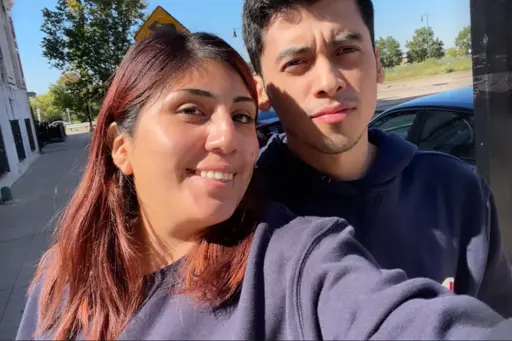
Photo: Gabriela and Martín Soto in a selfie taken before Martín was detained by ICE. (Gabriela Soto / The City Reporter)
The post Martín Soto released after eight months in ICE detention first appeared on Workers’ Voice/La Voz de los Trabajadores.
From Workers’ Voice/La Voz de los Trabajadores via This RSS Feed.
Innocent man kidnapped and held against his will for 8 months.
