

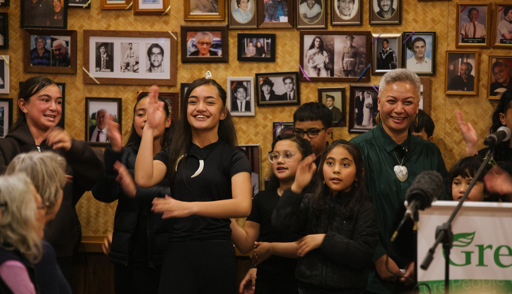

Polling suggests a broad shift in Māori party vote preferences this election. Enrolments to vote close today, with youth-led campaigns like On a Roll calling for rangatahi Māori to make their voices count. (Photo credit: RNZ / On a Roll)
Polling in the Māori electorates points to a broad shift in support among Māori voters, from Labour and Te Pāti Māori to the Greens, writes Jamie Tahana.
Polls are often fickle things. Former prime minister Jim Bolger famously said “bugger the pollsters” when the 1993 election, the last under First Past the Post, proved much narrower than anyone had predicted, resulting in a hung parliament.
That fickleness can be particularly acute with the Māori electorates, where some predictions have been comically bad. This time three years ago, in Tāmaki Makaurau, Labour cabinet minister Peeni Henare was predicted to cross the line with a comfortable 10-point majority. On election night, he lost to Te Pāti Māori’s Takutai Tarsh Moana Kemp by four votes, which widened to 42 on a recount.
This trend seems to be continuing this year. In Te Tai Tonga, for example, a poll conducted by Curia for Whakaata Māori in late September showed Takutā Ferris, formerly of Te Pāti Māori and now an independent incumbent, coming fourth in the race, 15 percent behind Labour’s Mananui Ramsden. But last week, a survey by Horizon for Mata showed Ferris with a slight lead. Such a drastic swing over a couple of weeks seems unlikely.
Still, polls can be incredibly useful, and in predicting the overall general vote at least, they’ve tended to be pretty accurate in New Zealand. Former prime minister John Key is said to have obsessed over them, using almost daily polling to provide him with something close to live feedback on policy announcements and the mood of the nation. Most politicians profess to have little regard for polls, each having their own variation of “bugger the pollsters”— yet their party machinery pores over the results feverishly.
Polls are at their most useful when they’re done regularly enough to plot trends over time, which doesn’t tend to happen in the seven Māori electorates.
For one thing, these electorates are so large and diverse that they’re notoriously difficult to survey. For another, no one really seems to focus on polling them, which is a shame because it looks as if the seven seats could prove crucial to forming the next government. As loose as the poll results so far may be, a broader shift appears to be emerging within the Māori electorate.
Across both the Whakaata Māori and Mata polls, the party vote points to an interesting shift, with support for the Green Party appearing to have surged among Māori. In the Mata poll, the Greens, with 28 percent, were one point ahead of Labour, with Te Pāti Māori on 16 percent. The ex-MP Tau Henare, formerly of New Zealand First, then Mauri Pacific, then National, said the result was “like sitting in Taupō when an earthquake goes off”.
The Whakaata Māori polls have picked up on a similar trend in the party vote, including Green MP Huhana Lyndon leading in Te Tai Tokerau. If she wins, it would give her party its first Māori electorate.
The Green Party says its surge in support has been the result of its strong support for Te Tiriti and other Māori policies, as well as a new slate of young Māori members. Others point to the influence of Te Pāti Māori’s call for people to put their party vote elsewhere (John Tamihere has already claimed credit for the Greens’ success). But infighting in Te Pāti Māori could equally have driven many of its former supporters to the Greens.
The polls also point to a drastic drop in support for Labour among Māori voters.
Since Tahupōtiki Wiremu Rātana formed an alliance with Michael Joseph Savage in the 1930s, Labour has enjoyed near total support in the Māori seats. That buckled with the advent of MMP in 1996, when New Zealand First won all the seats. Back then, Winston Peters was an advocate for the Māori seats. But this year’s polls show a near total collapse in support for New Zealand First in the Māori electorates, which Peters now wants abolished.
The seats swung back to Labour in 1999, but the Clark government’s handling of the foreshore and seabed in 2004 gave rise to the first incarnation of the Māori Party, which was sent packing from parliament in 2017.
In 2023, Labour was punished by the Māori electorate when the party lost all but one of the Māori seats. The party’s Māori campaign chair, Willie Jackson, has spent the past three years campaigning to get the seats back, but his leader, Chris Hipkins, at least in the televised debates, has appeared awkward and unconvincing whenever anything Māori is raised. In the Mata poll, Labour’s party support had dropped 17 percent, while the Green Party has increased by 19 percent, a clear indication of where its support seems to be heading.
There appears to be a generational shift at play, too. Among younger voters, Te Pāti Māori remained a firm favourite, with 13 percent naming Hana Rawhiti Maipi-Clarke as their preferred prime minister. The support for the Green Party was strong among rangatahi Māori, too.
In an election likely to be defined by the collapse of the two major parties, the Māori electorate — which is particularly young, and growing — appears to be at the forefront of this shift, a troubling trend for Labour.
Data released by the Electoral Commission this month showed that the Māori roll has reached its highest figure ever, with more than 315,000 people enrolled to vote across the seven electorates. More Māori are now on the Māori roll than the general roll, and young people enrolling for the first time tend to favour the Māori roll.
For all the criticism of Te Pāti Māori’s call for strategic voting, voters on the Māori roll have long been adept at tactical voting under MMP, with Māori seats often showing significant vote splitting.
Even the late Adrian Rurawhe admitted to splitting his vote in 2005, when he supported Tariana Turia and her newly-formed Māori Party in the byelection for Te Tai Hauauru, while keeping his party vote for Labour. “We still have the same aspirations — that hasn’t changed,” he told Q+A’s Jack Tame in February.
If successful, a manufactured overhang could skewer the proportionality of parliament, meaning the seven Māori seats could become crucial for the formation of any new government.
Enrolments close today, Sunday, October 25 at 5pm.
Changes to electoral law mean you can no longer enrol on election day, November 7.
You can enrol online, or check and update your enrolment details, here.
Or you can visit an enrolment hub in the community. See here for locations.
Jamie Tahana (Ngāti Pikiao/Ngāti Makino/Tapuika) is a journalist and broadcaster who has worked in both Aotearoa and the Pacific. He grew up between his Dutch mother in Hutt Valley, Wellington, and his Te Arawa dad in Rotorua. He has a master’s degree from Te Herenga Waka Victoria University and was the Māori news editor at RNZ until May 2023.
The post In the Māori electorates, a shift is emerging appeared first on E-Tangata.
From E-Tangata via This RSS Feed.