

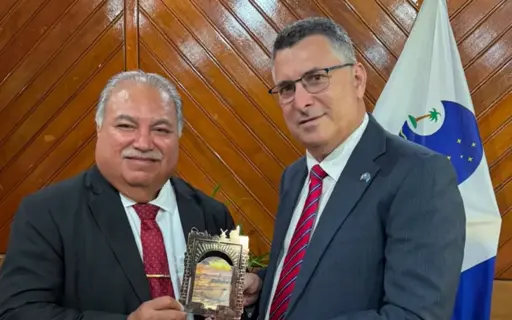

Israel has joined the Pacific Islands Forum (PIF) as a development partner, as a number of Pacific governments forge closer ties with Israel’s government. Here, Pacific Islands Forum secretary-general Baron Waqa confirms to Israeli Foreign Minister Gideon Sa’ar that Israel has been accepted as a Forum Partner. (Photo credit: Pacific Islands Forum)
Pacific people know what it means to have our lands taken, our sovereignty challenged, and our futures shaped by powerful outsiders. So why are some of our governments reluctant to defend those same rights for Palestinians? asks Nāsili Vaka‘uta.
Pacific people have long memories. We remember the taking of our lands, the imposition of foreign rule, the suppression of our languages, and the humiliation of being told that others knew what was best for us. We remember our ancestors’ struggle to protect their communities, their dignity, and their right to determine their own futures.
These histories aren’t distant memories — they remain part of who we are. That’s why the position of some Pacific governments towards Palestine is so deeply troubling.
At a time when Palestinians continue to struggle for land, freedom, and self-determination, several Pacific governments have chosen diplomatic positions that appear more sympathetic to the interests of the Israeli state than to the rights of a people living under occupation.
Fiji, Nauru, and Papua New Guinea have established embassies in Jerusalem. Last year, seven Pacific nations — including Fiji, Tonga and Nauru — voted against a United Nations General Assembly resolution calling for an immediate, unconditional and permanent ceasefire in Gaza.
These decisions are difficult to defend. How can nations whose histories have been shaped by colonial domination be so reluctant to challenge the domination of another people?
We understand that our governments operate in a world of unequal power. Small island nations depend on international partnerships for development, security, education, technology and economic opportunities. Israel, like many other countries, offers forms of cooperation that could benefit Pacific communities.
But as we all know, aid, investment, and diplomatic recognition all come with pressures.
How do we balance those pressures against our moral independence? And how far should dependency shape what our governments become willing to defend?
The anti-colonial thinker Frantz Fanon warned that colonialism doesn’t end when colonial administrators depart. Its assumptions can survive in the minds and institutions of those who were once colonised.
We may gain political independence, yet continue to reproduce the values and hierarchies of empire.
This contradiction confronts parts of the Pacific today.
We reject foreign domination when it threatens our islands, yet some of our governments appear prepared to accommodate it elsewhere.
We insist that our lands and oceans are inseparable from our identities, yet fail to extend the same understanding to Palestinians.
We demand that the international community respect our sovereignty, yet become hesitant when another people makes precisely the same demand.
Would we accept the displacement of Sāmoan families from their ancestral lands because an outside power claimed a superior historical entitlement? Would Tongans accept the occupation of their islands because another government invoked an ancient religious promise? Would Fijians regard the dispossession of their communities as legitimate simply because a powerful nation declared it necessary for its security?
Of course not.
So why should Palestinians be expected to accept what we would never accept for ourselves?
Across Oceania, land is more than territory. It is genealogy, memory, identity and belonging. It connects the living with those who came before them and those who will follow. For many of our communities, the relationship between people and place is fundamental to collective wellbeing. When land is taken, something more than property is lost. Relationships are disrupted, histories are fractured, and the foundations of community life are threatened.
Palestinians understand this profoundly. Their attachment to their homeland, their memories of displacement, and their determination to preserve their communities should be recognisable to Pacific peoples.
Our histories aren’t identical, but our experiences provide important grounds for solidarity. This is why the question of Palestine is also a question about the kind of Pacific we wish to become.
For years, our regional leaders have spoken about the Blue Pacific as a community bound by shared histories, collective interests and responsibilities to one another.
Fiji’s Prime Minister Sitiveni Rabuka has championed the idea of an Ocean of Peace.
These are aspirations worth defending.
But peace can’t simply mean maintaining friendly relationships with powerful governments. Peace must also mean justice for those whose rights are denied. An Ocean of Peace loses its moral credibility when its commitment to human dignity becomes selective.
In July 2024, the International Court of Justice concluded that Israel’s continued presence in the Occupied Palestinian Territory was unlawful. The Court also identified responsibilities for other states concerning recognition of, and assistance to, that unlawful situation.
For small Pacific nations, international law isn’t an abstract concern. It’s one of the few mechanisms through which less powerful countries can insist that their rights matter as much as those of larger states. If we weaken our commitment to international law when it concerns Palestinians, we undermine the principles on which our own sovereignty depends.
There’s also a religious dimension that deserves attention. Christianity has shaped Pacific societies for generations, and Christian beliefs continue to influence public life and political leadership. In some communities, Christian Zionist interpretations encourage the belief that the modern state of Israel possesses a special entitlement to land grounded in biblical promises.
But religious belief should never remove the obligation to examine the human consequences of political decisions. No people’s faith should become a justification for denying another people’s dignity. And criticism of Israeli government policies must never be confused with hostility towards Jewish people or Judaism. Antisemitism is unacceptable, just as anti-Palestinian racism is unacceptable.
The principle is simple. No community’s security or freedom should depend on the permanent subordination of another. Nor should attacks on civilians and hostage-taking by Hamas be used to justify collective punishment or the destruction of Palestinian communities. Our solidarity must be grounded in a consistent commitment to human life.
Fortunately, the positions of some Pacific governments don’t represent the whole Pacific. Across our region, community organisations, scholars, churches and activists have spoken in support of Palestinian rights. The Pacific Conference of Churches has advocated recognition of Palestine.
These voices remind us that our region possesses another political tradition, one of resistance to colonial domination, of communities standing alongside one another, and of recognising that our wellbeing can’t be separated from the wellbeing of others.
We find expressions of this responsibility in the many languages and cultural traditions of Oceania. In Sāmoa, vā reminds us that relationships carry obligations. In Tonga, tauhi vā calls us to nurture and sustain those relationships. Across the wider Moana, our understandings of collective life challenge the idea that we can flourish while remaining indifferent to the suffering of others.
These values aren’t merely cultural ornaments to be displayed at regional gatherings. They should inform how we engage the world. To take them seriously is to recognise that Palestinians aren’t strangers whose suffering has nothing to do with us. Their struggle asks whether our commitments to dignity, belonging and justice extend beyond our own shores.
This doesn’t mean Pacific governments must sever every relationship with Israel. It means those relationships must be subject to the same ethical and legal standards we expect of others. Our governments should explain their diplomatic decisions openly, support Palestinian self-determination, and refuse to treat international law as optional when powerful partners are involved.
They should also listen more carefully to their own communities, including those who question whether current diplomatic relationships reflect the values and aspirations of Pacific peoples.
The Pacific has much to offer the world. Our histories of resistance, our understandings of relational responsibility, and our continuing struggles to protect land and ocean offer resources for imagining a more just international order.
But those resources mean little if we abandon them when political convenience demands it. We can’t claim to be a region of peace while remaining indifferent to the conditions that make peace impossible for others. We can’t treat Palestinian freedom as negotiable. And we can’t speak of a decolonised Pacific while allowing our political imagination to remain captive to the interests of powerful states.
Palestine isn’t simply a distant foreign policy issue. It’s a mirror held up to the Pacific. And what we see in that mirror should trouble us.

Nāsili Vaka’uta
Nasili Vaka*‘*uta is a Tongan academic and director of the Centre for Advocacy, Research and Empowerment (CARE) in Aotearoa New Zealand.
The post Palestine and the Pacific: Have we forgotten our own history? appeared first on E-Tangata.
From E-Tangata via This RSS Feed.