


Geoffrey Clendon, playwright of Tāke Kurī: The Dog Tax Rebellion
In the latter half of the 1800s, the colonial government imposed a dog tax that discriminated against Māori, who owned dogs in larger numbers than Pākehā settlers. One hapū from the Hokianga resisted the tax, and the ensuing standoff became part of Aotearoa’s history.
Geoffrey Clendon’s ancestors were on both the Māori and Pākehā sides of the conflict, and he’s written a play about it. Here he explains why.
I’ve spent the past five years writing Tāke Kurī: The Dog Tax Rebellion. It’s based on a true story: a Māori-led protest in Hokianga in 1898, the result of smouldering resentment against bad laws, broken promises, and the steady undermining of Māori mana.
Little did I know at the outset how connecting with this historical episode would lead me into a deeper engagement with my own family history and whakapapa.
At the heart of the rebellion was anger at the imposition of a dog tax of two shillings and sixpence per dog, about $50 today. The government wanted Māori to become obedient British subjects, and making them pay taxes was one way to do that. At one point, the dog registrar from the local county council threatened to send non-payers to “an icebound land where your bones will crack.”
For Hōne Tōia, leader of Te Māhurehure hapū, the tax was the last straw. He felt it unfairly targeted Māori, who owned many more dogs than Pākehā settlers. Tōia took a public stand against the government and declared that Te Māhurehure would “march on Rāwene, armed.”
Events quickly spun out of control. There were stand-offs, two evacuations of Rāwene, and the arrival of sailors, police, politicians, cannons, four gunships, and up to 150 soldiers, all to take on about 50 Māori. The leader of the military contingent, Lieutenant Colonel Newall, had been the officer in charge during the sacking of Parihaka 17 years earlier.
Although there were comical aspects to both the rebellion and the government’s overreaction, it was, in reality, a near-tragedy. Slaughter was averted, but the hapū suffered ongoing social and economic consequences when 16 of their menfolk, including leader Hōne Tōia, were sent to Mt Eden prison.

Police stand guard over five Ngāpuhi who had resisted the imposition by Hokianga County Council of a tax of 2s. 6d. on dogs. The protest was led by Ngāpuhi leader Hōne Tōia (centre, wearing a hat). The protesters had descended on Rāwene with arms, and the government responded by sending a gunboat and 120 armed men. The leaders of the rebellion were arrested and imprisoned. In this May 1898 photo, taken in the Hokianga, are (police constables, from left): Charles W. Hendrey, John W. Skinner, Alexander McGilp, John Beazley, John McNamara, Edward M. Johnson, William McNeely and Douglas Gordon. In front, from left, are Romana Te Paehangi, Hōne Mete, Hōne Tōia (standing), Wiremu Te Makara and Rakene Pahe. (Alexander Turnbull Library, F. Barrett Collection Reference: 1/2-018754-F)
I first came across the dog tax rebellion in a history book 40 years ago and was struck by the injustice, bitter ironies, and over-the-top government reaction. I wondered why no one had made a film about it. My interest persisted over the years until I realised the story had potential for a theatrical treatment, and I began writing the play. Along the way, I learned that I had whakapapa to key protagonists and antagonists in the drama, both Māori and Pākehā.
My great-great-grandfather, James Reddy Clendon, a sea captain and trader, built Clendon House in Rāwene, which is now administered by Heritage New Zealand Pouhere Taonga. He sailed through the Hokianga Heads in 1828 and became a prominent member of the small number of early Pākehā settlers in the north, all of whom depended on Māori goodwill to survive.
His signature appears as a witness on both the 1835 Declaration of Independence and Te Tiriti o Waitangi. He sold his house and land at Okiato Point in the Bay of Islands to Captain William Hobson, the first governor of New Zealand. Okiato Point then briefly became Aotearoa’s first capital.
I descend from James’s second wife, Jane Takotawi Cochrane, whose mother was Takotawi Te Whata of Te Rarawa. From my paternal grandmother, Elizabeth Ellen Clendon (nee Beasley), I whakapapa to Muriwai of Utakura, a prominent Ngāpuhi rangatira, and to Hauraki of Ōmanaia.
My whānau became disconnected from their whakapapa after moving to Tāmaki Makaurau in the 1920s, so my upbringing throughout the 1960s and 1970s was Pākehā. Our close whakapapa links to Māori were seldom mentioned by my immediate family. I can only assume that this was because of the social pressures of the era, where a “good” Māori was assimilated, brown on the outside but white on the inside.
Although I was always interested in my Māori heritage, it was only later in her life that my grandmother revealed that she still had some reo, remembered from a childhood in Hokianga 80 years earlier. That kindled in me an even greater desire to learn more about who we were and where we came from. In 2022, I was awarded a month-long writer’s residency in Rāwene, and I spent time searching the archives at Clendon House.
Back in 1898, the local magistrate charged with enforcing the dog tax was a Clendon, as was the wife of the postmaster. Both were major players in what happened and supported the government’s stance. I also found a handwritten account of the rebellion from another family member who didn’t share their view. My great-grandfather, 27 at the time, was also there, and I wondered what he made of it, but there was no record of his thoughts.
Newspapers published contrasting views from Pākehā settlers. One side thought the government’s intentions were ridiculous and wasteful. The other side lived in fear of a “native uprising” and thought “the natives” needed to be taught a lesson.
During my residency in Rāwene, I talked with a range of locals, arts bodies, and venue managers. Their enthusiasm for seeing the rebellion played out on stage was encouraging.
It’s important to note that this is a work of fiction based on true events. I’ve been careful to respect the people involved and their descendants, some of whom will be coming to see the production. Some feathers will be ruffled, but that’s what you get when a nippy sou’wester gusts in through the Hokianga Heads.

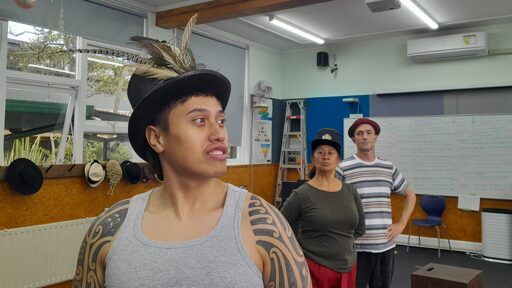
Johnson Manukau, Noa Campbell and Francis Mountjoy in rehearsal. (Image supplied)
Ka mua, ka muri. Walk backwards into the future, facing the past. The play is an exploration of one episode in Aotearoa’s history and contributes to New Zealanders’ learning about colonisation and its effects.
I hope it prompts people to ask questions about the wider context of that era and sparks discussions about the relevance of the play’s themes to contemporary struggles in Māori-Crown relations.
And, of course, I also want to give the audience a good show.
The production features four actors playing more than 20 characters, bringing to life Māori and Pākehā figures involved in the conflict. Canine commentators provide a wry perspective on the events unfolding around them.
At one point while writing this, I questioned my right to tell this story.
I usually start writing before it’s light, but one morning, as I was drafting Hōne Tōia’s climactic speech, in which he invokes his tīpuna looking down from the Hokianga maunga as the proceedings unfold, my courage faltered.
I thought: “Who am I to tell this kōrero? Do I have that authority?”
In that moment of crippling self-doubt, a ruru right outside my window started calling — to me. It was a tohu, a sign, and a reminder. I thought: “Hang on a minute. Those tīpuna who looked at Hone Toia as he spoke are my tīpuna too.”
I tangi ahau. I wept. Then I finished the speech. Tēnā koe, e te ruru.

The cast of Take Kurī.
Tāke Kurī: The Dog Tax Rebellion plays at Te Pou Theatre, Tāmaki Makaurau, from October 28- November 1. There will be a performance at the Turner Centre, Kerikeri, on November 12, and at Rāwene Town Hall on November 13. The final performances will be in Waiheke at Artworks Theatre on November 20–21.
Geoffrey Clendon graduated from Sydney’s National Institute of Dramatic Art in 1976, then worked in theatre, film and television on both sides of the Tasman. He spent 13 years teaching drama at Massey High School and now focuses on creating theatre.
The post Taking on the dog tax appeared first on E-Tangata.
From E-Tangata via This RSS Feed.