

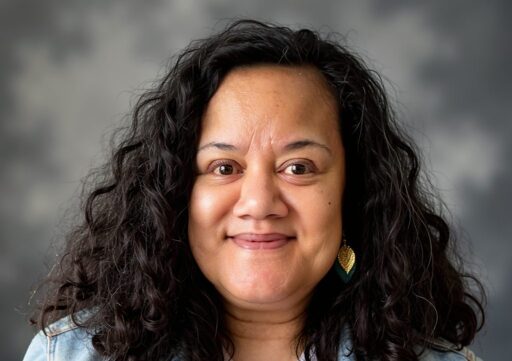

Candice Tutauha, author of the novel ‘Rua’. (Photo: Supplied)
Candice Tutauha’s debut novel, Rua*, is the coming-of-age story of a disabled teenager who dreams of a literary life in New York, far away from the gang-infested Whanganui suburb where she lives. Here Candice (Ngāti Ruanui, Te Ātihaunui-ā-Pāpārangi) talks to Atakohu Middleton about her semi-autobiographical novel and its connection to the Taranaki Wars.*
How does your own story start?
I was born at Wellington Hospital 53 years ago. My parents, Warren and Bella, rented a flat in Newtown, where they worked multiple jobs to save up for our first home, so I was whāngai’d by my maternal grandparents, Koro Bill and Nana Pet, in Whanganui until I was two. My parents would collect me for weekends and holidays.
Nana Pet was the matriarch in our whānau and helped raise the first generation of moko. Many of us cousins lived there as small kids. At the crack of dawn, she’d warm up the kitchen while Koro got ready for work at the council. He graded the city streets.
While Koro put on his work boots, Nana Pet would stand at the stove stirring a huge pot of porridge, their kōrero reaching us kids down the passage as we huddled in bed, waiting for breakfast to be ready.
Eventually, I moved back to Wellington for school, but leaving my grandparents after each holiday in Whanganui was a battle. I have memories of Nana Pet waving her hanky as my parents’ banana-yellow Toyota Corolla rolled down the driveway, as if the slow turn of its wheels might ease the anguish of leaving.
Mum and Dad’s first house was in Karori. Dad worked for Telecom and Mum was an accountant for Polygram Records in Miramar, which was on the other side of the city, near the airport. I went to Miramar South Primary School, a few blocks from Mum’s job. I found it easy to make friends, but sometimes I preferred my imaginary ones because they allowed me to be the ringleader!

Candice and her mum Bella on a visit to Napier. (Photo: Supplied)
Our house was filled with music, mostly Motown. Mum’s favourite singers, Donna Summer and The Supremes, were always on the turntable. In the evenings, Mum and Dad worked part-time, cleaning at an intermediate school in Newtown. As an eight-year-old, I’d hide in the library reading all the intermediate-level novels, while Mum and Dad buffed and polished the classrooms.
As I grew older, I began walking the length of Adelaide Rd towards the Basin Reserve, where my paternal grandparents, Koro Terry and Nana Bella, lived. I can’t remember what Koro Terry did for a living, but when I went over, he’d be sitting at the kitchen table reading the newspaper or doing the daily crossword, the ash from his cigarette falling onto the print as he carefully wrote in the answers. He also loved to knit.
Television wasn’t really a thing in their household. My grandparents were studious and patient. They nurtured my love of reading with Encyclopaedia Britannica and Reader’s Digest.

Candice aged 10 with her paternal grandparents, Nana Bella and Koro Terry.
I also walked to the factory where Nana Bella worked, making tin baking utensils. I can still hear the roar of the motor as old Rusty, Nana’s workmate, ground away at his machine on the floor above us, sunlit dust motes and metallic specks drifting down. It was a hive of steampunk adventure up there, a maze of oiled machines and apparatus, and Rusty in a pair of greasy overalls, a rollie dangling from his lips.
I loved my childhood. I was an only child for more than 10 years before my parents had my sister, Vern, and then our younger brother, Steven. I think books saved me from being lonely, and by the time my siblings came along, life felt very full.
Like Rua in your novel, you were born with X-linked hypophosphatemia (XLH), a form of genetic rickets that weakens teeth and bones and can affect mobility. What did that mean for you as a child and now?
X-linked hypophosphatemia (XLH) is a rare, inherited disorder that affects bone and phosphate metabolism. As a child, I suffered torturous growing pains, with acute bone and muscle pain that felt as if someone was stabbing me repeatedly with a searing hot fork. At night, my parents would wrap cold towels around my legs to bring some relief.
I stopped growing in my mid-teens and barely reached five feet. Now, my condition has become degenerative, and I feel as though I’m shrinking. With hip replacements, spinal scoliosis and weight gain, I can no longer get around without a mobility aid. I’m trying to avoid needing a wheelchair. It feels as though I’ve spent my entire life on a diet. At this age, I’m done with diets. I just want to enjoy life.
I used to take calcium supplements, which were later replaced with phosphate, and vitamin D. I’ve recently come off medication, as apparently someone my age shouldn’t be on it, but I’m hoping that medical advances will deliver some hope for all of us with XLH.
I am constantly adjusting to a world that isn’t built for someone my height. Everyday things can be a stretch, literally, and I’ve developed a hobbit-like fascination with the world around me, noticing details others might overlook, like granules on a countertop or dust in corners. Anyone over six feet tall gives me a crick in the neck.

In the book, which is set in 1995, Rua is a studious 16-year-old who loves to write. She has XLH and lives with her nan and koro, her aunt, her cousin Daisy, and other family members in a gang-ridden “dead-end street with dead-end people.” She dreams of becoming a writer and moving to New York to live a different life. You’ve described this book as “semi-autobiographical”. How did your teenage years reflect this setting and Rua’s experiences?
After I finished school, I felt stuck. The world didn’t fit my mould, or I didn’t fit the world. I didn’t know what I wanted to be or what to spend my life doing.
When Koro Bill died, I went back to Whanganui for his tangi and decided to stay, living with Nana Pet and an aunty. I reconnected with the aroha I enjoyed as a pēpi, when I was whāngai’d by my grandparents. That same aroha carried me into adulthood.
However, life in Whanganui was fraught with danger. Beneath the warmth of whānau and the comfort of belonging lay a harsher reality, where violence, drugs, and the consequences of destructive choices could seep into everyday life.
The place that offered me refuge wasn’t always a safe place to be, so I bounced back and forth like a yo-yo between Whanganui and Wellington. It was my childhood repeating itself, only this time the stakes were higher. I was an adult now, faced with the responsibility of making my own choices.
I left Whanganui for the last time around the turn of the millennium, with my son Leon, who was one then. These days, I live in Lower Hutt with Mum and Dad, my sister and her son, and Leon, who’s 26.

Candice, 29, and Leon, 2, in Whanganui. (Photo: Supplied)
Was its close-to-home nature one of the challenges of writing the book?
Yes. When people who know me read my work, they might recognise fragments of my life, even when I’ve changed details or created fiction.
Semi-biographical is an important distinction here. While my own experiences inform aspects of the story, the book is a work of fiction, and I’m sharing only certain parts of my personal journey with the public.
My close whānau say that this is my book and my point of view, so I just need to go for it.
When did you start to write, and why?
I was an avid reader from the age of five, and writing became a natural extension of that love. But making up my own stories through imaginary play was even more fun. I’d perform life-saving surgeries on my Barbie dolls, then fine-dine in the backyard or beneath a blanket hut, sipping grass tea and nibbling Shrewsbury tarts with the Queen of Hearts, who, in my imaginary world, wasn’t as cruel as her Alice in Wonderland counterpart.
With all this made-up stuff in my head, inspired by books and later movies, it never occurred to me that authors were real people. Becoming one and making a career of it seemed quite unrealistic. My own career took a different path for a very long time. A sensible albeit unfulfilling path.
I did an IT degree at WelTec and worked for Contact Energy in Wellington. One spring morning in my early 40s, as I was lying in bed, most likely going through some form of midlife crisis, I had the idea to write a children’s nursery-rhyme fairytale. I remember the moment so clearly because it felt as if I had found an answer to that big question: What am I doing with my life?
I got out of bed and spent the weekend writing the entire story, about an orphan who lives alone in a forest and tries to solve a mystery. Looking back, I realise that was when a spark was lit.
In 2018, I was offered a job in Auckland to work as a metering administrator for Vector. That was a turning point in my life. I got a scholarship for a creative writing course at The Creative Hub there, run by the author John Cranna. That was my first formal training in creative writing.
By then, I’d been working on Rua for a while. As a reader, I had longed to see modern Māori female characters with big dreams, complicated inner lives, a deep spiritual world, and the freedom to be funny, inquisitive, flawed and fiercely ambitious. So, I decided to write her.
You did a masters in creative writing at the University of Auckland in 2022 and 2023. How did that experience transform your skills as a storyteller?
Paula Morris, who runs the degree, shaped the messy parts of the novel I’d created into something that’s essentially how I envisioned Rua would turn out to be, but better.
In the course, we had a host of published authors share their knowledge and experience. The course was very condensed, and I learned so much over that short time. It gave me the confidence to finish my manuscript and keep honing my skills.
Rua is book one of a multi-generational trilogy, and securing a publishing deal with Bateman for the series gave me the assurance I needed to keep me on this path. Plus, I started learning te reo alongside writing Rua, and that has really lit a fire in my puku!
Why was it important for you to have a disabled central character in your novel?
We’re at a time in human history when it’s important to keep telling stories rooted in lived experience and insist on representation. Whose stories get told, and who gets to tell them, matters.
In the book, Rua is given the diary of a soldier named Johnson who fought for the British in the Taranaki Wars, and she realises that this soldier had met some of her tūpuna. I hear that you also came across a real soldier’s diary, and that changed the course of your novel.
I was midway through my master’s, and with the summer break coming up, I went looking for a project that would get me more involved on campus. A conversation with Dr Rowan Light, a historian at the university and the project curator for the New Zealand Wars at Auckland Museum, led to a project transcribing a diary that belonged to Edward Strickland, who was a British army officer. It captures his view of conflict at places like Otapawa and Ketemarae in 1865 and 1866.
I didn’t realise at the time how much of an impact the diary would have on me. There I was, right up close to a British soldier’s documentation of his regiment’s campaign in the Taranaki region. I was completely blown away, not just by the revelation that this soldier had been on my marae and most likely brushed shoulders with my tūpuna, but by the diary itself.
The writing was cursive and elegant, the words regimental and uniform. It felt matter-of-fact, yet private and candid. This taonga changed the trajectory of my story and inspired the main subplot for Rua. It compelled me to research the Taranaki Wars and the wider New Zealand Wars, deepening my relationship with the history I was writing about.
My soldier is fictional — his name is Johnson — but inspired by Strickland’s diary.
Faith is also part of the book, and I know that’s a big part of your daily life.
Faith has always been part of my life, although my relationship with it has changed over the years. In Whanganui, we grew up around the Rātana faith. During the annual Rātana celebrations every January, whānau from up north would visit, and all of us kids would hang out at the Rātana pā. It was such a fun time.
It wasn’t until I got older that I was pulled in a different direction and became a bit lost in my faith.
I’ve tried all sorts of faiths, from the Latter-Day Saints to a Korean cult I found online (long story!). These days, I’m convinced that faith is about being present and building a personal relationship with Jesus. I hang out with him through Scripture, and I trust the call to a church will come in its own time.
Rua by Candice Tutauha (Bateman Books, RRP $38.99) is available now. Read an extract from the book here.
Rua will be launched at Auckland Museum on Tuesday, October 27 at 6pm. Candice Tutauha and University of Auckland historian Dr Rowan Light will discuss the novel and its connection to the Taranaki Wars. Details here.
Auckland Museum is home to Atarau: Stories of the New Zealand Wars*, the country’s only permanent exhibition presenting stories from across the wars. From today, Sunday, October 25, to Wednesday, October 28, the museum is running free, guided 30-minute talks to increase understanding of our country’s 19th-century conflicts. Details* here.
The post Candice Tutauha: Writing the heroine she wanted to read appeared first on E-Tangata.
From E-Tangata via This RSS Feed.