

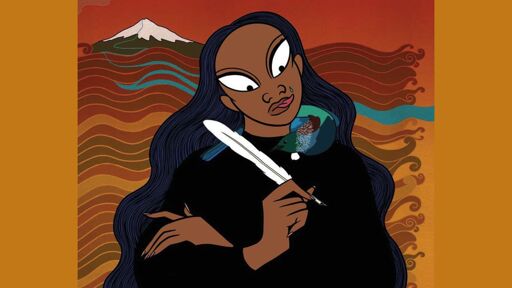

The cover of ‘Rua’, by Candice Tutauha. (Image supplied)
In this extract from Candice Tutauha’s debut novel, 16-year-old Rua and her 17-year-old cousin Daisy, who live with their grandparents in Whanganui, are woken by gunshots in their street.
It wasn’t the shouts that woke me, it was the gunshots — five of them. When you lived in our neighbourhood, you got to learn the difference between that and a car backfiring.
Little Day’s story was that the shooter came round the back of the flats and jumped the broken fence. Shot a Pā boy multiple times, then took off towards the beach.
When the police finally turned up, they flashed a torch in Little Day’s eyes, trying to polygraph his face. The burly one made him walk and talk, dragging him into the kitchen for questioning. The one with the barbed-wire tattoo on his left arm. He kept hefting that arm like he wanted to clout someone with it. A year ago, he’d put Uncle Pō in Kaitoke Prison for home invasion. Nan recognised him at once and refused to put the kettle on.
Daisy wedged her foot in the passage door, and we sewed our eyes to the sliver. It was cold; my neck constricted under my thin T-shirt, and Daisy’s hand was ice. The chink of light striped her face and for the first time in a long time, I saw fear in her eyes.
Less than a metre away, two police officers leaned against the yellow tiles, but only the third one with the arm tattoo spoke. He had a sly voice that made us press our bodies closer to the door. In Koro’s absence, he’d parked his arse at the head of the table, his tattooed elbow resting on the stove edge like he owned the place. Little Day slouched next to Nan in her cotton gown with her arms crossed over her ample chest. She kept swinging her grey braid left and right like a racquet lobbing a tennis ball over a net.
I watched and listened in the space that was a hairpin between my innate fear and anger that not all cops were good. I had been there when Uncle Pō taught my cousin how to deal with them. “Neph, if you ever get pulled up by the pigs, play your cards.” He was talking about Little Day’s poker face — a class act, cold as fuck. But he had a twitch: under a flat bridge and extreme pressure, his nostrils flared into tiny bat wings. A slow inhale and exhale of forced self-composure. He didn’t clench his jaw, blink a lot or ball his fists into potent fury like Cousin Piri — just that twitch. It started with one sniff, then another, like some coke addict after a line. And then he’d get this drawl in his voice and fuck around with his words.
Hefty snapped his fingers. “What was the shooter wearing?”
“Fuuuuuck, I don’t know, man. Didn’t see a rag on him. Some nigga off the street.”
“And where were you?”
“Bro,” said Little Day. “I was trying to break up a fight.”
“What fight? With whom?”
“I dunno. Couldn’t see dickshit in the dark. Someone pulled a knife on me and my mates.”
Hefty leaned his weight over the table. “Sooo . . . a shooter comes out the back and tries to kill your mate. Then someone else starts a fight?”
“Naaah, that fulla who got shot wasn’t my mate.”
“But he is,” said Hefty. He folded one arm over the other, biceps bulging out of his sleeves. “All you Pā boys run together.”
“I ain’t a Pā boy.”
“Then how’d they end up at your mate’s party?”
Little Day sniffed. “I didn’t invite them.”
Hefty smiled. “Davison, hand me that notebook.”
One of the cops by the kitchen sink shuffled over, handing a notebook to the trickster. “See,” said Hefty, “this is where it starts to get interesting.” Flip-flip. “There’s a witness who says you did invite them. To initiate the kid whose party you were at — Wiri Madden. Know him? Of course, you do.”
“What do you mean? He’s our whānau.” Nan made a face at him.
“Ma’am, we’re just trying to get to the bottom of this.” Hefty licked the cliché off his teeth like it was margarine. His eyes didn’t move off my cousin, who slouched in his seat, unflinching. “These Pā boys are all your mates, aren’t they? I know you’re trying to start a new branch; think you’re in some kind of LA gang. The Bloods, ain’t that right? Aren’t you their leader?”
Little Day sniffed again. “I ain’t leading shit. You got the wrong Māori boy.”
“I don’t think so, but we’ll get to that.”
Nan chimed in. “What’s all this? My moko’s not in a gang; he’s a good kid. Helps around the house and whatnot. He’s not a trouble — ”
“You were in the same spot the shooting happened, yeah?” Hefty banged his fist on the table and I jumped. “Little Day . . . that’s your name, right? Answer me!”
“Oi,” said Nan, getting up from her seat. “Don’t come harassing us in the middle of the night. Don’t bang your fists on my table. This is my whare. Who the hell do you think you are?”
Was that a smile on the prickster’s face? The clock above the fridge was the only sound that broke the five seconds of silence. Then he got up, towering over Nan in her fluffy slippers. “Ma’am,” he said. “This is an investigation. If your grandchild doesn’t cooperate, we’ll take him down to the station.”
When Nan wouldn’t sit down, he shifted his focus. “You keep upsetting your Nan, don’t you?”
Little Day stretched out his legs, and I heard an almost imperceptible sniffle. “You’re the one upsetting her.”
Nan sat back down, the chair scraping, and tapped Little Day on the elbow. “Moko, tell him the truth so they can leave.” She looked up at the cop, nostrils flaring. “Well? What other questions do you have?”
The cop held my cousin’s gaze, unmoving. “I’m going to ask you one more time. Where were you when the shooting happened?”
“Yo, I said this fulla came out of nowhere and shot the other guy.”
“Is that right?”
“Yup.” Little Day rubbed his jaw like he was bored. “Shot him a couple of times. Like I said, he came out of nowhere.”
Hefty nodded, but I knew he didn’t believe Little Day. “And you just stood there.”
“It was unreal. He’s probably at the beach by now, you should go check that out.”
“Oh, we will.”
The cop snapped his notebook shut and nodded to his partner; studied Little Day for a beat, like he’d made up his mind. “Alright, you’re coming with us.”
“What?” Little Day’s poker face slipped.
Nan’s protests turned to wailing as they led him outside. Even after the siren faded up the street, she didn’t stop. Red and blue lights bled into the dark. Her second youngest moko, strapped in the back like a chicken basted for roasting.
Rua by Candice Tutauha (Bateman Books, RRP $38.99) is available now. Read an interview with the author here.
Rua will be launched at Auckland Museum on Tuesday, October 27 at 6pm. Author Candice Tutauha and University of Auckland historian Dr Rowan Light will discuss the novel and its connection to the Taranaki Wars. Details here.
Auckland Museum is home to Atarau: Stories of the New Zealand Wars*, the country’s only permanent exhibition presenting stories from across the wars. From today, Sunday, October 25, to Wednesday, October 28, the museum is running free, guided 30-minute talks that aim to increase understanding of our country’s 19th-century conflicts. Details* here.
The post Rua — an extract appeared first on E-Tangata.
From E-Tangata via This RSS Feed.