

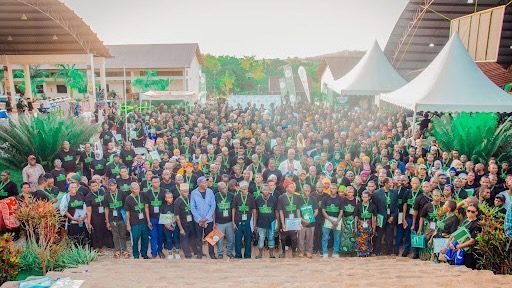

Some 850 smallholder farmers from across mainland Tanzania and Zanzibar met in Morogoro from September 29 to October 1 for the National Smallholder Farmers’ Conference and the 31st Annual General Meeting (AGM) of MVIWATA, the network of Tanzania’s smallholder farmers’ groups. The theme was “Towards Food Sovereignty: Land Security, Agroecology and Economic Justice for Smallholder Farmers” (“Kuelekea Uhuru wa Chakula: Uhakika wa Ardhi, Kilimo Ikolojia na Haki Uchumi kwa Wakulima Wadogo”).
The AGM is MVIWATA’s highest body. Founded by farmers in 1993, the organization interacted directly with 58,916 farmers last year, 57% of whom were women, according to its own count. Two days of conference debate precede the AGM, allowing members to debate policy before coming together to decide the way forward. For this year’s AGM, MVIWATA farmers took up the key issues of land, markets, seed and, for the first time, carbon trade.
Dr Bashiru Ally, Tanzania’s Minister of Livestock and Fisheries, opened the meeting, saying he had come to listen rather than lecture. He turned quickly to land: conflicts between peasants and pastoralists, he said, had killed at least fifteen people across five regions in September alone. He asked MVIWATA to help the government end the land conflicts.
Guests included the ambassadors of Cuba and Palestine, the Eastern and Southern Africa Small-Scale Farmers’ Forum, the Tanzanian Socialist Forum, and Pan Africanism Today, which delivered a message of solidarity on behalf of more than seventy movements and organizations in Africa. MVIWATA also read its statement of solidarity with Palestine and Cuba.

MVIWATA delegates attending the National Smallholder Farmers’ Conference and the 31st Annual General Meeting of MVIWATA. Photo: MVIWATA
Land discussions dominated the first day. Delegates said the courts were out of reach for most peasant farmers. MVIWATA’s chairperson, Apollo Chamwela, told those attending the AGM that in Magungu village in Kiteto, more than sixty farmers had lost their land when it was allocated for grazing. Subira from Msomero and Salum from Rudewa, both in Kilosa district, described village land taken by outsiders with the collusion of the local officials who should have prevented it. “How can the government take the side of the minority against the majority?” Subira asked. “Where should we run to cry?”
The second day of the AGM focused on markets: not markets in the abstract, but the system through which smallholders are made to sell their crops. Under Tanzania’s warehouse receipt system, farmers deliver produce to licensed warehouses, usually through cooperative unions, and it is sold by digital auction on a government-controlled exchange rather than at the farm gate. Delegates described a system in which farmers have little say over the floor price, and in which middlemen registered as farmers, “ghost farmers” in the words of MVIWATA Executive Director Stephen Ruvuga, sit where prices are set and gain at the real farmers’ expense.
Officials on the platform conceded that small producers outside the cooperative unions are “falling between the cracks.” The session on seeds addressed the regional seed law before the East African Legislative Assembly. The carbon session, the most heated of the three days, heard delegates from Dodoma, Katavi and Kagera describe companies counting trees and signing open-ended contracts with individual farmers who were given no opportunity to understand or scrutinize what they were signing.
On the final day, the conference resolutions were adopted by acclamation. MVIWATA will compile its members’ land grievances and submit them to the government through Dr Bashiru Ally, as he had offered. It will expand its legal aid and follow up on cases stalled with officials. It will document flaws in the crop-marketing system, present them to the authorities, build a seedbank dedicated to indigenous seeds, convene an inclusive forum on carbon trade, and track, analyze and critically engage carbon projects and their effects on farmers.

Dr Bashiru Ally, Tanzania’s Minister of Livestock and Fisheries, opens the MVIWATA meeting. Photo: MVIWATA
The AGM then turned to the organization’s future. Its strategic plan for 2027–2031 will put agroecology first, keep land access as a priority and make a farmers’ bank the next major task, starting with TZS 20 million raised from members themselves. Self-reliance ran through the proceedings: members debated doubling their own annual fee, and left energized to prioritize instruments through which farmers can continue to defend themselves. The meeting closed with the election of the board that will lead MVIWATA for the next three years.
In its 33rd year, MVIWATA left Morogoro with a sharper agenda: a dossier of land grievances to present to the government, a seed bank and a farmers’ bank to build with members’ own resources, and a public position on carbon trade. The new leadership’s first test will be whether the government acts on the dossier, and whether members fund what they voted for.

Delegates who spoke from the floor are identified by first name and village; office-holders are named in full.’
Jonis Ghedi-Alasow is the Coordinator of the Pan Africanism Today Secretariat.
From BT News via This RSS Feed.