

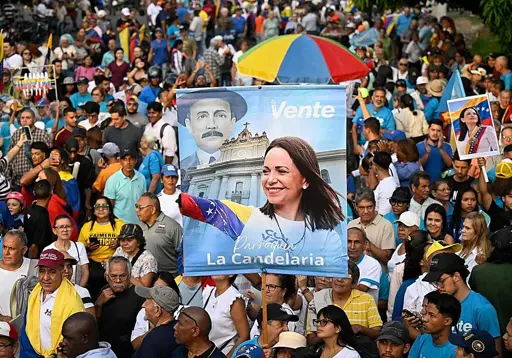
Caracas (OrinocoTribune.com)—On Thursday, October 22, the opposition rally called by María Corina Machado’s Vente Venezuela party drew a small crowd in Caracas and Maracaibo. Meanwhile, thousands of women marched through the capital for health and peace.
Telesur described the turnout as scant and said the mobilization showed the opposition’s diminished popularity even among its supporters. Its report also cited a social media post by SonPolemicas criticizing the small crowds at both far-right opposition mobilizations.
The opposition rally also became the setting for an attack on journalist Reynaldo Mozo. The National Union of Press Workers (SNTP), a heavily far-right opposition-leaning organization, said Richard Blanco Bencomo accused the Efecto Cocuyo reporter of being an ‘infiltrator’ and prompted people to aggressively remove him from a platform. Far-right NGOs reported that Mozo showed his press credential, but it was dismissed. He later reported being threatened by people associated with the Vente Venezuela security team.
Caracas y Maracaibo, las dos ciudades mas pobladas de Venezuela y esta fué la raquítica convocatoria que tuvo en ambos lugares, el llamado de María Corina Machado a las calles, para “derrocar al Chavismo”.
Fracasaron otra vez, realidad 👇 pic.twitter.com/AajEoUBcaJ— SonPolemicas (@SonPolemicas) October 23, 2026
A small opposition turnout
Vente Venezuela had called people into the streets to demand an electoral timetable and a date for presidential elections. However, the gatherings remained small. Machado described the mobilizations as “a marvel” in a social media post, while images and reporting from the two main demonstrations showed limited attendance. Her characterization did not match the turnout visible at the rallies.
The turnout was especially apparent in Caracas, where the opposition rally took place on the same day as a much larger Chavista women’s march. Con el Mazo Dando reported that thousands of women marched from Plaza Venezuela to Santa Capilla. The contrast was visible in the turnout of the two events: a limited opposition gathering alongside a mass mobilization led by women’s organizations and PSUV supporters.
Women march for health and peace
The march called by the United Socialist Party of Venezuela (PSUV) focused on breast cancer prevention, women’s health, and peace. Party Secretary General Diosdado Cabello said the march recognized women’s daily struggles and their role in popular organizing. He linked their leadership to the October 18 popular consultation, noting that women lead most communes and attributing their participation to the high turnout in that process.
Cabello also said the PSUV’s women’s secretariat works alongside the Bolivarian Revolution’s policies—leading, motivating, marching, and making decisions with women, rather than limiting its role to expressing support. He described women as having been “always at the forefront” and argued that their leadership strengthens collective political work.
Reporter targeted at opposition rally
Reynaldo Mozo, an Efecto Cocuyo reporter, was covering the opposition gathering near Plaza Venezuela when Blanco Bencomo, son of Richard Blanco Cabrera, a high-ranking opposition politician from Alianza Bravo Pueblo (ABP), accused him of being an ‘infiltrator’ and told him he should be covering the other march, as reported by local NGOs.
According to Espacio Público’s report based on Mozo’s account, the reporter showed his press credential and was told that anyone could have one. Vente Venezuela security personnel later shouted at him to leave the platform, and others joined the hostility. Mozo said he was the only journalist removed from the platform.
In remarks from the National Assembly, Deputy Pedro Infante warned that publicly labeling a journalist an ‘infiltrator’ in front of a crowd can put that person at risk of collective violence. He called for the practice to stop and urged political actors to defend dialogue and the press’s ability to cover public events.
Richard Blanco Bencomo later apologized publicly, describing the incident as a “confusion,” according to Espacio Público’s report. The apology followed the accusation and removal of a reporter who had identified himself as a journalist.
The incident carries a political context: Orinoco Tribune has documented attacks on Chavistas and people perceived as Chavista, including the 2017 killing of Orlando Figuera after he was accused of being Chavista, along with threats and incitement directed at Chavista supporters.
Rendón criticizes Machado’s approach
The turnout came amid public disagreement within the opposition over Machado’s strategy. In an October 19 interview, political consultant Juan José Rendón said Machado had months to build an alliance after January but had failed to consolidate one. He criticized her opposition to investments and the negotiating process, saying her effort to exert pressure had failed when Dinorah Figuera was selected by the White House to lead the opposition delegation.
Rendón argued that Machado should work with Figuera rather than undermine her. He also said rushing into elections before rebuilding institutions could leave any winner unable to govern. His comments expose a dispute within the opposition over whether to press for elections immediately or first negotiate institutional changes and political arrangements.
A relationship shaped by US imperialism
The US-Venezuela relationship now combines political confrontation, negotiations, and economic cooperation under the weight of direct military aggression. This situation followed the US bombing of Venezuela on January 3 to kidnap President Nicolás Maduro, killing over 100 people, including 32 Cuban and 47 Venezuelan soldiers.
The relationship has drawn criticism from opposing political camps. Far-left and liberal critics question whether Chavismo can survive making concessions for too long and handling US pressure without abandoning its socialist and anti-imperialist project. From the far right, Machado and other hard-line opposition voices criticize Washington’s willingness to work with Caracas and its failure to put her in charge of the transition.
The result is a sui generis relationship: Washington is negotiating with Venezuela’s Chavista leadership while maintaining the consequences of an intervention that kidnapped the country’s president and killed over 100 people. That contradiction shapes the talks, oil arrangements, and political criticism surrounding both governments.
Special for Orinoco Tribune by staff
OT/JRE/SF
From Orinoco Tribune via This RSS Feed.