

The October 16, 2026, episode of CounterSpin included archival interviews with Slate reporter Dahlia Lithwick (5/9/14) and Intercept reporter Liliana Segura (12/4/20) on the death penalty. This is a lightly edited transcript.
Janine Jackson: Christa Pike didn’t die, but her execution wasn’t the first indication of the messy horrors of this clinical state action. We spoke with journalist Dahlia Lithwick about a different case in 2014.
***
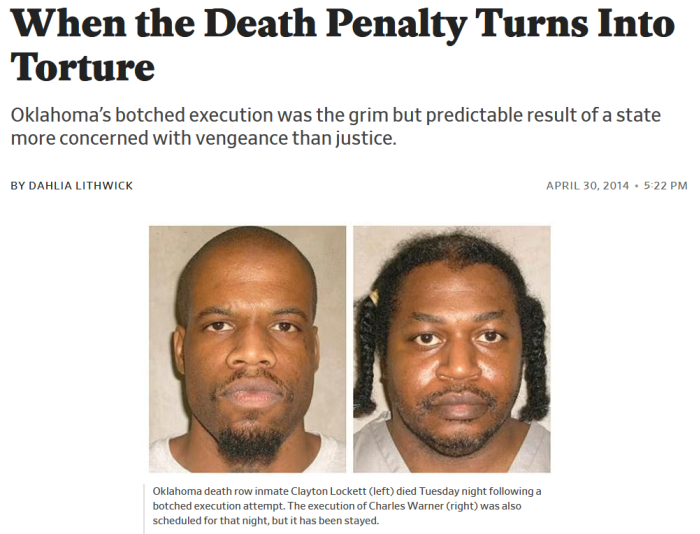
Slate (4/30/14)
JJ: Clayton Lockett, an Oklahoma man convicted of murder, was administered a mix of drugs meant to anesthetize and kill him on April 29, but he didn’t die immediately. He writhed and spoke and a curtain was pulled to hide the sight of his drawn out death from most observers.
Some suggest that while the story is nightmarish, a focus on particulars of how the state goes about killing people implies an unacceptable concession that killing is something the state has a right to do. That’s one debate, but there’s more to the case of Clayton Lockett than the state doing slowly what it intended to do quickly. And what went on before April 29 is as important as the events of that day.
Dahlia Lithwick writes about courts and the law for Slate. She joins us now by phone from Virginia. Welcome back to CounterSpin, Dahlia Lithwick.
Dahlia Lithwick: Thank you so much for having me.
JJ: Some people may say, while it’s not to be wished for, it’s not a bad thing to disabuse people of the idea that execution can ever be clinical or tidy or painless. But the death penalty is the law in Oklahoma as elsewhere. And in most places, the clinical-sounding lethal injection is how it’s done. What has been changing in the lethal injection field, if you will, that’s meaningful here?
Dahlia Lithwick: “We used to hang people in the town square. It used to be that it wasn’t meant to be clinical. It was meant to be a gruesome public spectacle.”
DL: I think you nailed exactly the paradox, which is we used to hang people in the town square. It used to be that it wasn’t meant to be clinical. It was meant to be a gruesome public spectacle. I think in a deep way, when we went from executing people at noon to executing people at midnight, I think that’s quite symbolic of all the ways that we’ve tried to make it look like it’s really just a medical procedure, but we have a couple of problems.
One is a lot of these procedures preclude doctors and other medical professionals from being involved, because the Hippocratic oath doesn’t allow doctors and people who promise to save lives and protect lives to be involved. So frequently, you have these lethal injection protocols administered by correction officers, not doctors. So that’s one piece of the problem. You’re doing what looks like an operation, but it’s not necessarily being done by physicians.
But the much more profound problem has been that since 2011, the states who use the three drug so-called cocktail, lethal injection cocktail, have been unable to get some of their drugs. First of all, American manufacturers stopped making them. And then, much more urgently for the states, European manufacturers really said, “We’re not going to supply these drugs to you if they’re going to be used to kill people.” So quite literally the supply dried up, and after 2011, a lot of the states that still have capital punishment turned to a whole bunch of other ways and tactics to get these drugs. And that has proven extremely problematic.
JJ: And as a result of how problematic it has been, there’s been a veil of secrecy drawn around just how and where those drugs come from.
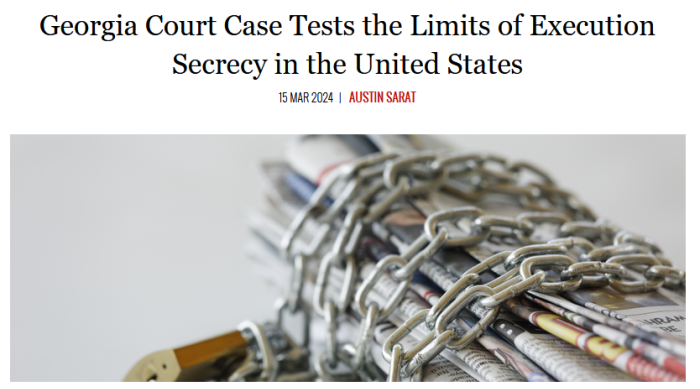
DL: Well, that’s almost the most important part of the story. One gets caught up in the Clayton Lockett piece of it, and how awful it was. But the truth is that several states–Georgia, Louisiana, Missouri, Oklahoma, Tennessee and Texas–have quite literally dropped a veil of almost perfect secrecy over their lethal injection protocols.
Verdict (3/15/24)
In fact, the court in Georgia will even protect their protocols from the judicial branch. They won’t even let the judges scrutinize it.
And so what you have is, overwhelmingly, where they go are these lightly regulated laboratories that are called compounding pharmacies. Batches differ from one to another. The pharmacies are often unregulated or underregulated. So the lawyers for folks who are about to be subject to lethal injection, not entirely unreasonably, say, “Where are these drugs coming from? What are you using? You’re using new combinations of new drugs that we’ve never heard of.”
They’ve often never been tried. The protocol that was tried on Clayton Lockett had never been attempted in Oklahoma.
And so what the lawyers are saying is, “Look, certainly lethal injection and capital punishment are the law,” as you said, but it’s also the law that the Eighth Amendment prohibits cruel and unusual punishment. And when you’re in effect experimenting on people on the night of their execution, that can’t be right. And what happened in Oklahoma really bore that out.
***
JJ: While it’s understandable, there’s something weird about the concerns that the state is “getting executions wrong.” We discussed the bigger picture with reporter Liliana Segura in 2020.
***
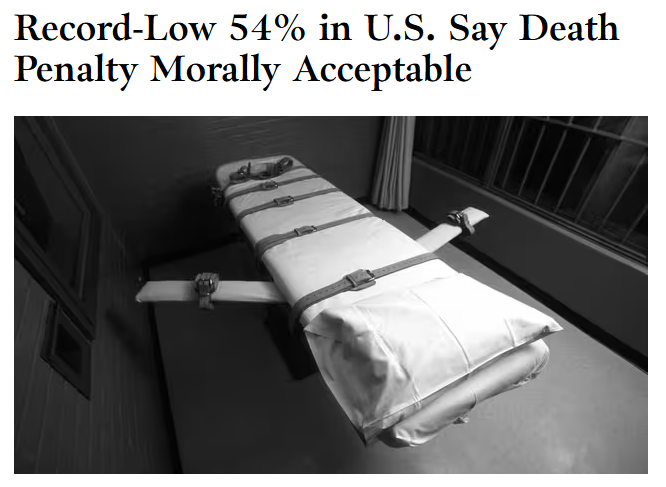
Gallup (6/23/20)
JJ: As with a lot of things, it feels like we’re moving in two different directions. More people, if still not a majority, say the death penalty is morally unacceptable. The data has sunk in that its application, anyway, is unfair and racist, and not a deterrent to crime.
But then, when individual cases come up, it becomes a different category of story, if you will, and statistics matter less than “What if it were your sister?” You’ve been doing, as I say, this reporting since before Donald Trump and Bill Barr. I just wonder how you’ve approached the terrain of this issue, and what you’re making of the present moment?
Liliana Segura: It’s been a very surreal time to be covering these executions. As you highlighted, I’ve written about the death penalty a lot, for many, many years. And actually, one of the bizarre aspects of my work in recent years has been that since I moved to Nashville, about five years ago, the state of Tennessee has actually carried out a large number of executions. And the last several of those were carried out using the electric chair. Although I haven’t witnessed those executions, a number of my local friends and colleagues in the media have.

Liliana Segura: “I don’t think Americans quite realize just how much we’ve tolerated a system that continues to use things like the electric chair.”
Outside of our local bubble, and I think more broadly, I don’t think Americans quite realize just how much we’ve tolerated a system that continues to use things like the electric chair, which, when it was announced that the Trump administration was looking to bring back the electric chair and firing squads, it really generated a fair amount of revulsion among a lot of people who seemed unaware, or maybe haven’t thought about these issues in a long time.
So I think we run the risk a little bit of putting these federal executions in the context of this horrifying, violent Trump era, which has broken so many norms that we’re accustomed to. And yet, when you look at different states, when you look at what’s been happening in Tennessee, we’ve been pretty violent in the past several years, and tolerating quite a bit as Americans when it comes to these more mundane executions, from day to day and year to year.
So part of my project, when William Barr announced that they were looking to restart federal executions after more than 15 years, my task was to remind myself of the history that underpins this federal system. We hadn’t seen a federal execution since 2003.
So the first piece that I wrote was actually going back and reexamining how we got here. And so much of that story really is about the Democrats, frankly, and is about the era of the 1994 crime bill, and the vast expansion of federal prosecutions, federal death sentences, as a result of that crime bill.
JJ: The death penalty has a finality, an irreversibility, that for many people set it apart. But we should be wary, shouldn’t we, of imagining that an equally certain but slower death in solitary confinement without possibility of parole is somehow a feel-good alternative. We can’t just have a piece of this conversation about the continuum of cruelty that’s reflected in our criminal system.
And I know your concerns are expansive in that way; it’s important to contextualize the death penalty. It’s not like it’s the one bad thing the system does.
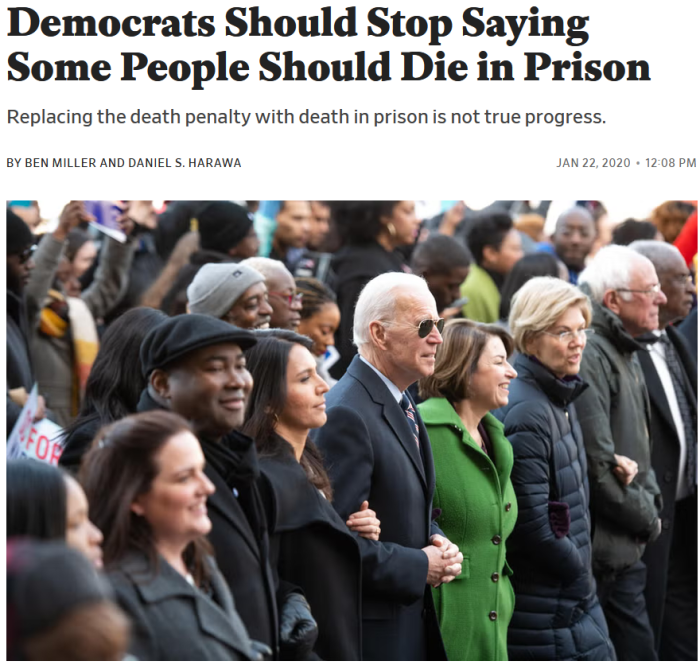
Slate (1/22/20)
LS: Yeah, that’s exactly right, and thank you for bringing that up. That’s something that, fortunately, I think, we’ve started to see a little bit of change in the broader landscape around the way people see what I call “permanent sentencing.”
I was struck, during the primaries, when everything was so heated, that Elizabeth Warren, I believe, got into a little bit of trouble at one point where she kind of said—and I don’t remember the precise context—but essentially, gave support for the idea that life without parole is an appropriate sentence, I believe, as an alternative to the death penalty.
And at least on Twitter and social media, a lot of people jumped all over this comment, to say that this was almost as bad, it’s a form of torture, that we shouldn’t support life without parole. And I gotta say, as somebody who’s been covering life without parole and the death penalty for years and years, that is different. It was not people’s knee-jerk response to the notion that “LWOP,” as we call it, is an appropriate alternative.
The anti–death penalty movement for many years has pushed life without parole—in my mind, erroneously—as the default, acceptable alternative to state-sanctioned murder. And those issues have generated a fair amount of debate and tension. But I think that the broader culture, at least in the context of the primaries, has kind of come around on questioning that as well, and I think solitary confinement and that form of torture is a big part of that.
From FAIR via This RSS Feed.