

Before proceeding, let’s just get one thing straight: this is not another premature autopsy of the Zohran Mamdani administration. In February, just one month after his inauguration, the Wall Street Journal was already crowing that his honeymoon was over because of his supposedly controversial pied a terre tax and his criticism of Israel and the genocide in Gaza. But of course, the Wall Street Journal is nothing but a pack of reactionary liars. Increasing taxes on the rich is widely popular among huge swaths of New Yorkers, and, thanks in large part to the movement for Palestine, Israel is more reviled than ever. In fact, Mamdani still remains popular across the city precisely because he continues to espouse these positions.
However, a growing sector on the Left, including many of those who helped bring Mamdani to power and many in the Democratic Socialists of America (DSA), is increasingly fed up with the mayor for a whole host of other very legitimate reasons. These include backroom deals with establishment democrats like Kathy Hochul and Hakeem Jeffries, public appearances with President Trump, New York City’s new anti-semtism bill, his deployment of the NYPD against protesters, and his continued refusal to get rid of Police Commissioner Jessica Tisch or to disband the NYPD’s hated Strategic Response Group (SRG).
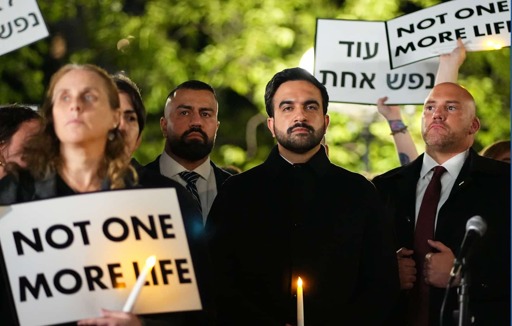
These criticisms became even more pronounced earlier this month when Mamdani’s NYPD was deployed to protect and aid ICE agents who had shot a Bronx man with his five year old son in the car. In the press conference after the shooting, Mamdani stood by, without a word of criticism, as Commissioner Tisch rattled off a list of the victim’s previous convictions, as if that justified ICE’s use of force. That shooting came just days after the mayor had been met with jeers by hundreds of demonstrators who called him a “traitor” and a “sell-out” for attending an October 7 memorial service and for allowing the NYPD to arrest pro-Palestinian activists who protested Benjamin Netanyahu’s appearance at the United Nations. Despite all of his bravado that Netanyahu should be arrested, Mamdani neither attended nor encouraged others to attend those protests.
Mamdani’s critics — including those from the pro-Palestine movement, the YDSA, and several DSA caucuses — have a point. By seeking to win favor with the powers that be, the mayor has betrayed many of the principles that brought him to office. And those backroom deals failed to produce a first budget able to deliver any meaningful relief to New Yorkers. So, with little to show but compromise and cooptation, it is unsurprising that Mamdani’s critics on the Left and many of his former supporters are becoming more vocal.
It’s Not About Mamdani
But there is a fundamental problem with such criticism. It is largely focused on Mamdani as an individual representative and grounded in the assumption that criticizing the mayor is an effective way to move him to the left. Unfortunately the anger being directed at Mamdani from outside the DSA, though justified, is coming from a small vanguard that still lacks the ability to lead the forces necessary to impose an agenda on the city and the state. Meanwhile, most of the criticisms of Mamdani coming from within the DSA offer no horizon beyond the Mayor’s and the DSA leadership’s own limited agenda of legislative reforms. For many of his critics, especially those in the DSA, the only demands being put forward are for the mayor to reverse course and take action — action to end the SRG, to fire Jessica Tisch, to protect pro-Palestine protesters, etc. This is understandable, and it would be good if Mamdani did these things, but the old canard that we can get politicians to deliver by holding their feet to the fire is just not true.
Mamdani has betrayed his principles, yes, but not because of any individual political or moral failing. His politics are not a reflection of his personal beliefs but of the limited strategy of municipal socialism that both he and the leadership of the DSA have been advocating since before he was elected. Therefore, making demands on the mayor will not magically bring about a change of policy. Such demands only work when there is real power behind them — such as the massive demonstrations and strikes taking place in France right now — and unfortunately the strategy that the DSA leadership is pursuing with Mamdani is not building that power.
In fact, it is doing the opposite. Rather than acting as a catalyst for revolutionary self-organization, the DSA’s electoral strategy of working within the confines of the Democratic Party and the logic of the capitalist state — the same strategy that it pursued for decades under the direction of Michael Harrington — separates the working class from the source of its true power: it’s independence from the capitalist class and its parties. By treating working people as a mere mass of maneuver to be deployed every two or four years to elect Democrats, and by presenting the state as a space for the reconciliation of class conflict rather than an apparatus of class rule, it risks misleading an entire generation into the dead end of endless reformism.
As author and frequent Jacobin contributor Peter Frase correctly points out, there is a fundamental contradiction between Mayor Mamdani’s position as an executive of the capitalist state and the socialist demands of his base and the DSA.
That is, a contradiction in the properly dialectical Marxist sense: an antagonism that cannot be resolved without overcoming the larger system that gives rise to it, such as that between capital and labor. In this case, the contradiction is between Mamdani as a product of the Democratic Socialists of America (DSA), an organization at least nominally aiming to overturn the capitalist mode of production, and Mamdani as a politician attempting to operate the machinery of the capitalist state apparatus.
This is precisely why appeals to Mamdani as an individual miss the mark. Having chosen to stand inside, rather than in opposition to, the capitalist state, he has resigned himself to working within the constraints of the political system he represents.
For Frase, this contradiction is just a fact of life that the DSA has to navigate while maintaining what he calls a position of “revolutionary honesty.” That’s a sexy way of saying “sticking to the program.” Ironically, such revolutionary honesty, according to Frase, does not apply to Mamdani, whom he concedes must, by virtue of the contradictions of executive rule, tactically remain silent on the more ambitious parts of the DSA’s program. That Frase can so clearly see the problem, but is unable to offer any real solutions other than rhetoric, reveals the ways in which reformism limits the horizons of even its most critical supporters. Rather than attempting to manage such contradictions, we need a strategy that can resolve them.
It’s About Strategy
If Mamdani’s critics and the leadership of the DSA are serious about actually building the power of the working class and oppressed to win their demands, their criticisms must extend beyond the mayor as an individual leader and wrestle with the problems inherent in the strategy that brought him to power.
Towards this end, we have two tasks before us.
Rather than driving working people back into the Democratic Party, we must prioritize independent self-organization in our communities and workplaces against capitalist exploitation and oppression. In New York City, that concretely means organizing for community and workplace assemblies to discuss and debate how to build the power needed to win our demands and to put forward a program that extends well beyond Mamdani’s proposed reforms. At a time when our immigrant, Black, and LGBTQ+ neighbors are being attacked by the federal government, it also means building and growing existing emergency response networks like those that helped to drive ICE out of Minneapolis. But it also means building rank and file organization to force our unions to use our resources to take action to fight for our demands and to protect our most vulnerable neighbors.
One example of such a process is currently unfolding in Europe, where young people, union members, and their allies, are rising up against centrist and reformist leaders like Emmanuel Macron, Pedro Sánchez, and Edi Rama. In France and Spain, protesters are building public assemblies to plan further demonstrations and have forced their unions to call for general strikes against their respective governments. In Argentina, too, thousands of people are organizing public assemblies to fight back against Milei’s austerity policies.
But such self-organization is weak without a leadership capable of growing, directing, and concentrating the force and power of the working class and oppressed toward the goal of overthrowing the exploiting class and the state. This is why working people need a political party of their own, completely independent of the Democrats. But not just any old third party. We need a party of class struggle that challenges the state both inside and outside of the halls of government. One that is led by representatives who earn wages no greater than a school teacher’s and who are accountable and directly recallable by the rank and file.
In Argentina, where a right-wing reactionary government aligned with Trump is attacking the working class, the PTS, one of the sister organizations of Left Voice, has used its representatives to raise the banner of revolutionary socialism inside the parliament as well as on the streets. Socialist revolutionary and PTS member, Myriam Bregman, is now the most popular politician in Argentina and is regularly bringing the ideas of socialism to millions of people, many of whom are organizing and fighting alongside her and the PTS, which is helping to build hundreds of assemblies across the country.
Doing the same in the United States will be difficult for sure, but without self-organization and an independent revolutionary leadership, it will be impossible.
Because Mayor Mamdani’s power is so limited, and because he has chosen to accept those limitations without a fight, his term is likely to end in disappointment for the millions of working people who voted for him. As we saw in Greece, Argentina, and Brazil, the failures of reformism can fuel the growth of reactionary projects and usher in right-wing governments. If Mamdani fails, his supporters may turn to the right or just learn to expect less. But there are many others who will draw the conclusion that the Left needs a strategy that goes beyond reformism and municipal socialism. So long as the DSA leadership stands in the way of that alternative path, it will sow the seeds of pessimism and fill the ranks of the reactionary Right.
The post Mamdani’s Honeymoon is Coming to an End for Many on the Left appeared first on Left Voice.
From Left Voice via This RSS Feed.