

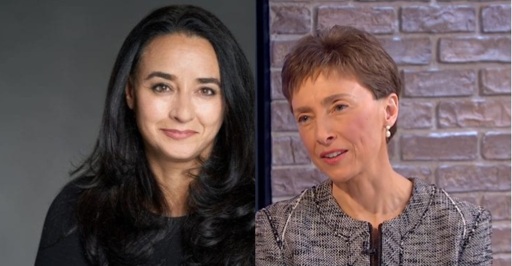
The October 16, 2026, episode of CounterSpin included archival interviews on domestic violence with Soraya Chemaly from the Women’s Media Center Speech Project (6/17/16) and**Jane Manning from Women’s Equal Justice (10/1/21). This is a lightly edited transcript.
https://media.blubrry.com/counterspin/content.blubrry.com/counterspin/CounterSpin261016Domestic.mp3
Janine Jackson: Three women in the US are killed every day by their current or former boyfriends or husbands. Once every five days, a man kills multiple family members. The man who killed 49 people and wounded 58 others at the queer nightclub Pulse in Florida in 2016 had a record of domestic violence. But for much of news media, that was an unrelated story. We spoke with Soraya Chemaly about the problems there.
***
JJ: I’ll start where your article starts: I was not, in fact, surprised to learn that the killer in Orlando had a record of domestic violence. Why wasn’t I?
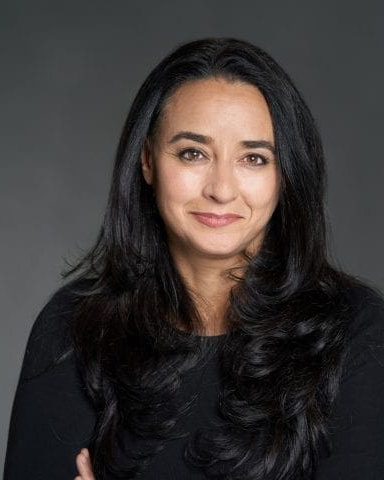
Soraya Chemaly: “It’s violence in homes, and tolerance, societal tolerance, for violence in homes, that is the necessary precursor to all of this public violence.”
Soraya Chemaly: I think time and time again we’ve seen examples, and we could go through a list: Sandy Hook, the Sydney shootings—I’d forgotten about that, but that had started in domestic violence—the Colorado abortion clinic attack. And so, when you see it happen, and it’s such a distinct pattern in the course of the violence, you sort of wait for the other shoe to drop.
And I think what happens is that most people, who maybe aren’t attuned to this particular dimension, will see items in the news that are fairly poorly framed, are given headlines that don’t really address perpetration, but instead identify victims. It’s hard to then understand the wider context for this idea that it’s violence in homes, and tolerance, societal tolerance, for violence in homes, that is the necessary precursor to all of this public violence.
JJ: Connecting dots between coercive and abusive behavior, some of which is considered “normal,” and lethal violence doesn’t mean saying every domestic abuser is a mass murderer in the making. But it’s a value in seeing these echoes, right, in terms of telling us all of the points that we need to engage?
SC: That’s right. I think a lot of people hear 57% of mass killings start in acts of intimate partner violence or family violence, whether it’s sons killing parents and siblings, or fathers killing entire families, or ex-spouses attacking intimates. They leap from that to hearing, instead, all domestic abusers are going to be mass killers, which is obviously just a breakdown in logic.
But I think that as a society, we’re trying to figure out why this is happening, how can we prevent it from happening. And very clearly, one thing we have to do, otherwise I really do believe efforts will fail—even though, clearly, better gun control would reduce the number of gun deaths we have—but clearly one of the things we have to do is really take a step back, introspectively, and look at how tolerant we are of violence in homes. Very hands off about it, still.
JJ: Right. And of course you don’t want to be framing it as, let’s pay attention to men who commit domestic violence, because they might go on to do something else.
SC: No. That’s right.
JJ: The point is what they’re doing now.
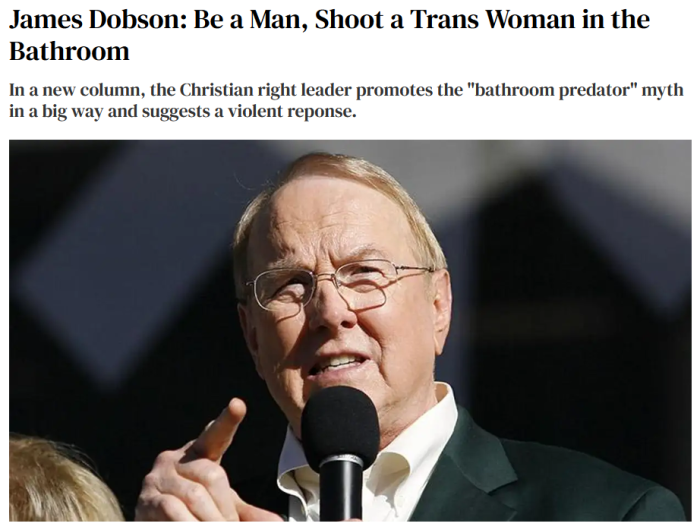
Advocate (6/1/16)
Well, some people—not enough, maybe, but some—noted that a week before the killings, conservative Christian leader James Dobson had suggested that men take up arms to defend their wives from trans people in bathrooms. He said:
If you are a married man with any gumption, surely you will defend your wife’s privacy and security…. If this had happened a hundred years ago, someone might have been shot. Where is today’s manhood?
Well, there’s a line between that and killing queer people in a club, and it doesn’t pass through Islam.
SC: Right.
JJ: At the same time, Dobson said, Barack Obama is “a tyrant, he is determined to change the way males and females relate to one another.” And I think that gets at something that you wrote about as well.
SC: What we’re looking at here is this clash of some very, very fundamental beliefs about gender roles and gender identity. And there simply are people who, for whatever reasons—psychological, emotional, financial—they really believe in binary gender roles, rigid gender roles; and changes in the culture that destabilize that belief are highly threatening.
So that’s why public bathrooms are such a flashpoint. The point is that women and children are much, much, much, much, much more vulnerable in their own homes, and in places of worship, to sexual assault, than anybody is in a public bathroom. I mean, that’s just clear, factually, on the basis of what we know. So the public bathroom flashpoint is more symbolic of the fear that people have about those cultural changes.
And so there ends up being, for lack of a better way of putting it, a kind of hermeneutic void in public understanding, because we are so silent, so shamed by what is happening in homes, that we cannot construct the language or the public policy to make sense of it, and to then prevent it.
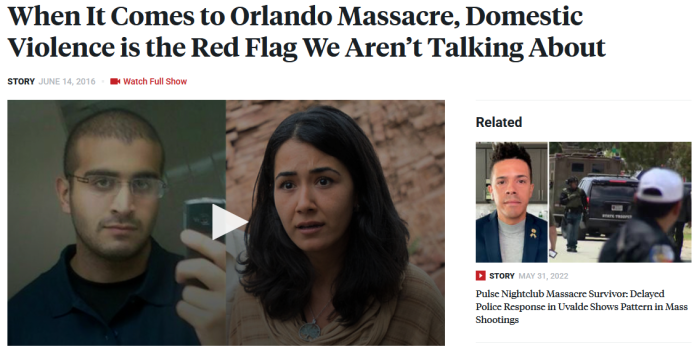
Democracy Now! (6/14/16)
JJ: And with that is an inability to collect data, I heard you say on Democracy Now!, to collect the kind of data that would make it a coherent issue, so we could see the scope of—
SC: Absolutely.
JJ: Right. Well, I remember in 2014, a man came to New York City and killed two police officers, and the media were like, basically, oh, right, and before that he shot his girlfriend. It was very clearly segregated, it was not of a piece in the story.
SC: No. It’s like incidental. “Oh, by the way….”
JJ: You know, it was like what happened before he was violent.
SC: Yes.
JJ: Stopping doing that would be good. Stopping saying that people had “no history of violence,” when they have records of domestic violence. What else would you ask for from media in terms of this issue?
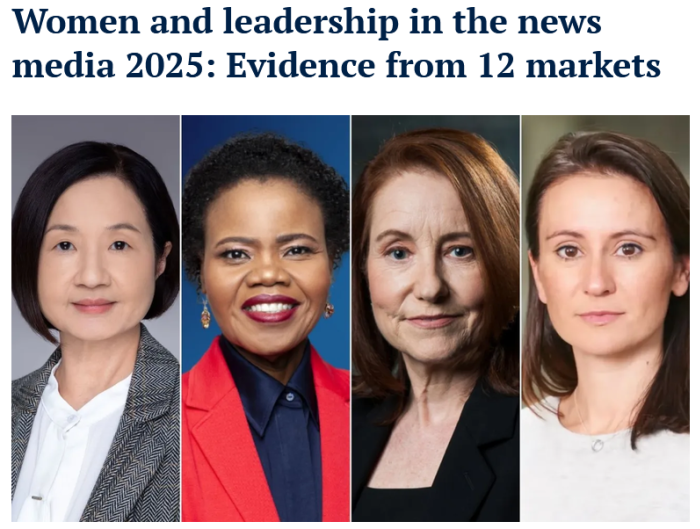
Reuters Institute (3/6/25)
SC: Well, I’d like media to diversify its own management. Because as long as we have distinctly not-diverse management and ownership of media, we will continue to have these epistemologically skewed understandings of the world. We’re not asking the right questions, so we cannot end up with the right headlines or the right counter-narrative.
And that connection is, I think, also fairly elusive. I mean, it’s hard for media to critique itself, right? The reason that we don’t have a good understanding of domestic violence and sexual violence, and the role that those play in persistent misogyny and racism, is, frankly, because we don’t have a very diverse media. And so people tell stories that tend to reflect their own experiences, or that they understand, and as a result of that, you just don’t see these stories in dynamic profusion.
JJ: Right. And you sometimes wonder why some stories do rise to the surface. The Stanford rapist, for example: You feel grateful for the opportunity to shine a light on certain things, but part of you says, you know this happens every day, right?
SC: Right.
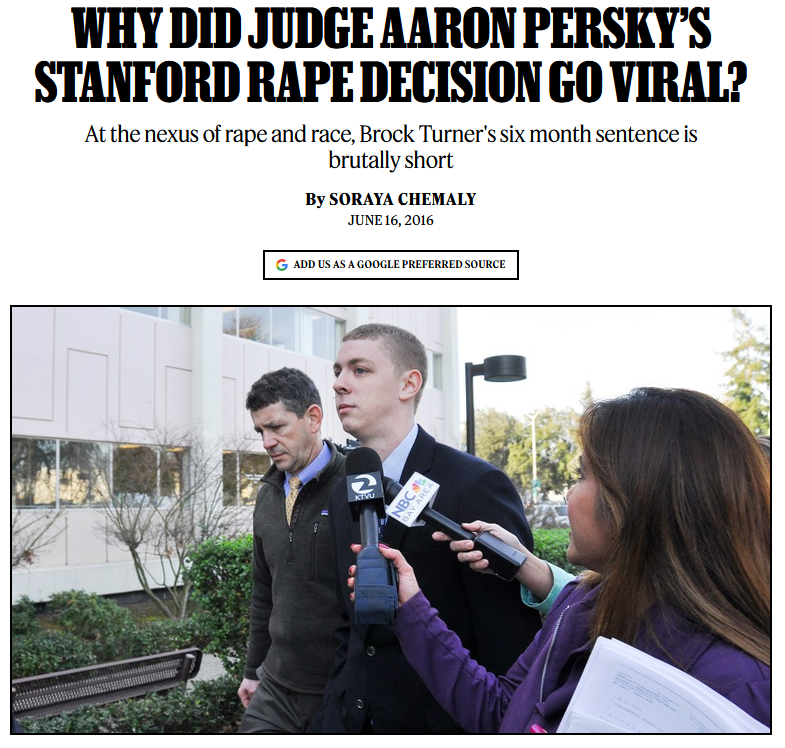
Rolling Stone (6/16/16)
JJ: But for media, it’s almost as though the everydayness of a problem means it gets less attention.
SC: It’s interesting. I actually just this morning published a piece about why the Stanford story became viral.
JJ: Uh-huh.
SC: What was that? Because it is something that happens absolutely every day, and there are some other really horrific stories that are extremely similar, like the Vanderbilt gang rape case last year, that didn’t raise any public alarms.
And what I think is interesting about the Stanford case is that it brought together the Title IX movement and Black Lives Matter in a very graphic way. Brock Turner’s face really became a graphic symbol of those two issues coming together in their mutual critique of fraternal white male supremacy. And it just happened to be at this moment of time that those two forms of entitlement, which are often exercised in rape, came together.
JJ: And people were able to see it for the opportunity to look at those issues and to not look away, I think, which was what was so gratifying. And maybe it was social media much more so than media media.
SC: Oh, I believe that to be the case. Because what you saw was mass social media movement, right? There were petitions. The judge was just removed from a case yesterday that involved an unconscious woman and a male nurse. There’s no doubt to me that the grassroots activism of both of those movements was largely enabled because of the power of this media; [that] is what is creating these challenges.
***
JJ: In 2021, media were talking about Larry Nassar, the Olympics gymnast team doctor who sexually abused numerous young women after being reported, and Gabby Petito, the young woman who was murdered by her fiance, who had already been reported abusing her. We spoke with Jane Manning of the Women’s Equal Justice project about domestic violence and criminal justice.
***
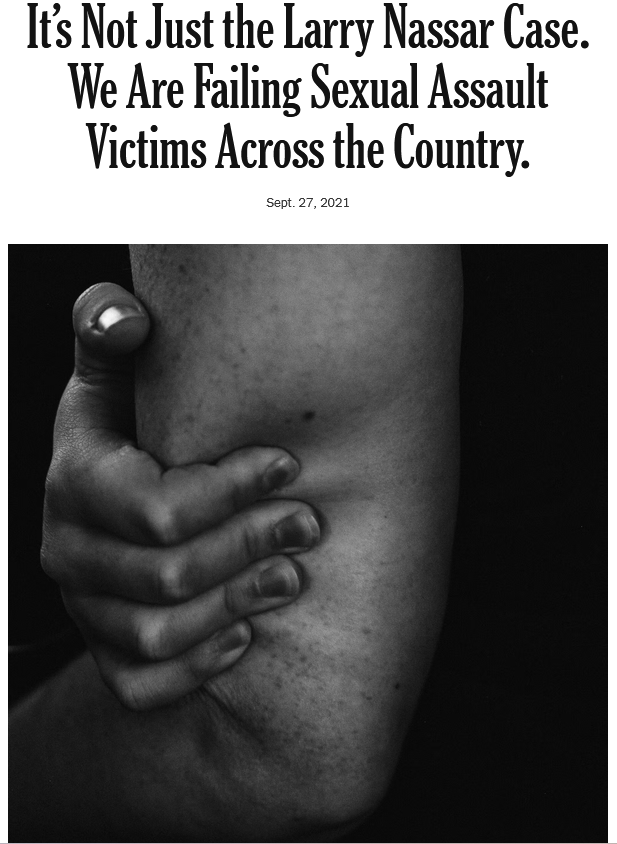
New York Times (9/27/21)
JJ: The Larry Nassar case, which you wrote about for the September 27 New York Times, seems emblematic, in that people might think the agency “dragged their feet,” or “didn’t do all they might have.” But it’s not just negligence. And then, also, a decision not to do something is an action, is a choice—and one that seems to get made again and again.
Jane Manning: You’re so right about that. I love the way you just put that, Janine, that the decision not to do anything is a choice. That’s right.
I mean, we live in a legal regime, right? The state has what’s called a monopoly of force, so if you’re raped or battered, you’re not allowed to take a gun and go settle the score for yourself, right? We look to the justice system to provide accountability and justice for survivors, and also to provide protection to the rest of society from future violent offenses.
And so when the justice system refuses to act in cases of gender-based violence—sexual assault, domestic violence, stalking, human trafficking—they are effectively depriving women and other groups that are targeted for gender-based violence, LGBTQ survivors and other marginalized groups, they are effectively depriving us of safety and of the equal protection of the law.
JJ: The fact that mishandling of assault cases and gender-based crime cases so often pairs with mistreatment or demeaning treatment of survivors, that just highlights the depth of the problem in the system.
JM: That’s exactly right. One of the survivors who came to me for help told me that when she went in to be interviewed by a detective after she was raped, the detective’s first question to her was, “How often have you cheated on your husband?”

Jane Manning: “When the justice system refuses to act in cases of gender-based violence…they are effectively depriving us of safety and of the equal protection of the law.”
JJ: Oh my God.
JM: Another survivor said to me that her detective said to her, “Are you really sure you want this guy arrested? Who knows, you could end up dating this guy.” And the survivor said to me, “When I heard him say that, I asked myself, how can I possibly get an unbiased investigation from this detective?” And she was right. The detective went on to do a very shoddy, minimal investigation of her case, and then closed it down while there were a lot of investigative leads still unpursued.
So it’s both of these issues. It’s the demeaning treatment, but it’s also the failure to investigate, the failure to prosecute, the failure to take action. And both of those things really impact survivors.
JJ: Another part of the Gabby Petito media phenomenon was folks calling out the relative inattention given to disappearances and even killings of Black and brown women, Native American women. In your piece for the Washington Post back in May, you noted how racism and sexism are intertwined here. I wonder if you could talk a little bit about what those intersections can mean, can look like, in terms of criminal justice and sexual assault.
JM: That’s exactly right. This kind of law enforcement inattention to gender-based violence cuts across various intersecting forms of inequality. So when police agencies refuse to investigate gender-based violence, sexual assault for example, that has a disproportionate impact on all women. It has a disproportionate impact on all LGBTQ communities.
But it has a particular impact for the most marginalized women, the most marginalized survivors. So women and girls and survivors in communities of color, in communities that are facing poverty, in Native and Indigenous communities, disabled survivors, all of these groups that face more than one form of social oppression. So gender and race, or gender and disability. Or survivor status and poverty. These intersecting forms of oppression often combine to make it even harder for a survivor to receive justice, or even to feel like that survivor can go to the system and report in the first place.
From FAIR via This RSS Feed.
What a doomed framing to headline the discussion with.
‘We Have to Step Back and Look at How Tolerant We Are of Violence in Homes’
Sort of, set up for failure. Why not just: We need to stop tolerating violence in the home. Or we need to not tolerate violence in the home.
… it’s not really a question of “Well, how much?” as the title puts forth.
Initial framing can be pretty important to how people think about an issue:
https://en.wikipedia.org/wiki/Anchoring_effect
https://en.wikipedia.org/wiki/Conservatism_(belief_revision)
https://en.wikipedia.org/wiki/Ballot_order_effect