

The Superior Electoral Court enforces free public transport mandates and monitors vote access nationwide.
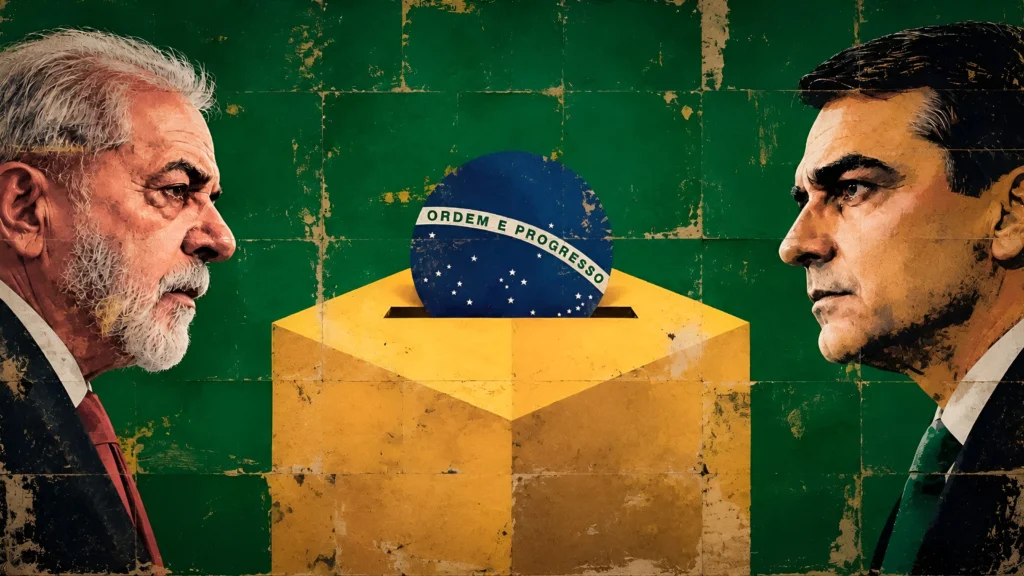
The Brazilian presidential campaign has entered its final stage ahead of the runoff vote scheduled for October 25, 2026. Incumbent President Luiz Inácio Lula da Silva faces Senator Flávio Bolsonaro, a candidate for the Liberal Party (PL), after a competitive first-round election on October 4, 2026.
RELATED:
Lula Proposes Constitutional Amendment for Free Weekend Transit in Brazil
The general election results established a narrow margin between the top two candidates. In the first round of voting, Senator Flávio Bolsonaro finished first, securing 47.03 percent of valid votes, or 56,103,033 ballots. Incumbent President Lula da Silva finished second, receiving 45.16 percent, or 53,870,724 ballots.
Turnout remained consistent with historical participation figures, reaching approximately 79 percent of registered voters. Lula maintained a structural lead throughout the Northeast region, winning majorities in key states such as Bahia, Pernambuco, and Ceará.
Economic indicators and social policy debates formed the primary foundation for candidate speeches throughout the first round. In campaign speeches, President Lula highlighted the accomplishments of his current administration, citing expanding employment rates, social assistance programs, and inflation control measures implemented since 2023.
Flávio Bolsonaro focused his campaign speeches on public security concerns, national debt levels, and economic challenges, presenting his platform as a continuation of conservative governance under his father, former President Jair Bolsonaro, who remains legally barred from holding office.
Street Mobilization and Electoral Propaganda Networks
Campaign operations shifted toward intensive physical rallies and structured broadcast messaging during the runoff period. The Workers’ Party (PT) and its broader political coalition centered their ground mobilization around major urban centers and traditional working-class strongholds.
Popular social movements, including the Landless Workers Movement (MST) and the Homeless Workers Movement (MTST), along with trade union confederations such as the Unified Workers’ Central (CUT), coordinated door-to-door canvassing operations and public rallies in major metropolitan areas including São Paulo, Rio de Janeiro, and Salvador.
Flávio Bolsonaro’s ground strategy relied heavily on state-level executive endorsements and conservative municipal networks. Key allies, including re-elected conservative governors from São Paulo, Minas Gerais, and Rio de Janeiro, organized regional logistics to boost conservative voter turnout.
Flávio Bolsonaro’s campaign speeches during street rallies emphasized hardline public security measures, moral issues, and support for the agribusiness sector, utilizing alliances with conservative caucus members in Congress to secure local political support.
Broadcast media exposure operated under the free electoral advertising time framework regulated by the Superior Electoral Court. The regulations ensured equal daily broadcast time across television and radio networks for both finalists during the runoff window.
Parallel to traditional broadcast propaganda, digital media networks expanded rapidly. Both campaign organizations directed significant funding toward micro-targeted online advertising and social media distribution channels to capture voters outside traditional media formats.
Digital outreach strategies diverged between the two operational teams. Lula’s digital apparatus utilized organized volunteer networks, endorsements from cultural figures, and policy fact sheets distributed through verified messaging channels.
The Flávio Bolsonaro campaign relied on decentralized messaging channels, emphasizing direct-to-voter video distribution, security rhetoric, and critiques of government institutions.
WHO’S THE REAL THIEF? LULA CHALLENGES BOLSONARO TO SHOW RECORDS
Ahead of Brazil’s presidential election, Brazilian President Lula da Silva publicly challenged rival Flávio Bolsonaro to open his bank accounts, release his phone records, and let the Brazilian people decide who… pic.twitter.com/U6Ge0yOV6A
— Sovereign Media (@sov_media) October 21, 2026
Meta, Disinformation, and Electoral Defense
The Superior Electoral Court (TSE) established strict administrative parameters to govern political content across major social networks, focusing heavily on Meta’s platforms, Facebook, Instagram, and WhatsApp.
Electoral judicial resolutions prohibited paid digital political advertising in the final 48 hours leading up to the October 25 vote, restricted automated messaging software, and required tech platforms to execute judicial content removal mandates within expedited timeframes.
Monitoring reports submitted to electoral authorities by digital rights watchdogs and research institutes identified recurring patterns in content dissemination across Meta’s channels.
Independent audits logged instances of dark ads, unverified allegations targeting electoral integrity, and micro-targeted digital campaigns deployed in private messaging groups.
Meta adjusted its content moderation operations in Brazil to comply with TSE directives, expanding its ad library transparency protocols and updating content review procedures.
The company reported the removal of non-compliant posts and the deactivation of unauthorized bulk-messaging networks. Despite these technical platform adjustments, electoral oversight bodies noted that closed messaging networks remained a primary vector for unverified political narratives due to end-to-end encryption limitations.
Broad Coalitions, Strategic Endorsements, and Voter Demographics
The transition from the October 4 first round to the October 25 runoff required both campaigns to expand beyond their primary ideological bases.
President Lula da Silva maintained a broad front coalition uniting left-wing parties with center-right political figures. Vice President Geraldo Alckmin returned as Lula’s running mate, reinforcing ties with business sectors and moderate electors, while key cabinet figures and allied governors led outreach campaign efforts aimed at consolidating anti-far-right voter segments.
Senator Flávio Bolsonaro expanded his campaign footprint by consolidating conservative regional power structures and legislative blocks. Selecting PL lawmaker Alfredo Gaspar as his vice-presidential running mate, a former prosecutor and public security secretary from Alagoas, Flávio Bolsonaro sought to bolster his law-and-order platform while solidifying backing among conservative lawmakers in Congress.
Flávio’s runoff effort secured endorsement commitments from conservative state governors, agribusiness associations, and international right-wing figures, reinforcing his position across traditional conservative strongholds.
Incumbent President Lula retained consistent lead margins among female voters, lower-income households earning up to two minimum wages, residents in the Northeast region, and older age demographics.
Conversely, Flávio Bolsonaro maintained stronger support metrics among male voters, higher-income earners, Evangelical Christian voters, and electors situated in the agribusiness-heavy South, Southeast, and Center-West regions.
Both campaign organizations directed their final operational focus toward undecided voters and middle-income suburban districts in the key battleground states of Minas Gerais, Rio de Janeiro, and São Paulo.
Lula’s campaign says Instagram, Facebook, and WhatsApp are muffling the left days before the October 25 vote. Meta blames glitches.https://t.co/qdSD2z01ny pic.twitter.com/SfYhdxpi4L
— The Brazilian Report (@BrazilianReport) October 20, 2026
Debate Performances, Fact-Checking, and Media Coverage
The televised presidential debates between incumbent President Lula da Silva and Senator Flávio Bolsonaro emerged as decisive turning points during the three-week runoff window. Major media coalitions organized direct face-to-face encounters, allowing the candidates to present competing vision frameworks for Brazil’s governance.
During the live broadcast exchanges, President Lula focused his arguments on economic stability, job creation, and social progress achieved during his term, emphasizing the expansion of public investments, inflation control, and environmental protection initiatives.
Lula confronted Flávio Bolsonaro on fiscal proposals, judicial integrity, and the anti-democratic precedents associated with the far-right movement.
In response, Flávio Bolsonaro framed his candidacy around conservative public security policies, government austerity, and tax reforms. Flávio heavily criticized the economic administration’s public debt metrics and targeted the federal judiciary, presenting his campaign as a necessary alternative to political continuity.
Mainstream media coverage focused heavily on candidate posture, tone, and strategic attempts to appeal to the estimated 10 percent of undecided voters heading into the final days of the race.
Brazil’s top electoral court has said it will fine Meta $200,000 a day until it can prove that president Luiz Inácio Lula da Silva and his far-right challenger Flávio Bolsonaro get equal treatment on its platforms.
Last week, a judge at Brazil’s top electoral court ruled that… pic.twitter.com/AWLGPT6mKT
— Novara Media (@novaramedia) October 21, 2026
Election Day Execution, Institutional Resilience, and Regional Impact
Supervised directly by the Superior Electoral Court (TSE), voting logistics across all 26 states and the Federal District rely on fully digitized electronic voting machines (urnas eletrônicas) to ensure rapid processing and secure transmission of total ballots.
To facilitate maximum democratic access, federal judicial rulings mandated free public transportation (passe livre) across capital cities, while electoral inspectors monitored security forces to prevent voter transportation disruptions or targeted law enforcement checkpoints.
Following the October 4 first round, where Flávio Bolsonaro led with 47.03 percent (56,104,503 votes) against Lula’s 45.16 percent (53,879,538 votes), both organizations focused their final operational pushes on key battleground states like Minas Gerais, Rio de Janeiro, and São Paulo.
The outcome of the October 25 vote carries far-reaching geopolitical implications across Latin America and the broader global stage. A victory for President Lula would ensure the continuation of active multilateral diplomacy, regional integration through BRICS and CELAC, and strong federal commitments to Amazonian environmental conservation.
Conversely, a victory for Flávio Bolsonaro would mark a significant resurgence for the continental far-right, shifting Brazil’s diplomatic alignment toward conservative international blocs and introducing sweeping changes to domestic fiscal and environmental policy frameworks.
Sources: Brasil de Fato – Agência Brasil – Gov.br – O Globo – Folha de S.Paulo – O Estado de S.Paulo – El País – CNN Brasil – EFE – Instituto Tricontinental – La Base América Latina – Diario Re
From teleSUR English via This RSS Feed.