

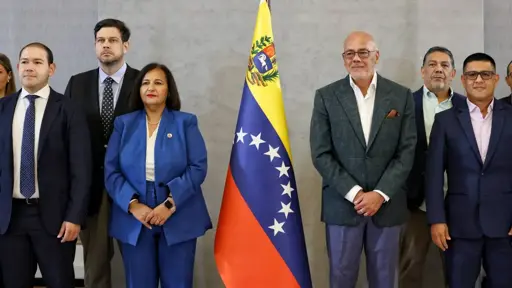
The delegations of Venezuela’s government and the extinct so-called “2015 National Assembly” have concluded their third round of negotiations, reaching agreements focused on access to political guarantees, the review of the legal framework on judiciary and electoral disqualifications, and progress toward the renewal of the authorities of the Judicial Branch.
The summary of the session this Wednesday, October 21, was presented by the spokesperson and representative of the far-right delegation, Dinorah Figuera, alongside the government delegation led by National Assembly President Jorge Rodríguez, following a work agenda that spanned six working days, two plenary sessions, 15 meetings, and the deployment of four specialized technical tables.
Ha culminado el tercer ciclo de conversaciones de la Mesa de Diálogo con la delegación de la AN 2015. Compartimos el siguiente comunicado firmado por ambos jefes de delegación. pic.twitter.com/FYfRcSPmCJ
— Jorge Rodríguez (@jorgerpsuv) October 22, 2026
Achievements and agreements set at the third meeting
The parties finalized commitments made during this round of negotiations through the installation of the Fourth Table on Political, Economic, and Social Guarantees.
Among the main agreements is the application of mediation and conciliation mechanisms of the Program for Peace and Democratic Coexistence of Venezuela, as well as the formal start of discussions to create the Ombudsperson for Political Guarantees and Citizen Participation as an entity for the protection of these rights.
Both delegations agreed to begin a process of in-depth review of various laws to strengthen democratic coexistence, focusing on a Law on Political Parties, Public Meetings, and Demonstrations, to guarantee organizational autonomy; the Organic Law Libertador Simón Bolívar; the Organic Law against Organized Crime and Financing of Terrorism, to specify the definition and classification of this crime; and the Organic Law of the Comptroller General of the Republic and the National Fiscal Control System, to evaluate matters inherent to the process of political disqualifications.
In the judicial and institutional sphere, Jorge Rodríguez reported that during this round, the work of the Preliminary Commission of the Judicial Nominations Committee was built upon following its interviews of 127 candidates from across different sectors of society.
To give continuity to the process, it was announced that at the next session of the National Assembly, the 12 members who are to make up that nominations committee will be designated, allowing the publication of the corresponding constitutional schedule and the subsequent activation of the Credentials Review Council.
On economic and sovereign matters, the delegations reiterated the urgency of recovering Venezuela’s international reserve assets deposited in the Bank of England (Venezuelan gold), in order to follow up on the agreement of the first cycle announced last August 12, regarding funds destined to assist the population affected by the earthquakes of June 24.
In this phase, it was agreed to form a parity delegation that will manage the allocation of these funds to the care of the population affected by the seismic event and the recovery of public services. The determination of both delegations to join efforts to guarantee economic prosperity and social rights in health, food, education, and workers’ income was also ratified.
Far-right commentators criticized the third cycle’s announcements as sparse and focused on longer-term measures rather than immediate change. Their calls for quick results—including María Corina Machado’s prompt return to Venezuela—reflect their demand for a rapid political turnaround that could restore their control of Venezuela. The dialogue, by contrast, is addressing institutional questions and political participation guarantees through an ongoing process.
Follow-up on commitments reached in previous cycles
During the development of this third round, follow-up was also given to the three previously created active tables. The advances of the Second Table, corresponding to the strengthening of freedom of expression, pluralistic thought, and the right to information, were ratified in this sitting. In that area, progress in strengthening freedom of expression, pluralistic thought, and the right to information was recognized, and it was agreed to continue working in that area to obtain the best results. It was further recommended to advance in updating the concessions for use of technology for the dissemination of thought.
The reviews of the First Table, on the strengthening of democracy and the judicial branch, and the Third Table, aimed at addressing the territorial emergency and the recovery of gold, concluded the meeting by reaffirming both parties’ commitment to constantly monitor compliance with what was agreed, as well as to present progress reports to the nation effectively and in a timely manner.
Third Round of Dialogue Between Venezuela’s Authorities and 2015 National Assembly Begins
US empire’s role and María Corina Machado
CNN reported on Wednesday that an unnamed US imperial official in Caracas was defending Washington’s role in accompanying the dialogue and its gradual timetable. Asked about a possible election date, the official said: “The timeline we are working with must be deliberate and thoughtful; we are not setting fixed dates. Look at the stability there is now compared with the past; but that stability may be fleeting, so we must have a high level of confidence in phase one before moving to a tumultuous activity such as an election.”
The remarks put Washington’s influence over the process in plain view: a US colonial official was publicly discussing the pace and conditions for Venezuela’s electoral path and blatantly attempting to interfere in the sovereign processes of the nation.
Asked why Washington had not pushed harder for Machado’s leadership, the official said the process was not about any one person but about achieving elections as a “durable outcome” for Venezuelans. The official also claimed that Machado’s party had been invited and that she had supported the process.
On Wednesday’s episode of Con el Mazo Dando, PSUV Secretary General Diosdado Cabello noted that the CNN report confirmed Chavismo’s repeated criticism of Machado’s excessive pursuit of protagonism and her obsession with power and control.
He pointed to the absence of her far-right party, Vente Venezuela, from the negotiations as evidence that the group’s pursuit of political prominence takes priority over the country’s broader interests.
Cabello also rejected Machado’s claims that either Venezuelan or US imperial authorities were preventing her return to the country, calling them an excuse to avoid exposing her limited political weight in Venezuela and what he described as her destructive political nature.
(Telesur) with Orinoco Tribune content
Translation: Orinoco Tribune
OT/JRE/AU
From Orinoco Tribune via This RSS Feed.
The Bolivarian Revolution is dead. 🥀🪦😢
