

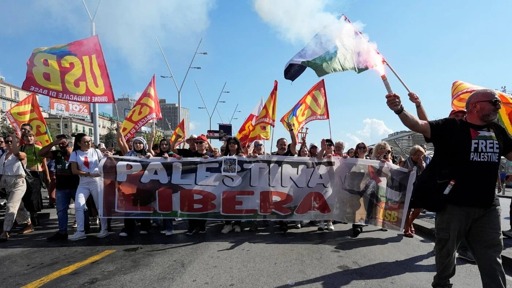
On October 30, port workers from various countries are calling for an international day of strikes and mobilization against the arms trade, the militarization of ports, and the war economy. The call to action aims to disrupt the logistics networks that supply armies and to denounce the role of commercial infrastructure in military conflicts, with a special focus on the genocide against the Palestinian people.
The mobilization is the result of international coordination among labor unions in the maritime and port sectors, which agreed to organize a joint day of action following the third International Meeting of Dockworkers’ and Port Workers’ Unions of the Mediterranean and Europe, held in Istanbul in May 2026.
The initiative brings together unions from France, Greece, the Basque Country, Turkey, Morocco, and Italy, representing workers from more than 40 European and Mediterranean ports. Various reports estimate that 57 ports are expected to participate in the international day of action.
The call to action represents a new attempt to shift opposition to war into the realm of direct action by the working class. Rather than merely denouncing military operations and government decisions, the unions propose to intervene in one of the material conditions that make them possible: the transport of weapons, ammunition, military equipment, and troops.
From the Ports to the Logistics Chain of War
The focus of the day of action is the refusal to turn ports into instruments of the military machine. The Istanbul Declaration demands that port facilities not be used to transport weapons destined for war zones nor be transformed into military bases serving NATO, the United States, or the European Union.
This demand comes amid rising military spending, expanding rearmament plans, and the growing involvement of transportation infrastructure in military logistics, while Israel presses ahead with its plans in Gaza. The argument is that maritime routes, warehouses, ports, and distribution networks are not spaces separate from war: they are part of the supply chains that sustain it.
Refusing to load and unload military equipment thus becomes a tool for exerting pressure. If war materiel depends on the labor of thousands of people to reach its destination, the collective action of those who perform that work prevents its movement.
The call to action on October 30 builds on a previous international mobilization, held on February 6, 2026, against the transport of weapons and the involvement of port infrastructure in military operations. The unions aim to establish stable coordination that will allow them to repeat and expand this type of action.
The day of action also has the support of the Palestinian labor movement, which has called on port, transportation, and related sector unions worldwide to join the mobilization, while respecting the leading role of labor organizations and the specific conditions in each country.
Italy: A Strike Aiming to Spread to All Sectors
One of the main focal points of the call to action will be in Italy, where the Unione Sindacale di Base (USB) has called for a general strike encompassing both the public and private sectors. The mobilization also has the support of ORSA Porti, an organization that has joined the international coordination effort.
Extending the protest beyond the docks is meant to link the struggle against the arms trade with other sectors of the working class and increase pressure on the government and companies involved in the war economy. The goal is to ensure that opposition to rearmament and militarization is not limited to workers directly involved in maritime transport.
The Italian call to action is part of a history of mobilizations against arms shipments and the use of ports for military operations. The port of Genoa, in particular, has been the scene of protests and actions against arms shipments intended to fuel the Zionist genocide against Gaza.
International coordination aims to strengthen this ability to exert pressure, preventing companies from circumventing the protests by shifting operations to other ports or countries. Hence the importance of expanding the mobilization and coordinating union decisions on both sides of the Mediterranean.
The Struggle Against War Is Also a Struggle for Labor Rights
The October 30 action is not limited to opposition to the arms trade. The Istanbul Declaration links the struggle against war to the labor demands of port workers, who denounce job insecurity, the intensification of the pace of work, safety issues, and pressure on wages.
The unions are demanding real wage increases, stable employment, a reduction in the workweek, and decent pensions. They also reject the use of automation, artificial intelligence, and mechanization to destroy jobs, worsen working conditions, or undermine the rights workers have won.
These demands highlight a central contradiction: while governments allocate ever-increasing resources to rearmament and shipping companies seek to increase their profits, workers face pressure on their living and working conditions.
The militarization of ports also threatens to turn infrastructure essential to economic activity into spaces subordinated to the strategic needs of states and military alliances. For the organizing unions, defending ports as spaces for decent work also means rejecting their transformation into cogs in the war machine.
That is why the mobilization’s slogan, “Ports for Peace, Decent Jobs,” encapsulates two dimensions of the same struggle: halting the use of civilian infrastructure for war and defending the living conditions of the people who work in them.
The Global Sumud Flotilla Joins the Mobilization
The Global Sumud Flotilla has announced its participation in the international day of action on October 30, bringing the solidarity movement with Palestine into the initiative led by the port unions. Its participation aims to connect civil action at sea with workers’ ability to exert pressure on the logistics chains that sustain military conflicts.
The organization believes that the blockades, military operations, and destruction in Gaza cannot be understood in isolation from the commercial and maritime networks that supply the war machine. Its support for the day of action reinforces the convergence between internationalist mobilization and union action, although the call for October 30 stems from coordination among port workers’ organizations.
The Flotilla advocates for preventing public ports from continuing to be used for the transport of weapons and for protecting maritime workers exposed to the risks arising from military escalation.
Turning Solidarity into Material Force
The call to action on October 30 poses a challenge that goes beyond a one-off day of protest: building international coordination capable of influencing the trade and logistics flows that sustain the war.
Workers’ refusal to transport weapons can become a decisive tool if accompanied by union organization, solidarity across countries, and sustained mobilizations. The experience of Mediterranean ports shows that opposition to war can also be expressed from the workplace, challenging the economic interests that profit from it.
On October 30, the organizing unions are calling for a work stoppage and mobilization against the arms trade, rearmament, and the militarization of strategic infrastructure. This day of action seeks to unite the defense of labor rights with internationalist solidarity and opposition to war.
Because stopping the war machine also means taking action where it operates: in the ports, in the logistics chains, and in the workplaces that make its operation possible.
The post International Port Strike on October 30 Against the Arms Trade and the War Economy appeared first on Left Voice.
From Left Voice via This RSS Feed.