

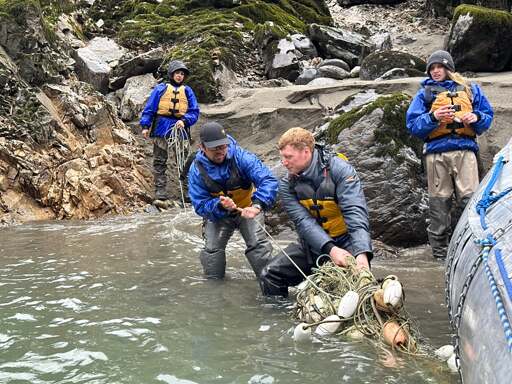

Volunteers Lyza Adoplh, John Redan, Nick Froese and Roxx Ledoux work to haul abandoned fishing gear out of the Fraser and Thompson rivers. Photo by Santana Dreaver
This article has been co-published with the Narwhal as part of their 2026 Indigenous journalism fellowship.
After starting the day with a prayer and a safety demonstration, a group of volunteers gears up in water-resistant clothing and lifejackets, ready to hit the water.
The crew is preparing to scour a stretch of the Fraser and Thompson rivers, removing any fishing gear or waste left behind. Fishing nets left underneath the water are commonly known as ghost nets, which trap and kill fish.
As the saying goes on a volunteer call out poster, “ghost nets create ghost fish.”
TLKemchEEN (Lytton First Nation) has led the river clean-up program in the area for the past 20 years, all in an effort to preserve salmon populations and aquatic life following harvest season.
Over two days in September, a group of 40 volunteers spent a total of 20 combined hours on the water.
From Lillooet to Lytton during the first day, and from Lytton to Yale during the second day, volunteers passed through white-water rapids and rugged terrain such as the famously turbulent passage of Hell’s Gate.
When the raft leader yells “hold on,” that’s exactly what participants do, reaching down for a rope attached to the raft, laughing and hollering, ripping through the Fraser Canyon rapids.
The cold river water splashes everyone — waking up the crew as countless bald and golden eagles watch from above.
“I didn’t realize how impactful everything is along the shores. I guess I didn’t realize that some leave their garbage and nets out there,” volunteer Rebecca Riley, who is from the Stʼatʼimc Nation, said.
“Once I saw that with my own eyes, I wanted to jump in and be a part of it.”

A newspaper ad about the river clean-up project inspired Rebecca Riley to get involved. She has helped remove ghost nets since 2018. Photo: Supplied by Rebecca Riley
‘That fishery is a communal right’
It’s a sentiment shared by many volunteers on the boat, who eagerly approach the shoreline when a ghost net comes into sight.
Whether the net will take one person to remove, or up to five to pull out of the water, is unknown until people get their hands wet.
During the non-rapid portion of the cleanup, countless stories were told, Indigenous people exchanged words in their languages to compare similarities and differences and folks even had hot chocolate along the shore, courtesy of Kumsheen Rafting, which was contracted to support the program this year.
During the first year of the program, 126 ghost nets were collected.
“This year we picked up six nets and some garbage, some years prior we’ve picked up zero. We have to remind our fishermen not to be lazy and take their gear home,” Kevin Duncan told the Narwhal.
Duncan is an elected councillor for TLKemchEEN in “B.C.’s” Southern Interior, part of the Nlaka’pamux Nation Tribal Council. He has been involved with the program since its inception. He attended both cleanup days this year with his son, Aaron.

Kevin Duncan, an elected councillor for TLKemchEEN, has been involved in Lytton’s ghost net clean-up initiative since it started 20 years ago. He always leads a prayer before they begin. Photo: Supplied by Rebecca Riley
For TLKemchEEN, stewarding their waters as they always have is crucial — especially as salmon numbers decline. Life along the Fraser and Thompson rivers is deeply connected to salmon. And TLKemchEEn is home to where the two rivers meet, in the country’s largest salmon-bearing watershed.
“For future generations, sometime down the road, I’m afraid all they’re going to be looking at is pictures of salmon in a book,” said Duncan.
The nets recovered by the program are given to those in need, including single mothers, low-income families and Elders from the nation.
“As a Nlaka’pamux or Stʼatʼimc member … that fishery is a communal right, it’s not an individual right. It’s looked after by your nation,” Duncan said.
“Most times, you just get to see portions of the river from the highway, but once you’re down on the water, floating for eight hours from Lillooet to Lytton, it gives you a better perspective on where people fish.”

Now 20 years into the program, volunteer spots fill up months in advance. Photo by Santana Dreaver
Removing fishing gear from the cold and fast-moving river can be dangerous, which is why Duncan starts each day of the program with a yémit, or prayer in Nlaka’pamxcín.
“Salmon are the lifeblood of our people, and when these fish pass through coastal communities, they pray for them in the lower Fraser. We’re doing the same thing as they pass through our territories in the mid Fraser. … These fish hear that prayer.”
Nations collaborate to steward salmon
Volunteer Riley is Lillooet Tribal Council’s fisheries manager. She has participated in the river cleanup program three times, beginning in 2018 when she saw an advertisement in the newspaper.
Although she’s been on the Fraser and Thompson rivers many times throughout her fisheries career, she said that the ghost net removal program was “eye opening,” regarding the number of fishers out on the water.
She said that Lillooet Tribal Council is happy to help as the neighbouring nation to Nlaka’pamux territory, given the large area to cover and the shared value of protecting salmon.
“When we’re having the long days and we’re getting splashed and it’s cold, if we save a salmon or two that are still alive and let them free, or we clear out a net so we know that other animals can’t go in, it’s very gratifying and humbling,” she said.
“At the end of the day, when you’re riding the bus home and you’re cold and hungry, you know in the back of your mind it was so worth it.”
While the focus of the program is cleaning up the river, volunteers take the opportunity to support other initiatives while on the water, such as mapping traditional fishing sites to prove occupancy.
According to Conservation Biology, “Proof of occupancy is the foundational legal and moral requirement needed to establish Aboriginal Title, regain territorial sovereignty and protect ancestral lands from unauthorized exploitation.”
Lillooet Tribal Council’s extreme heat resiliency planner, Lyza Adolph, did a lot of heavy lifting over the two days removing ghost nets, but also had a mission of her own.
A member of the Stʼatʼimc Nation, this was her first time participating in the ghost net removal program.
“It was very cold, but with the group that we had, it was very enjoyable and uplifting,” she said.

Despite the cold water, Lyza Adoplh, Roxx Ledoux, Doug Mitchell, Nick Froese and John Redan shared laughs and stories as they hauled abandoned fishing gear out of the Fraser and Thompson rivers. Photo by Santana Dreaver
With a focus on planning for extreme heat in her position at the tribal council, Adolph monitored fishing sites during the program to see if there were any shade trees nearby, scoping out areas to potentially plant some.
“The program tied in with my traditional shade tree planting. I know more about the upper river, but from Lillooet to Lytton and beyond, I didn’t know too much about it. It was definitely nice to see the various fish camps and see if there were shade trees,” she told The Narwhal.
Shade trees are beneficial for both humans and aquatic life.
As spawning salmon break down, their nutrients feed the trees. In turn, trees offer shade to cool the water, which is critical for survival on a warming planet, and tree roots and branches give salmonids space to hide from predators while also preventing erosion.
In the Fraser Canyon, which includes the communities of Yale, Lytton and Lillooet, fishing sites can be hard to access. Adolph’s shade tree monitoring data, collected by boat, will be used in future tree planting projects.
“I would definitely do it again,” Adolph said. “Although it was very cold, it was very refreshing and rewarding by the end of the day.”
The post ‘Gratifying and humbling’: First Nation leads ghost net cleanup from Interior ‘B.C.’ rivers appeared first on Indiginews.
From Indiginews via This RSS Feed.