

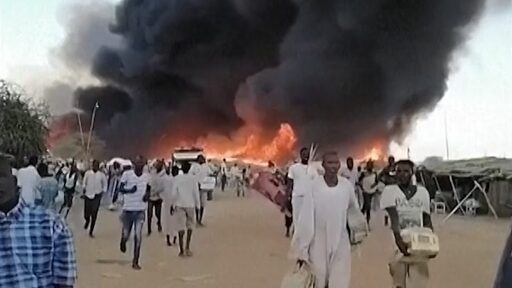

Drone strikes in war-torn Sudan have killed hundreds in just three days. Most of the deaths were in West Kordofan state, including in an area contested with South Sudan, sparking fears of a spillover of the war.
The paramilitary Rapid Support Forces (RSF) reportedly killed 41 people by striking a gathering of Internally Displaced People (IDPs) near Sudan’s southeastern border with Ethiopia in the Blue Nile state last Friday, October 16.
Later on Sunday, October 18, air defenses of the Sudanese Armed Forces (SAF), which heads the government, intercepted multiple suicide drones launched by the RSF. The drones targeted Upper Atbara and Setit dam complex in Gedaref state, and the Khashm El-Girba dam in neighboring Kassala.
The following day, on October 19, the RSF launched a wave of drones toward the airport in the national capital, Khartoum. While the air defenses intercepted most of them, one drone struck near the airport, killing four people, including three children.
The RSF took over the capital soon after starting this war in April 2023 against the SAF, the national army with which it had ruled as part of a military junta. The SAF regained control of the capital in March 2025.
In the meantime, later in October 2025, the RSF consolidated control over most of Sudan’s vast western region of Darfur, overrunning the SAF’s last holdout, El Fasher, and depopulating the city in a campaign deemed genocidal by a UN investigation.
Read more: A bloodbath visible from space: RSF’s massacres in Sudan’s El Fasher
After thus taking over Darfur – except for some SAF small holdouts on the border with Chad – the RSF has since been pushing eastward toward Khartoum. The Kordofan region in between, comprising three states, has since become a main front of this war.
Here, on October 18, in West Kordofan’s RSF-controlled town of al-Dabba, SAF struck a transport hub that was crowded on a market day, killing 80 people on the spot. 30 others later died in hospital. Another SAF drone also struck a market in the Al-Mujlad town.
Then, on the morning of October 19, SAF drones struck yet another market it suspected to be a source of fuel supply for the RSF, killing 153 people in Abyei, an area disputed by Sudan and South Sudan, ever since the latter seceded from the former in 2011.
This area in the Nile oil basin has over 4,000 UN peacekeepers and is jointly administered by Sudan and South Sudan. South Sudan’s government summoned Sudan’s ambassador to protest this strike.
A spillover of Sudan’s war into South Sudan could have dire consequences, especially since South Sudan, the world’s youngest country, is itself at a heightened risk of slipping back into its own disastrous civil war, which had claimed up to 400,000 lives between late 2013 and mid-2015.
The death count of the war in Sudan has been lost after exceeding 150,000 as early as June 2024. By the time the war entered its fourth year in April 2026, drone strikes had become the main driver of civilian casualties in this war, causing 80% of all the civilian deaths in the first four months of this year, killing at least 880 people.
“We are alarmed by the continued deadly drone strikes across the country that are killing civilians, including children, and that are disrupting essential services,” UN Spokesperson Stéphane Dujarric said on October 19.
Read more: The war in Sudan is “between two wings of a comprador parasitic capitalist class”
From BT News via This RSS Feed.