


Bullets:
The Pentagon and Wall Street are spending and raising capital to build metals supply chains, outside of China.
Investment banks are offering new funds, ETF’s, and IPO’s of companies that are in the exploratory phase of rare earth mining.
But initial enthusiasm from investors did not last, and share prices for those names are in free-fall.
The spikes in the so-called “risk-free rates” are largely to blame. Mining is a decades-long bet, and patient capital is instead being sucked out of equities to finance massive government deficits.
Inside China / Business is a reader-supported publication. To receive new posts and support my work, consider becoming a free or paid subscriber.
Report:
Good morning.
Government bond yields across the world are racing higher, almost everywhere—China excepted.
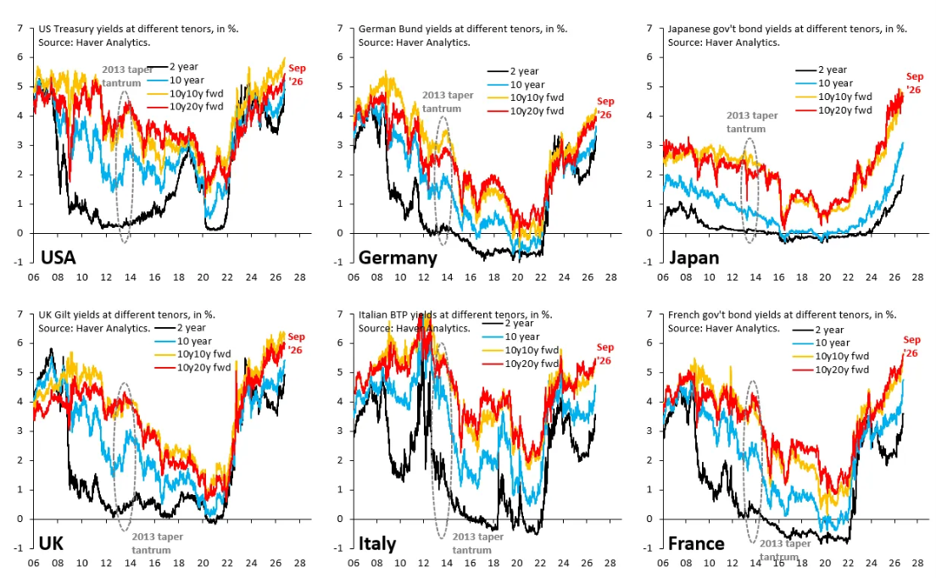
And that complicates how investors make decisions today. Investors in the United States, for example, make over 5% in interest, per year, just by loaning money to the American government. For sectors that demand very long-term and patient capital, that’s a problem.
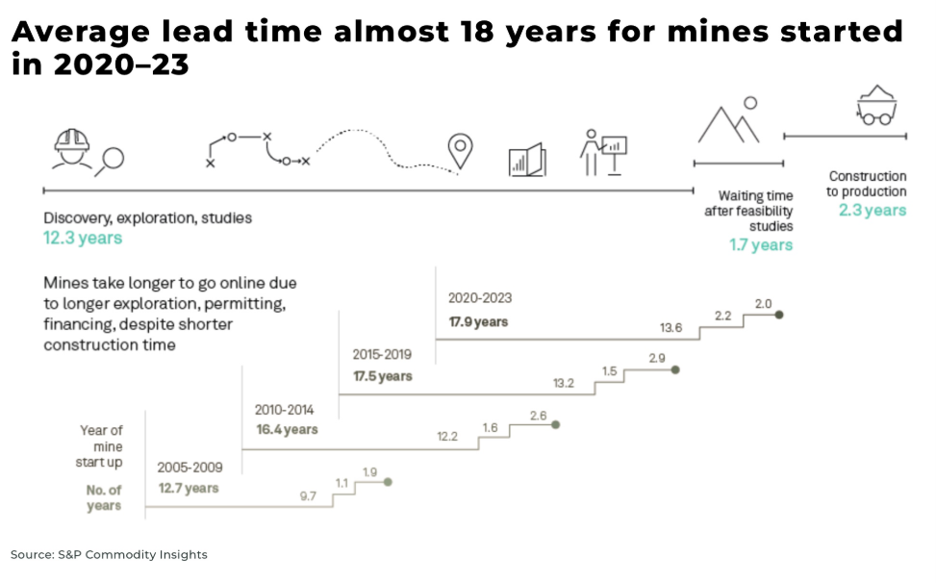
Mining is one of those sectors, because it just takes so long to take a new mine from the prospecting and surveying stages, to production. Rare Earth mining in North America and in Europe adds more layers of high risk again, because the refining and manufacturing of rare earths into usable products are other industries that need to be created in parallel, and will also demand high volumes of high-cost capital.
Some of the best industry research comes from asset managers hawking stocks of companies they already own, or from investment banks that are underwriting new securities. On the bear side, some of the best data come from short-sellers; investors who make money when stocks go down in value. That makes for a double-edged sword then, and investors should be aware that much of what they’re reading isn’t completely objective.

Early last year, Morgan Stanley issued this report, The Humanoid 100. MS mapped the humanoid robot value chain, from the brains—the software-- to the motors and actuators that allow the robots to move around, and down to the raw materials that are needed to build everything.
On page one they point out the China problem: that the Chinese lead in the development and the deployment of robots, and that is already a challenge for Tesla and the other Western robot manufacturers. Media and investor interest in the industry is growing, fast, and probably will continue to do so.
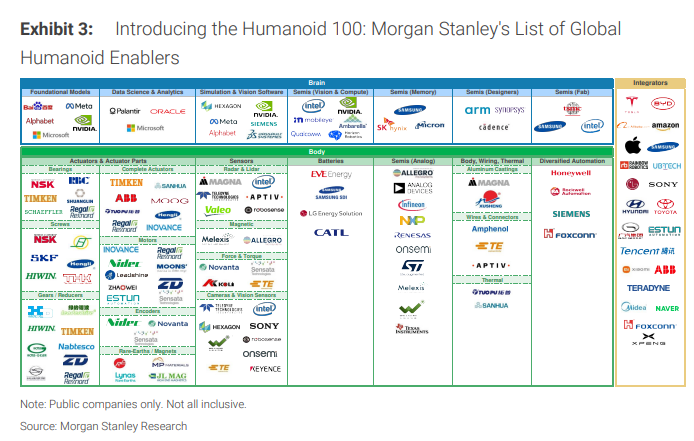
Morgan Stanley identified a hundred companies that they called the “global humanoid enablers”. Asian companies were already dominant, with over 70 firms out of those 100. China was half. Investors are looking for domestic companies to buy, besides Tesla and Nvidia, but the concern industry-wide is right there, the bottom sentence:
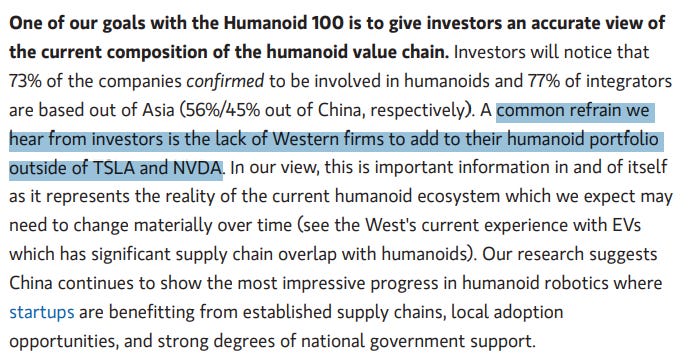
China continues to show the most impressive progress in humanoids. Their supply chains are already established, and government support is strong. The report itself is a good read, and it is instructive about how investment banks promote new themes to bring in new investors, and how institutions go on to build ETF’s and mutual funds.
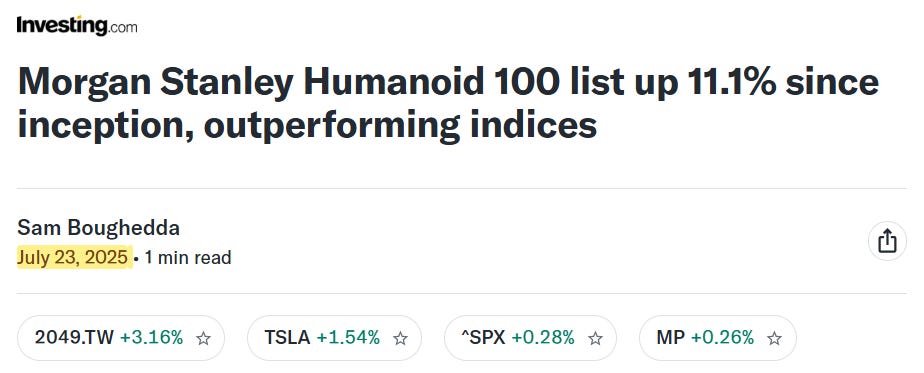
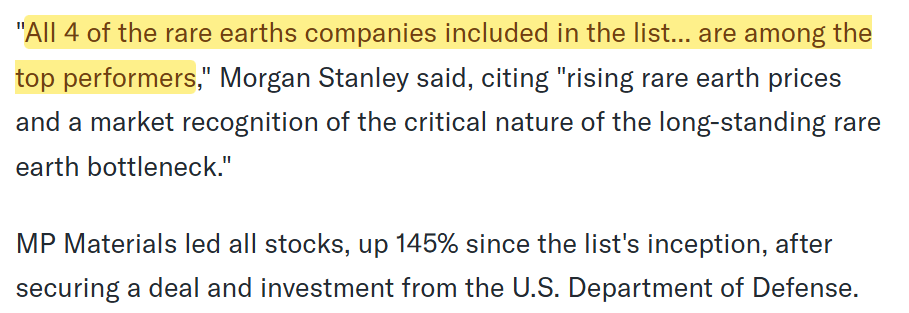
Just after that report dropped, new capital did roll in. Six months later, that Humanoid 100 list gained over 11%, three times the return on the S&P 500. And all four of the rare earths companies singled out by MS also showed strong performance. Two of those companies were Chinese, though. MP Materials—a US company, led the way, more than doubling just since Morgan Stanley told their investors about it.
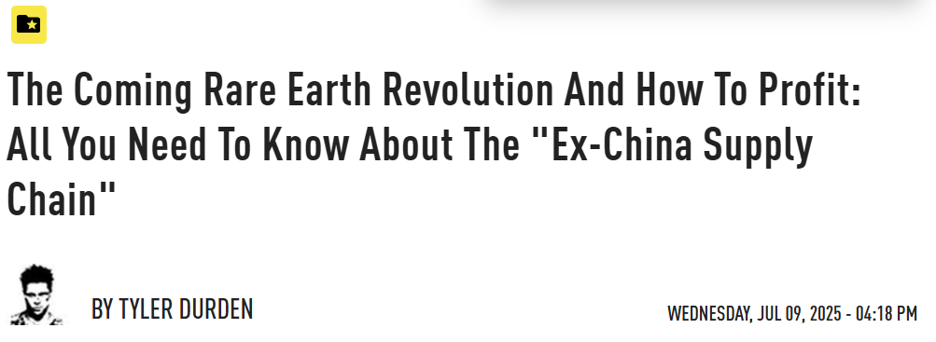
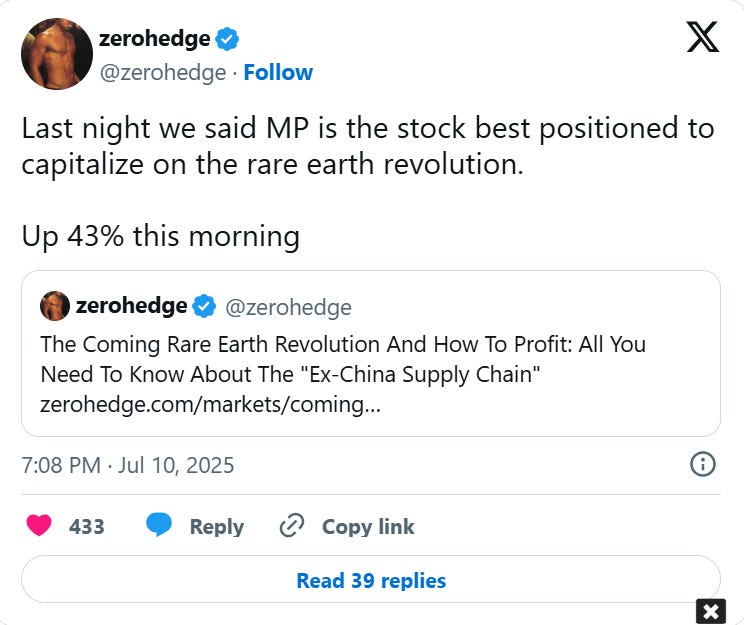




ZeroHedge also ran a piece: The Coming Rare Earth Revolution” and how to profit from the non-Chinese companies who were looking for rare earths, and they also singled out MP Materials as the best in class. The stock jumped 43% in just the few hours immediately following the Zerohedge recommendation.
That X post, and those comments, are from a year ago. One commenter is thankful for a nice return in a short time. Another said that Zero Hedge should take a victory lap. Other posters were more cynical: ZH has millions of followers and can move a thinly-traded stock just by saying something nice about it. And John Tuld there knows a “pump and dump” when he sees one, and suggests we wait a year.
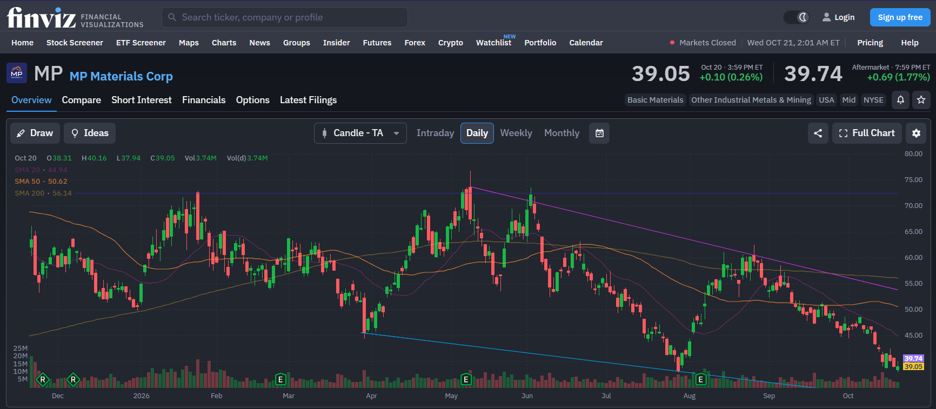
It’s now a year later, and the skeptics were right. MP shares are grinding lower. Shares of other ex-China rare earth miners are even worse.
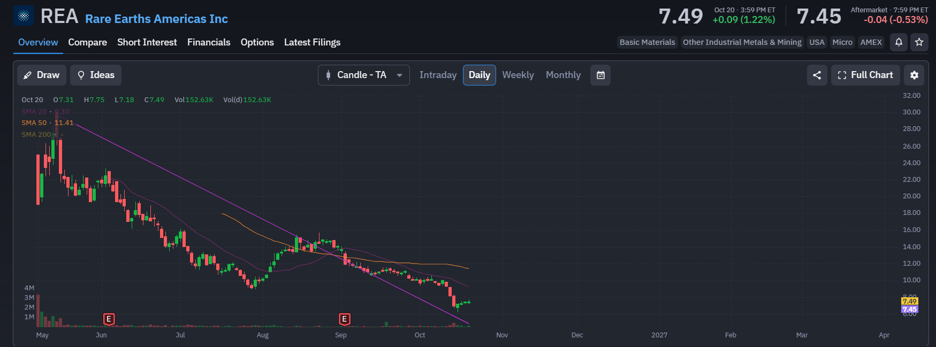
Rare Earths Americas went public a few months ago at $19 and ever since looks like a double-black-diamond ski slope.
Top 10 Holdings, Sprott Rare Earth Ex-China ETF:
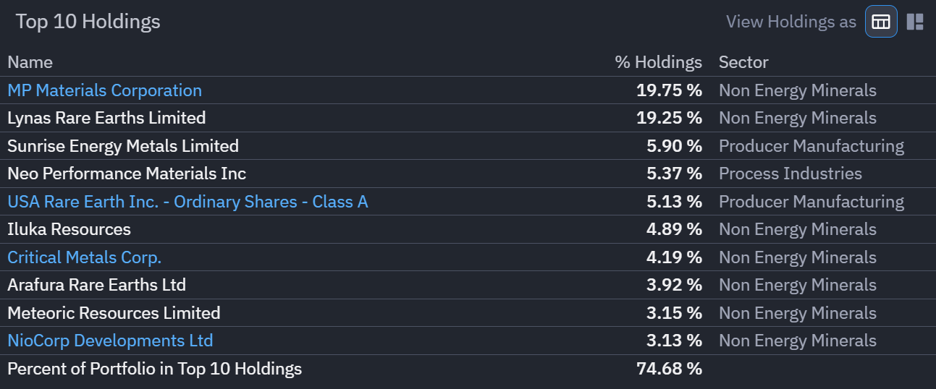
Sprott Rare Earths ETF Ex-China specifically excludes companies here, and the portfolio concentrations there are interesting. If a fund has more than 20% of portfolio in a single security, it creates a massive single-company risk. MP and Lynas are just a shade under 20%, each, which may be the maximum their prospectus allows. And Sprott’s chart looks better suited to wingsuit base jumpers.
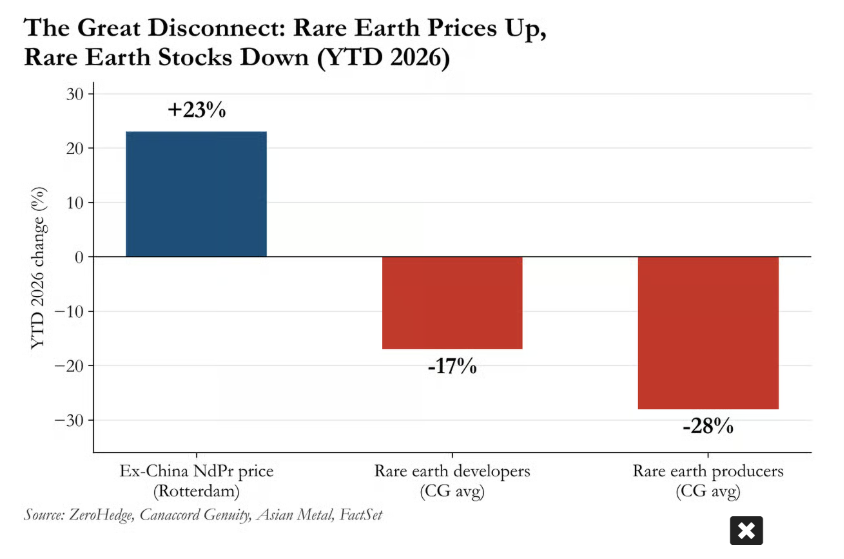
Now the companies that heavily promote the stocks are explaining that the market has been wrong for the past year. If anything, these valuations should be even more compelling now, in their view. Rare Earth minerals prices are going up, and the shares of the companies that do the mining for those minerals are crashing lower.
Chinese supply is still cut off, the Trump Administration has a “floor” under finished magnets, and Western companies are paying from 5 times to more than 300 times what Chinese firms pay, for the same raw materials:
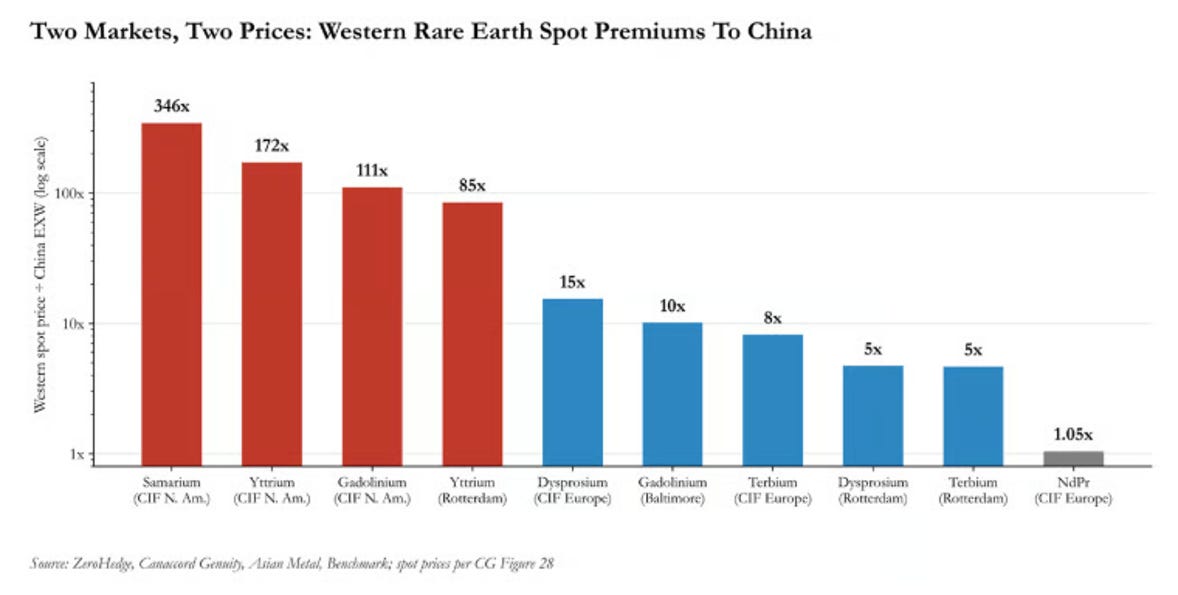
That chart is logarithmic, and begs a lot of other questions. Dysprosium Rotterdam: European companies pay 5X for dysprosium compared to what Chinese buyers pay. But Dysprosium CIF prices—that is after shipping and insurance costs to Rotterdam, the premium is 15 times. If that’s true, it means that the metal isn’t getting there, and the spot price will reflect that, soon enough.
Samarium, Yttrium—the heaviest rare earths are getting pinched the hardest. And it makes sense, too, on the Chinese side: China dominates the production and refining of those elements, they’re not allowed to export their surplus production to foreign markets, so prices paid here are holding steady, or even falling.
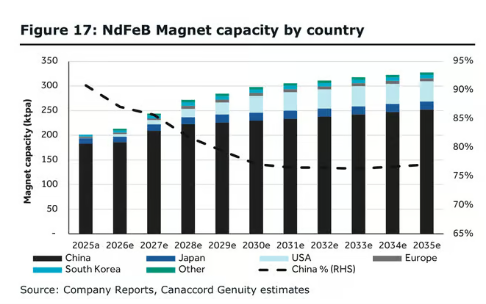
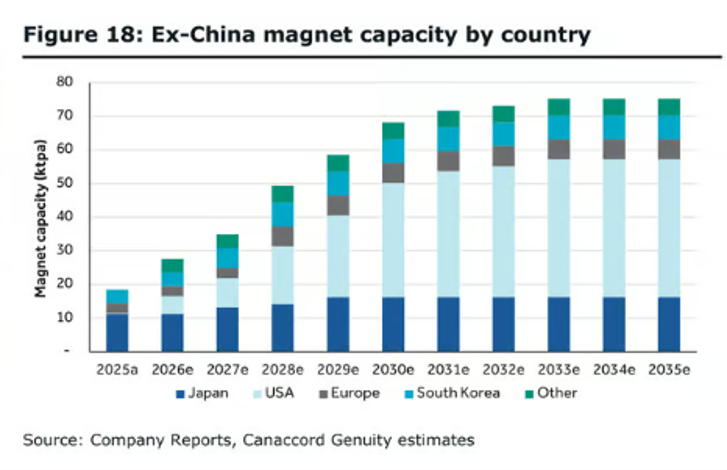
China dominates the end-to-end supply chain all the way through to the magnets, and the Ex-China chart is what remains after we saw all those dark blue bars off the chart that includes. Light blue is the United States, and analysts were forecasting production to rise, IF the sector can raise the funds to get the mines and refineries built.
That thesis was always a stretch, anyway, and the supply chain problems show up everywhere. There are very long lead times for key capital equipment, for example, and even in a Goldilocks scenario where the money does come in and the mines produce on time, that doesn’t mean more rare-earth magnets.
These are publications whose work I respect, generally. And we’ll say again that the research they provide is valuable, even though we know they’re talking their book. This is another on humanoid robots at OilPrice, and how the supply chains run through China, and REalloys is a company that wants to build supply at home.
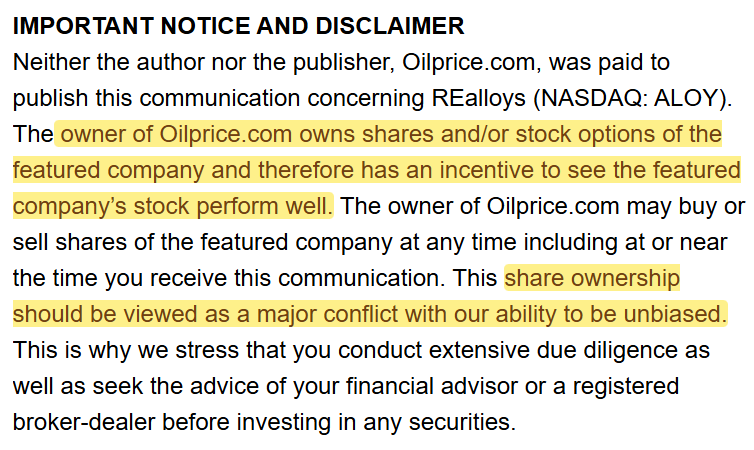
They have that disclaimer at the bottom of the report, that the media company itself is long the shares, and wants the price to go up.
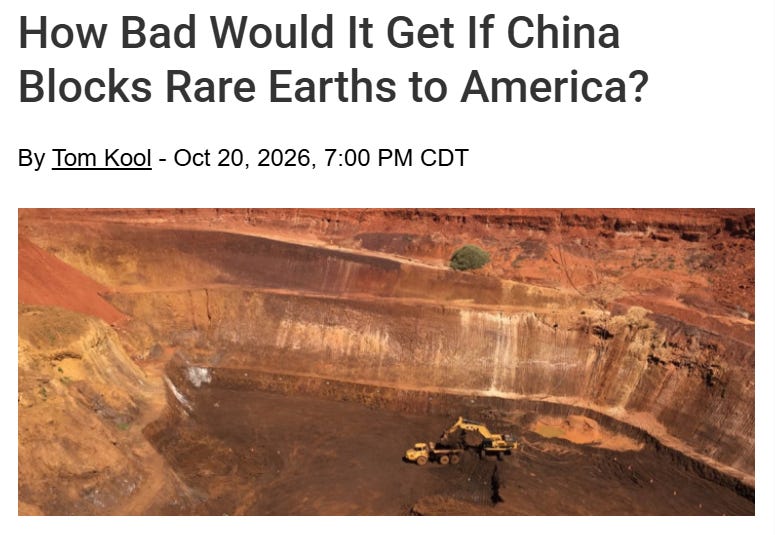
Here’s another: How bad would it get if China blocked rare earths to America—which has already happened. So another reason for patriotic Americans to buy REalloys stock.
But the rare earths theme has a lot of deeply structural problems, outside China. It took the Chinese decades to get there. But building an ex-China supply chain assumes that such a chain can be built outside China in the first place. And everything outside China costs a lot more, and it costs a lot more to build anything in Western countries today, compared to building in China 30 years ago.
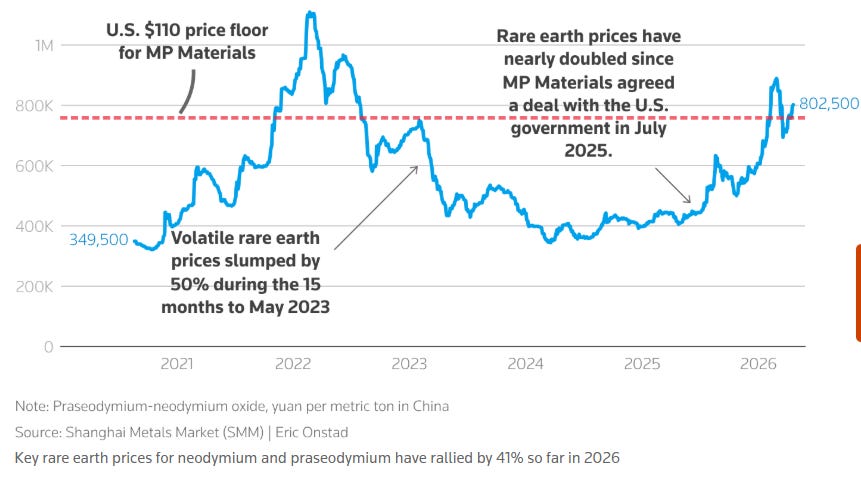
So investors need those high price floors for the refinery output to last for decades, that they’ll be high enough for long enough for those equity investors to get their money back.
Because it’s the US government itself that is competing, right now, for that 30-year capital commitment. Investors can plow their savings into long-shot mines and refineries, hoping that the Trump-era promises for price floors and Pentagon contracts last until the 2050’s.
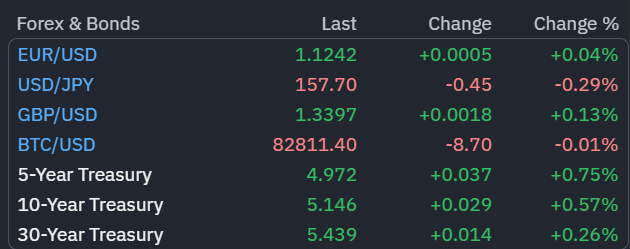
Or, investors can simply lend to the US government for 30 years at 5.439%. They can buy a long-term government bond, and investors will double their money in about 13 years. They’ll double it again in 26 years. At 30 years they get their principal back.
The Department of War says they want a China-proof supply chain, but there’s no money left to build one.
Be Good.
Resources and links:
The Humanoid 100: Mapping the Humanoid Robot Value Chain
https://advisor.morganstanley.com/john.howard/documents/field/j/jo/john-howard/The/_Humanoid/_100/_-/_Mapping/_the/_Humanoid/_Robot/_Value/_Chain.pdf
Morgan Stanley Humanoid 100 list up 11.1% since inception, outperforming indices
https://finance.yahoo.com/news/morgan-stanley-humanoid-100-list-133041576.html
Stock prices and charts from FINVIZ
https://finviz.com/stock?t=MP&p=d
https://finviz.com/stock?t=USAR&ty=c&ta=1&p=w
https://finviz.com/stock?t=REA&ty=c&ta=1&p=d
https://finviz.com/stock?t=REXC&ty=c&ta=1&p=w
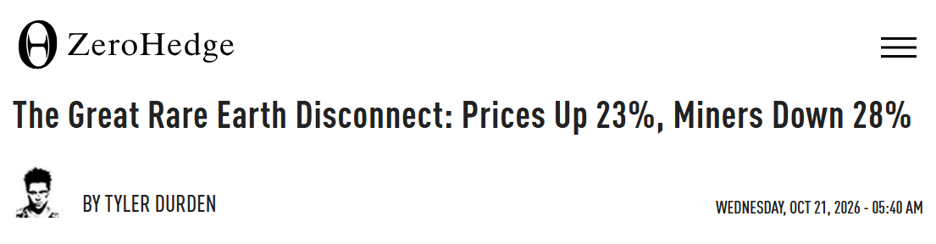
The Great Rare Earth Disconnect: Prices Up 23%, Miners Down 28%
https://www.zerohedge.com/commodities/great-rare-earth-disconnect-prices-23-miners-down-28
Robot Wars – How China Has the Robotics Industry in Its Grip
https://oilprice.com/Energy/Energy-General/Robot-Wars-How-China-Has-the-Robotics-Industry-in-Its-Grip.html
How Bad Would It Get If China Blocks Rare Earths to America?
https://oilprice.com/Energy/Energy-General/How-Bad-Would-It-Get-If-China-Blocks-Rare-Earths-to-America.html
America Needs 48,000 Tons of Rare Earth Magnets. It Only Makes 300
https://oilprice.com/Energy/Energy-General/America-Needs-48000-Tons-of-Rare-Earth-Magnets-It-Only-Makes-300.html
How a Global Debt Crisis Starts
[Robin J Brooks
How a Global Debt Crisis Starts
Thank you for subscribing to my posts. If you’re not yet a paying supporter, please consider becoming one. That’ll allow you to DM me with questions and comments. Your contribution will help cover the cost of the data I use in my posts, which I fund out of my own pocket. Thanks so much for your support and feedback…
Read more
23 days ago · 123 likes · 17 comments · Robin J Brooks](https://robinjbrooks.substack.com/p/how-a-global-debt-crisis-starts-2e0?embedding_publication_id=3320368)
New mines take nearly 18 years to build in 2020-23
https://theoregongroup.com/investment-news/new-mines-take-nearly-18-years-to-build-in-2020-23/
S&P Global, US rare earth investments, price floors aim to challenge China’s market grip
https://www.spglobal.com/energy/en/news-research/latest-news/metals/052926-us-rare-earth-price-floors-aim-to-challenge-chinas-market-grip
Inside China / Business is a reader-supported publication. To receive new posts and support my work, consider becoming a free or paid subscriber.
From Inside China / Business via This RSS Feed.