

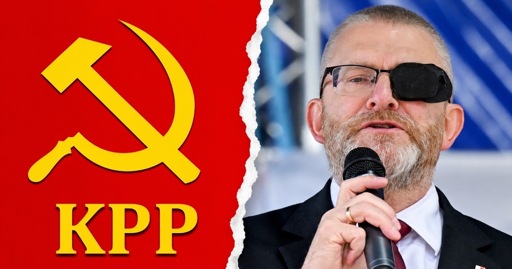

The Communist Party of Poland (KPP) has strongly criticized far-right politician Grzegorz Braun and his Confederation of the Polish Crown (KKP), warning that their supposedly anti-establishment rhetoric conceals a deeply reactionary, anti-communist and aggressively pro-capitalist political program. In an article published on October 20 under the title “Braun Is Not the Solution,” the Polish communists argue that growing dissatisfaction with the liberal establishment, militarism and the threat of war has driven sections of society toward political forces presenting themselves as opponents of the existing system. Braun’s fascist party, however, offers no genuine alternative to capitalist exploitation.
The Communist Party points to Braun’s naked anti-communism and his public association with Janusz Waluś, the far-right murderer of South African communist leader Chris Hani. It also condemns the party’s glorification of reactionary historical traditions, authoritarianism and religious fundamentalism.
Particular emphasis is placed on the KKP’s economic program, which the communists describe as an extreme neoliberal assault on working-class rights. Its proposals include the privatization of healthcare and education, the dismantling of social protections, restrictions on trade union activity and greater privileges for capitalists.
According to the Communist Party, Braun’s political project serves as a safety valve for capitalism, channeling legitimate popular anger into a movement that leaves the economic power of the bourgeoisie untouched. The Polish communists stress that the genuine alternative lies not in reactionary nationalism or another defender of capitalist interests, but in independent class struggle against exploitation and the power of capital.
Grzegorz Braun, currently a Member of the European Parliament, received 1,242,917 votes (6.34%) in Poland’s May 2025 presidential election. His electoral support must be viewed against the backdrop of a deeply entrenched reactionary and far-right political current in Poland, which has developed over several decades, reinforced by aggressive nationalism, clerical conservatism, anti-communism and historical revisionism. Braun’s political activity, marked by antisemitic incidents, xenophobic rhetoric and ultraconservative positions, represents one particularly extreme expression of this broader political environment.
From In Defense of Communism via This RSS Feed.