

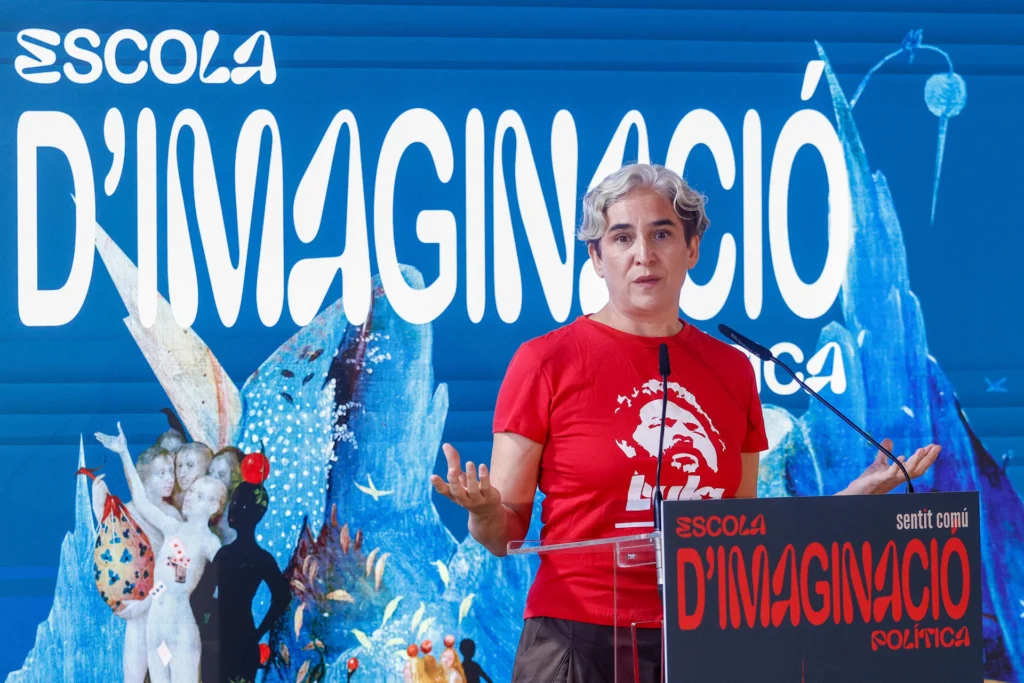
United States has denied former Barcelona Mayor Ada Colau permission to travel to Puerto Rico, where she was due to take part in a municipalist forum next month, a decision that sources close to her link to her pro-Palestinian activism.
Ada Colau, a candidate for the Frente Amplio, had planned to attend the Ciudades Valientes meeting on November 3 and 4 in the municipality of Caguas in central Puerto Rico. When she applied for the digital travel authorization known as ESTA (Electronic System for Travel Authorization), U.S. authorities approved the members of her delegation but denied her request. She was then advised to attend an in-person interview at the U.S. embassy in Madrid.
According to people close to Colau, the interview held two weeks ago focused on her position on the conflict in Gaza. “The entire interview was about the Flotilla and her pro-Palestinian activism, with a lot of insistence on the three days she was held in Israel,” they said.
RELATED: U.S. Expands Social Media Review for Visa Applicants Starting October
After the interview, U.S. authorities issued a final denial, citing “suspicion that she wants to migrate illegally to the country.”
“This is a clear case of political censorship. And it is a disgrace, because while we see that Javier Milei can travel freely to our country to insult the press and citizens in general, his friend Donald Trump bans me from entering a country like Puerto Rico, which is a colony occupied by the United States,” Colau said.
The US has refused to grant a visa to former Barcelona mayor Ada Colau over her participation in the Global Sumud Flotilla and her support for Palestine.
Colau had been invited to attend a meeting convened by New York City Mayor Zohran Mamdani. pic.twitter.com/TuEEQasz9x
— The Times of Palestine (@PalTimesNews) October 21, 2026
Ada Colau governed Barcelona between 2015 and 2023. She had traveled to the Caribbean archipelago in April 2024 to discuss urban planning, access to housing, human rights and the role of women in politics. During that visit, at a conference on government and citizen participation, she advocated for truth, justice and reparation in the face of European colonization in Latin America.
The prohibition echoes other restrictions imposed by Washington on figures critical of its foreign policy. The same administration has repeatedly denied a visa to Palestinian leader Mahmoud Abbas to attend the United Nations General Assembly. In Colau’s case, the stated rationale of immigration risk collides with a documented history of official visits and public conferences.
Event Agenda Unchanged
The decision keeps the event in Caguas and preserves the original schedule rather than postponing or relocating it.
The Puerto Rican collective confirmed that its upcoming event will keep its original agenda, and that the political leader will participate remotely. “Ada will be present, one way or another, because ideas and courage do not require visas to cross the borders imposed on us to divide us,” they affirmed.
“Colau is one of the founding voices of the international municipalist movement that inspires this meeting and her physical absence will be felt, but we maintain our commitment to the exchange of experiences,” the organizers said, rejecting the ban.
“Her physical absence will be felt, but we maintain our commitment to the exchange of experiences. Our collaboration with Ada and with the Sentit Comú Foundation remains just as strong and Brave Cities will take place as planned,” the League stated in a public communiqué.
For her supporters, the case exposes the double standard at the heart of the colonial relationship. The denial of entry, they insist, is not a security measure but a political sentence delivered through administrative channels.
Organizers say the work continues, and that Colau’s ideas will still shape the conversations in Caguas even in her in-person absence. The entry ban, however, ensures that a voice critical of U.S. policy will not speak from the island that Washington governs as a colony.
🚨🇪🇸 BREAKING — Ada Colau:
“If we trivialize and allow the genocide in Gaza, and apartheid and the colonial persecution of Palestine, humanity is lost.
Therefore, all humanity must not give up, resign itself, normalize or trivialize the genocide in Gaza and the persecution of… pic.twitter.com/cLg7UIx5Ss
— Pamphlets (@PamphletsY) October 18, 2026
Puerto Rico has been under U.S. control since 1898, after the Treaty of Paris, and since 1952 has held the status of a commonwealth with its own constitution, although the United States retains exclusive control over immigration, customs, defense and currency. ESTA was required because of the island’s colonial status. Puerto Rico is a U.S. territory, and ESTA applies to travelers from visa-waiver countries such as Spain who enter U.S. territory.
Rights groups have often criticized U.S. visa denials based on political views, while U.S. officials typically say such decisions follow immigration law and are not open to public discussion.
From teleSUR English via This RSS Feed.