

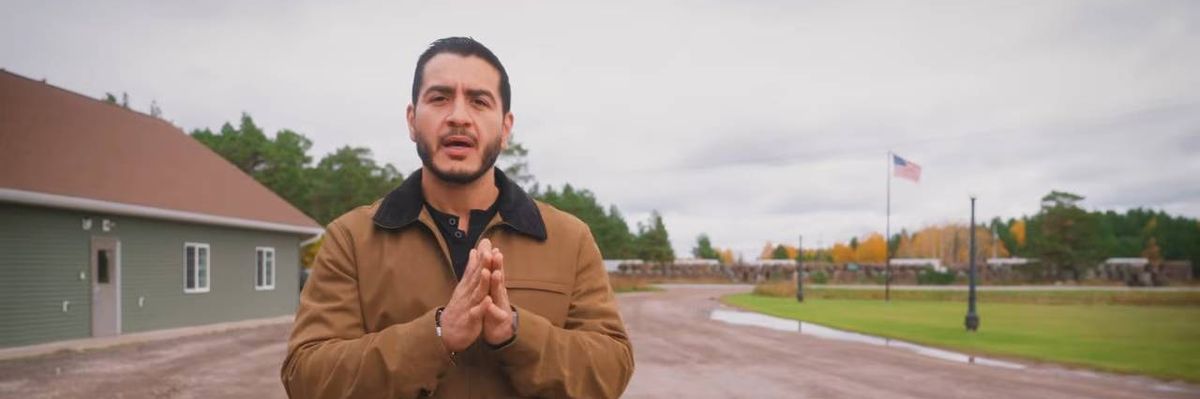
At a Michigan elementary school built around outdoor learning, noise from a Bitcoin mine across the street has forced students’ lessons indoors. Abdul El-Sayed, the state’s Democratic candidate for the US Senate, says it’s a prime example of why data centers proliferating across the nation need regulation.
On Wednesday, El-Sayed—a former Detroit public health official—posted a video of himself at Lake Superior Academy in Dafter Township just south of Sault Ste. Marie in Michigan’s Upper Peninsula. The tuition-free Montessori school provides around 100 students in kindergarten through fifth grade with multiple hours of outdoor learning each day. At least, it did.
“It was incredible until about two years ago, when that monstrosity behind me moved in,” El-Sayed said, pointing to the series of large metal pods just across the street, behind rows of stacked hay bales.
The hay bales were put up last year to block out the noise from the facility’s cooling fans, which constantly hovered around 70-75 decibels—approximately as loud as a vacuum cleaner.
“The students often, daily, say, 'When is this going to stop?’” superintendent Susie Schlehuber told Michigan Public Radio. “Our special needs students, some will come out and cover their ears.”
The students attending Lake Superior Academy were supposed to spend their days reading and journaling outdoors, learning to garden, and photographing wildlife. But after the facility began operating in March 2025, Schlehuber said, the noise had “forced us to stay within our classrooms, close our windows, and not enjoy nature."
“Our whole school philosophy, everything we were founded on, has been disrupted because of the noise,” she said.
School officials sought answers from the township and the mine’s operators, but struggled to establish who was responsible. Workers at the facility refused to identify its owner. And at a town meeting, where residents had come to voice concerns about noise, pollution, and other nuisances, a representative for the site reportedly refused to name the owner or provide his own last name.
“We left with more questions than what we had when we arrived,” Schlehuber said.
This lack of transparency has been a pattern since the facility was first permitted in October 2024. The application described the project as a “storage/warehouse” facility but remained vague about what would happen inside—saying it would merely contain computers managing data. This allowed it to be approved without a review of cryptocurrency mining’s potential effects on nearby properties, including Lake Superior Academy.
Business records revealed that the Florida-based holding company Odessa Partners LLC owned the site and the Florida-based Bitcoin mining operator Alpha Watt owned the computer equipment.
Named in the filings is Michael Carbonara, a Florida businessman running as a Republican to represent Florida’s 22nd Congressional District in the US House. Carbonara has opposed an effort to build an artificial intelligence data center in Palm Beach, known as Project Tango, but has insisted that his facility in Michigan is different.
“I have built a data center, but it’s not an AI data center. It’s actually a Bitcoin mining operation,” he said. “I’ve been attacked by the George Soros and the No Kings people… so it’s been quite a ride because they want to attack innovation.”
The school filed a nuisance lawsuit against both companies, resulting in a temporary shutdown in June 2025. The operators then countersued, alleging that the shutdown had resulted in $184,000 in lost revenue. They claimed the hay bales they’d erected reduced the noise. Reporting from October 2025 said the noise level had fallen to about 50 decibels.
The school’s lawsuit remained pending in the Chippewa County Circuit Court as of September 2026.
During his visit to the school this month, El-Sayed said he could still hear a constant “high-pitched din.”
“This is a place that is supposed to be a healing environment, a nurturing environment for kids that has to contend with this sound of a Bitcoin mining operation,” he said. “The fact that we don’t have zoning regulations, the fact that we don’t have terms of engagement to protect where, and how, and under what circumstances these kinds of operations can be located, is exactly why they can put it right next to a school and then force this school into litigation that lasts for years.”
While this facility mines Bitcoin, communities around the country have been increasingly pushing back against the rapid expansion of data centers powering the artificial intelligence boom. Those facilities have prompted similar noise complaints, along with concerns about driving up electric bills, sucking up local water supplies, and causing dangerous pollution. Residents have often found that local governments approve these facilities with little transparency or public input.
As the midterm elections approach, data centers have become politically toxic, with 75% of voters across party lines saying they’d oppose new ones built near their homes, according to an August poll. More than three dozen communities around the country have ballot measures in November that could ban data centers, according to Stateline.
Even El-Sayed’s opponent, Republican former US Rep. Mike Rogers, who months ago endorsed the Trump administration’s plan to accelerate data center construction, has appeared to recognize it as a losing issue, recently calling for a one-year moratorium in Michigan.
El-Sayed has put opposition to unchecked data center expansion at the forefront of his campaign. He has called for local and state pauses on data center development until federal safeguards are established.
His proposed “terms of engagement” seek to give residents a meaningful role in approvals, require enforceable community benefits agreements, protect households from higher energy costs, safeguard water supplies, and hold developers to promises that facilities will create jobs.
He said the Bitcoin mining facility that has disrupted Lake Superior Academy is “what our terms of engagement is intended to protect folks from.”
From Common Dreams via This RSS Feed.