

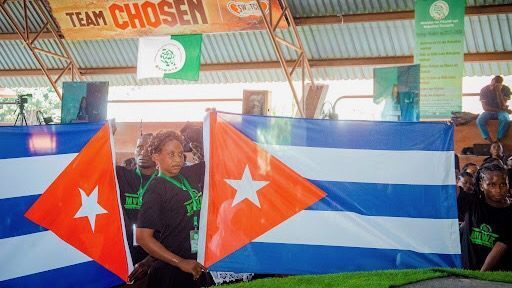

On the opening day of its National Smallholder Farmers’ Conference and 31st Annual General Meeting (AGM), held from September 29 to October 1, MVIWATA, Tanzania’s national network of smallholder farmers’ groups, set aside time during a program on land, seed, and markets to state solidarity with the peoples of Palestine and Cuba, with the ambassadors of both countries present in the hall.
“We, the members of MVIWATA, who have convened in Morogoro for our 31st Annual General Meeting, wish to give a brief statement in support of the people of Palestine and the Cuban people,” read Theodora Pius, MVIWATA’s head of program, opening the statement. The organization said it was “extremely angered by the ongoing genocide of the Palestinian people” and “frustrated to see an open silence on war crimes that happen every day against the people of Palestine by the State of Israel and its allies.” It said its solidarity was with all of Palestine, “not only in the Gaza Strip.”
The statement then turned to Cuba, denouncing more than 60 years of US-imposed blockade, it said, imposed because Cubans exercised their freedom to choose their own political system, and went on to articulate what the blockade now means: “no electricity, no fuel, no medicines, no food.” Despite this, the statement said that the Cuban people have continued to send their expertise (doctors above all) to support life in other countries.

The Cuban Ambassador, Yordenis Despaigne Vera, addresses delegates attending the National Smallholder Farmers’ Conference and the 31st Annual General Meeting of MVIWATA.
The Cuban Ambassador, Yordenis Despaigne Vera, thanked the smallholder farmers and described the current stage of the blockade as an energy war. United Nations agencies reinforce this characterization. By May, the Cuban people were living with daily blackouts of up to twenty hours, and more than 100,000 patients, including 11,000 children, were waiting for operations delayed by power cuts and shortages. Cuba’s own health ministry recorded infant mortality rising from 7.1 to 9.9 deaths per thousand live births between 2024 and 2025. The ambassador called the United States program “a silent genocide” and said Tanzania’s government and people had stood with Cuba throughout. A week earlier, at the UN General Assembly, Tanzania’s Vice-President had reaffirmed the country’s “unwavering solidarity with Cuba” against unilateral sanctions. Last October, the Assembly voted 165 to 7, with 12 abstentions, to demand an end to the blockade; Tanzania voted in favor.
The Palestinian ambassador, Salam Abu Sharar, addressed the room of farmers. Land, he said, is close to the hearts of the Palestinian people and of MVIWATA alike, and the question of Palestine “is not about religion; it is about land.” In a hall where the first working session opened with the words “land is life, land is not a commodity,” he spoke the delegates’ own language: the struggle of Tanzania’s peasants and the national liberation of Palestine are one struggle.

The Palestinian ambassador to Tanzania, Salam Abu Sharar with MVIWATA Chairperson Apollo Chamwela. Photo: MVIWATA
MVIWATA has been here before. Its AGM in Njombe in December 2023 condemned Israel’s genocide in Palestine. In July 2025, it hosted the youth of La Via Campesina in Morogoro, whose declaration ended with “Free Palestine!” Within days of that meeting’s close, Israeli forces bulldozed the seed multiplication unit of the Union of Agricultural Work Committees, the Palestinian farmers’ organization in Hebron, destroying more than seventy local varieties. The same year, MVIWATA and the International Association for Popular Cooperation ran an Africa Bioinputs School in Tanzania, with participants from thirteen countries, including Palestine, learning how farmers make their own fertilizers and pest controls.
On the conference’s final day, the Tanzanian farmers resolved to build their own bank of indigenous seed. In Hebron and in Morogoro, the seed is where the struggle over who feeds whom begins. MVIWATA Chairperson Apollo Chamwela told the ambassadors that the organization stood ready to do for Cuba what it had tried to do for Palestine: collect food if mechanisms for transporting it can be arranged.
MVIWATA is a membership organization of smallholder farmers, founded in 1993 and organized across mainland Tanzania and Zanzibar. It was a meeting with a government minister as its guest of honor. Its statement on Palestine and Cuba came in the same breath as its demands for land, seed, and dignified prices for its members’ produce at home. For these farmers, sovereignty over food and sovereignty over territory are one question, whether the territory is a village in Kilosa or a hillside in Hebron.
The hall closed the statement with a call and response. “Long live Palestine! Long live!” “Viva Fidel! Viva!” “Viva the resistance of the people of Palestine! Viva!”

Photo: MVIWATA
Jonis Ghedi-Alasow is the Coordinator of the Pan Africanism Today Secretariat.
From BT News via This RSS Feed.