

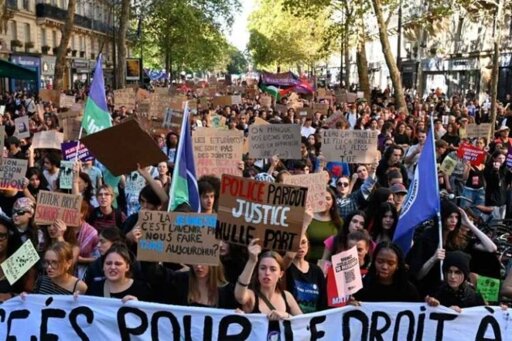
Faced with austerity measures, the dismantling of public education, precarious living conditions, authoritarianism, and — particularly in Europe —opposition to rapid military rearmament, young people are rising up in different parts of the world, rejecting the idea that they should accept deteriorating living conditions at home while being rallied behind their governments’ political and military agendas. The determination young people have shown in the streets could inspire workers to join the struggle, and their unity could carry the movement into workplaces, where strikes and other forms of collective action could deepen the confrontation with the government.
France, is currently the epicenter of class struggle, after massive and intense clashes that made worldwide headlines in recent days. The situation is intensifying, with the Macron regime stepping up repression and sectors of the establishment threatening to call in the army, while young people, alongside the Yellow Vests and sectors of the working class, make it clear that they are preparing to intensify the struggle. At the same time, Italy, Spain, Albania, and Portugal are among other countries where the past few days have seen mass mobilizations, sit-ins, and clashes with the police — demonstrating that, beyond the specific circumstances of each country, the rejection of the rottenness of this system is beginning to be felt more and more strongly beyond France alone.
France: A Night of Barricades Marks a Growing Protest Movement
Saturday, October 17, marked a historic day of barricades and mass mobilization, with more than 800,000 people taking to the streets across France. High school and university student assemblies, the Yellow Vests, and sections of the working class had called for a “Saturday of Rage,” even as the inter-union coalition — the coordinating body of the major union leaderships — refused to call a genuine general strike in the immediate future. The marches, barricades, and clashes with police defied the government’s repression and its administrative closure of schools.
You Might Be Interested In: The Labor Movement in France Must Join the Fight as It Did in 1968
This situation is putting Emmanuel Macron’s government on the defensive, as it moves forward with its repressive measures and is now instructing mayors in various cities to enforce a curfew and ban several demonstrations. Some sectors of the establishment are even calling for a state of emergency to be declared and for the army to be deployed to help repress the movement. Despite this, the determination to fight seems to be growing stronger, and various sectors are already calling for next Saturday, October 24, to be a “Second Act” that continues the massive demonstrations across the country. The organization Révolution Permanente, a sister group of Left Voice, has been emphasizing the need for the labor movement to join the struggle with their full force and for the trade union federations to urgently call for a general strike against Macron’s faltering government and its austerity measures.
This massive rebellion began on September 21 at the Saint-Exupéry High School in Créteil in the working-class suburbs of Paris, before quickly growing into a nationwide movement. It began as a protest against the lack of teaching staff and the appalling conditions in schools (overcrowded classrooms and even the presence of asbestos) and escalated to include hundreds of schools and dozens of universities (such as Paris 8, Nanterre, and the Sorbonne) in cities like Paris, Lyon, Marseille, Toulouse, and Rennes. Young people took to the streets to protest the proposed austerity budget of the government led by President Emmanuel Macron and Prime Minister Sébastien Lecornu, which would cut €54 billion by freezing salaries and eliminating jobs while increasing military spending by more than €6.4 billion.
Italy: School Occupations, Riots in Milan, and the Move Toward a General Strike
Chanting “We must do as they did in France,” young people took to the streets of Rome, Turin, Florence, Milan, Bologna, and other Italian cities on Friday and Saturday, condemning rearmament and austerity measures, rejecting Giorgia Meloni’s far-right government and its racist and ultra-repressive policies, and demanding an expanded education budget.
In Milan and Bologna, protesters resisted fierce police repression, and more than 200 people were arrested, most of them minors. The scale of the protests and clashes prompted Prime Minister Giorgia Meloni to convene an emergency cabinet meeting on internal security.
Meanwhile, a general strike called by the Union Sindical de Base (USB) is scheduled for October 30. It promises to be a significant day of protest. The CGIL, the country’s main labor federation, has called for a general strike on November 20, seeking to defuse the situation.
The momentum of the French struggle has resonated with Italian youth, fueling debate in schools and universities over Italy’s education budget — just 8 percent of public spending, two percentage points below the European average — and stagnant teachers’ salaries… Added to this is the outright rejection of the authoritarian policies and reactionary measures of the far-right government led by Giorgia Meloni and her Minister of Education, Giuseppe Valditara, which include explicit racism against migrant students.
Last year, Italian youth and workers led a massive general strike under the slogan “Blocchiamo Tutto” (“Let’s Block Everything”) in protest against Israel’s genocide in Gaza. Now that same call is being taken up across Europe as protests spread from country to country.
Spain: Education and Housing Struggles Fuel Calls for a General Strike
Spain is one of the most important flashpoints of this massive wave of rebellion, where young people and teachers are leading the charge against the dismantling of public education, austerity measures, and the brutal housing crisis that is suffocating working-class families with unaffordable rents and systematic evictions.
This discontent has led to a massive uprising that began with the indefinite teachers’ strike in Madrid, spearheaded by college and high school students alongside teachers and education workers. These protests are closely linked to the mass housing movement, which has made Puerta del Sol — the site of the historic 15-M encampment — a center of resistance to real-estate speculation, the expansion of the tourism industry, and precarious living conditions.
The government responded swiftly: on the first day of the education strike, police violently repressed students at the Complutense University of Madrid, firing rubber bullets at close range and arresting several. But the crackdown did not intimidate the movement; the Green Tide and youth collectives turned out in force across central Madrid, demanding the immediate resignation of those responsible for the police violence.
The coming weeks will be shaped by the November 11 call for a general strike, with grassroots committees already organizing to make it a day of active struggle. At the same time, the snap elections Pedro Sánchez has called for November 29 are approaching, and he will seek to channel that anger into the ballot box and empty the streets.
Portugal: Lisbon Protest Demands Higher Wages and Opposes New Rent Law
Lisbon saw a massive protest fueled by rising living costs, low wages, and opposition to a new rent law that threatens to worsen the housing crisis. At the rally, speakers denounced how real estate speculation is pushing working families and younger generations into a situation of unsustainable precariousness. This show of strength in the streets of Lisbon reaffirmed the decision to continue the fight against austerity. The demonstration, organized by the General Confederation of Portuguese Workers (CGTP), also protested the draft 2027 State Budget currently being debated in Parliament and demanded a 15 percent wage increase.
At the same time, housing-rights groups set up tents in Lisbon for an indefinite encampment, awaiting a response from the government. Their efforts follow an earlier attempt to establish encampments in Porto that was met with repression.
Germany: School Blockades Against the Education Crisis and Military Service
Following the school strikes that took place in September, German youth launched the first school blockades (Schulblockaden) during the week of October 12–16, using dumpsters, padlocks, and fences to block access to schools. The actions began on Monday, October 12, at the Französisches Gymnasium in Berlin and the Max-Brauer School in Hamburg, spreading to universities such as the Free University of Berlin (FU Berlin) and leading to a call for an open assembly this Friday, October 16, at the Technical University of Berlin (TU Berlin) under the slogan “GenZ regelt” (“Generation Z rules”).
The protesters are denouncing a projected structural shortage of 27,000 teachers by 2035 and the deterioration of school buildings. However, the central political driving force is the categorical rejection of state militarism and the plans of Friedrich Merz’s government to reintroduce mandatory military service (Wehrpflicht). The police have responded by forcibly clearing blockades and using chokeholds on minors, which has accelerated the organization of student committees to prepare for the International Youth Strike scheduled for November 20.
Belgium: Strike and Protests in Brussels Against EU Austerity Measures
In Belgium, following days of protests in Liège, Mons, and Charleroi on Thursday, October 8, more than 50,000 people — mostly high school and college students, along with the FGTB union — marched through Brussels the following day, bringing transportation to a standstill. Young people and workers took to the streets to protest the $11.2 billion austerity plan pushed by Bart De Wever’s government to meet the European Union’s fiscal targets and finance military spending.
In schools and universities, the budget cuts have resulted in tuition hikes, the elimination of free school meals, teacher shortages, and the presence of asbestos in school buildings. The October 9 march led to violent clashes with police in the capital’s downtown area, resulting in more than 110 arrests following the indiscriminate use of tear gas, while debate intensifies over a call for a general strike in late November.
Albania: The “Flamingo Revolution” and Student Protests Set Tirana Ablaze
In the Balkans, the student protest merged with the “Flamingo Revolution,” a mass movement that began in June and has been protesting for more than 100 days against the concession of Sazán Island and the protected Vjosa-Narta lagoon to Donald Trump’s son-in-law, Jared Kushner, for a 1.4 billion euro luxury resort. Thousands of high school and college students took to the streets of Tirana to protest unaffordable tuition fees, unheated classrooms, and the lack of jobs that is driving people to emigrate.
These have been days of fierce clashes. The protests escalated with the siege of Parliament, the burning of the Supreme Court, and the partial burning of the Ministry of Education, as well as attacks on branches of the Austrian transnational bank Raiffeisen, leaving 89 people injured and hundreds detained. Far from subsiding, the protests are spreading to other key cities such as Shkodër, Elbasan, Durrës, Vlorë, and Korçë, with a commitment to expand the daily rallies until Prime Minister Edi Rama resigns. However, he continues to insist that he has no intention of stepping down, further fueling the anger among Albanian workers and youth.
India: The “Cockroach Rebellion” Reignites Protests on the Streets of New Delhi
In South Asia, Indian youth recently secured a historic victory in July, when the mass mobilization organized under the satirical “Cockroach Janta Party” (Cockroach Janta Party—CJP) forced Narendra Modi’s authoritarian government to back down following the cheating scandal in the NEET medical school entrance exam, securing the resignation of Education Minister Dharmendra Pradhan, compensation for the affected families, and the withdrawal of legal charges. However, as their spokespeople had warned, this victory did not mean the end of the movement, but rather the beginning of a fundamental struggle against precarious conditions and the nationalist regime that has been implementing severe austerity measures in education.
In recent weeks, youth protests have once again taken over the center of New Delhi on a massive scale. Thousands of students and young people have once again flooded the streets to demand the immediate resignation of the head of the Election Commission (Gyanesh Kumar), denouncing the manipulation of voter rolls and the lack of democratic transparency. In the face of intensified repression ordered by the Modi government, young people are demonstrating that the “cockroach rebellion” remains as combative as ever and continues to stand on the front lines against state authoritarianism.
Chile: National Education Strike Challenges Budget Cuts
In the southernmost part of Latin America, the Chilean Student Confederation (CONFECH) and the Coordinating Assembly of Secondary School Students (ACES) led a national education strike on Thursday, October 1, under the slogan “Not a single peso less for education.” The protest condemned the budget bill proposed by the government of José Antonio Kast, which calls for the elimination of 15 educational programs and a 15% cut in funding for another 42 programs.
Massive marches took place in Santiago, starting from the former Plaza Baquedano/Dignidad, as well as in Valparaíso, Antofagasta, and Concepción. Police forces attacked the marches on the Alameda with water cannons and toxic gases to prevent the protest from advancing toward the capital’s downtown area, resulting in indiscriminate arrests.
The demonstrations in Chile and the emergence of the student movement coincide with the dramatic decline in the far-right government’s popularity and growing opposition to its austerity measures.
Brazil: Protests Against the Far Right
Across Brazil, mass demonstrations—with a strong youth presence—have condemned Flávio Bolsonaro and opposed a possible return of the far right to power. Large assemblies have also been held at universities. In this context, large assemblies have been held at many universities. The recent approval of an end to the 6×1 work schedule (six days on, one day off) is seen as a victory for this sector, showing that young people will not resign themselves to the loss of rights proposed by Bolsonaro. The massive scale of the demonstrations also shows that they will not accept harsh measures from a potential new Lula administration, should he manage to overcome the rightward shift reflected in the first-round results.
Colombia Takes to the Streets
In Colombia, just two months after the far-right Abelardo de la Espriella took office, the first major day of nationwide protests took place on Wednesday, October 14. In cities such as Bogotá, Popayán, and Cali, student groups marched alongside the United Workers’ Union (CUT) and social organizations.
Students and workers took to the streets to defend threatened gains such as free college tuition and labor rights. The mobilization rejected Decree 1525, signed by De la Espriella on Tuesday, October 13 — which allows for more flexible use of repressive force by law enforcement in response to road blockades.
These developments, along with the massive uprising that swept through Bolivia just a few months ago, show that despite the electoral victories right-wing governments have been achieving across the continent, their path to attacking working people is by no means clear.
A New Generation Is Rising Up
The present struggles do not fall from the sky. In recent years, we have witnessed the awakening of a generation that mobilized en masse around the world against the genocide — broadcast live — in Gaza. From the United States to Pakistan, from Chile to France, including the historic protests in Italy.
This profound rejection of the worst massacre so far in the 21st century — coupled with the increasingly evident weakness of U.S. imperialism, most recently marked by its resounding failure in the war in Iran —is giving rise to new ways of thinking and a sharper spirit of dissent.
This is a generation increasingly aware that the system offers it little hope for the future, as governments drag it toward austerity, the threat of war, and climate catastrophe.
Yet the return of young people to the streets cuts against those who hastily predicted that this generation had turned to the right. Far-right governments in Europe, the United States, and Latin America may try to set the agenda, but resistance to their reactionary plans is growing, as are calls for the labor movement to enter the struggle with its decisive strategic weight. The final word has not been spoken. A new wind is blowing from different corners of the globe, and it is the struggle that will ultimately define the spirit of the age.
Originally published in La Izquierda Diario on October 19
Translated and adapted by Adrien Masson.
The post Youth in Revolt: A Roundup of Protests in Europe and Around the World appeared first on Left Voice.
From Left Voice via This RSS Feed.