

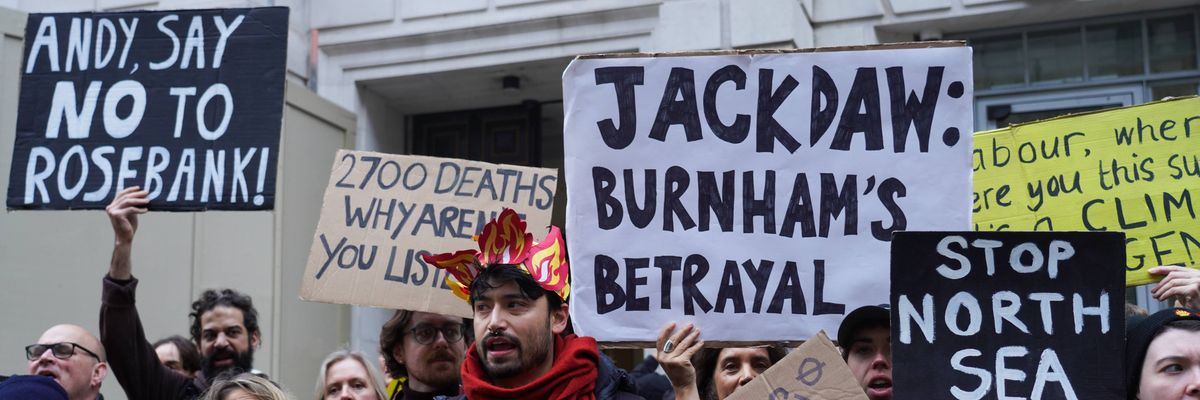
With drilling in the Jackdaw gas field in the North Sea set to go forward following the United Kingdom’s approval, announced on Wednesday, climate groups and progressive lawmakers demanded to know how Prime Minister Andy Burnham could declare the decision a “pragmatic” one, considering the meager job growth and energy savings and massive climate damage expected from the project.
“Is the prime minister living in a parallel universe?" asked Danny Gross, climate campaigner for Friends of the Earth (FOE). “One where we haven’t just endured our hottest summer on record, with droughts, wildfires and, in all likelihood, the most heat-related deaths on record?”
The approval of the oil and gas extraction from Jackdaw by Adura, a joint venture between Shell and Equinor, was announced as the United Nations warned that continued fossil fuel drilling has put the possibility of avoiding a global temperature rise that breaches the 1.5°C threshold out of reach, and emphasized that countries must take action to mitigate the damage and ensure the breach is temporary.
The UN said greenhouse gas emissions must be slashed by nearly one-fifth in the next four years to avoid the worst impacts of the climate crisis.
“Against this backdrop, there’s nothing that justifies giving the go-ahead to a colossal new fossil fuel project in North Sea. The disconnect is absolutely maddening,” said Gross.
The Jackdaw approval was announced as the government said inflation had jumped to its highest level in almost a year, with US President Donald Trump’s war on Iran and Russia’s invasion of Ukraine driving up energy prices worldwide.
But an analysis by the UK climate action group Uplift, which compiled data from the public record, found that the Jackdaw project would provide enough gas to displace just 2% of the UK’s current imports.
“This will not lower international gas prices paid by UK consumers,” said Greenpeace, which also emphasized that Adura has admitted in an environmental statement that the project is projected to create just 27 full-time jobs—making little difference to the area surrounding Aberdeen, Scotland, the center of the UK oil industry where local officials have reported losses of 1,000 oil and gas jobs per month.
Zack Polanski, the leader of Britain’s Green Party, said the projected impact of the Jackdaw project couldn’t compare “to all the benefits of investing in renewables and insulating our homes.”
CBI Economics found earlier this year that the UK’s green economy employs more than 1 million people and is worth £100 billion ($133 billion) per year, with workers in the sector paid more than the national average.
“Jackdaw won’t make a jot of difference to our energy bills, but it will fuel the climate chaos already unfurling in front of us. The route to lower bills and true energy security lies in the UK’s vast capacity for cheap, homegrown renewable power and street-by-street home insulation programs," said Gross. “This decision makes Shell and its shareholders richer at the expense of ordinary people’s lives—a move that sees the prime minister turning his back on the very people he claims to be on the side of."
Richard Burgon, a member of Parliament who represents Burnham’s Labour Party, called the approval “absolutely terrible” and urged the government not to “repeat the same mistake” with Rosebank oil field in the North Sea, which the prime minister said he would make a decision about at a later date.
Fossil fuel development in both the Jackdaw and Rosebank fields was blocked by a moratorium in 2024, imposed by the Labour government of former Prime Minister Keir Starmer. Drilling has previously been approved in 2022 and 2023 by the Conservative government. Supporters of oil and gas extraction in the North Sea have argued that since the fields were approved for exploration under the Conservatives, allowing drilling now does not violate the moratorium.
The climate impacts of the two projects are projected to cost each UK household £3,000 ($4,017) annually, according to Greenpeace, and gas production from Jackdaw is estimated to be equivalent to about 40 million barrels of oil, Adura has said.
“Using government calculations for climate harm, burning Jackdaw’s gas will cause an estimated £16.1 billion [$21.5 billion] in global damage and over 8,000 heat-related deaths,” said Greenpeace.
This past summer, extreme heat across Europe helped ignite wildfires and was blamed for tens of thousands of excess deaths on the continent. The breakdown of a glacier in Nepal and Tibet also caused a flooding disaster that killed more than 1,000 people.
“It is a shame that one of the first big decisions for the new energy secretary, Miatta Fahnbulleh, has been to approve more fossil fuel drilling," said Rosemary Harris, North Sea senior campaigner for Oil Change International. “At a time where the impacts of climate breakdown are so clearly felt, from the loss of livelihoods, homes, and lives in the UK over the summer, to the devastating floods in Nepal, our government should look to the future, not cling to the past.”
The approval also came weeks before Burnham is set to represent the UK at the UN Climate Change Conference (COP31) in Antalya, Türkiye.
While drilling in the Jackdaw field will “make no real difference to our energy bills or security,” said Bob Ward, policy and communications director at the Grantham Research Institute on Climate Change and the Environment at the London School of Economics and Political Science, "it will signal to other fossil fuel producers that they too should carry on with business as usual, less than a month before the COP31 United Nations climate change summit.”
Harris said that following the approval, “all eyes are now on Rosebank, and the hope that Andy Burnham and his energy secretary have the courage and vision to push back against the industry and plot a path to an energy transition that provides more security, lower bills, and a safe climate.”
From Common Dreams via This RSS Feed.