

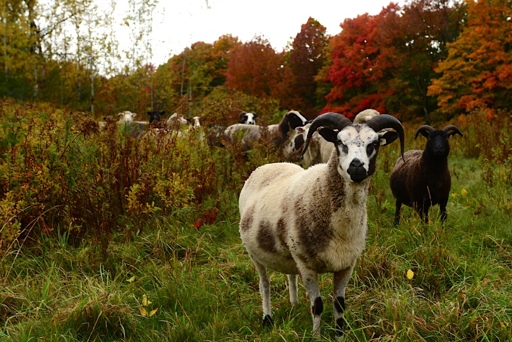
VERSHIRE, Vermont – When Sabra Ewing and Sebastian Lousada bought a tired dairy farm with pastures featuring old apple trees alongside sprouting maples, it was obvious that the grass below these trees’ crowns was a lot lusher than in the open. Then they noticed their sheep began to prefer those shady spots, and their manure added to the richness of the grass and of the other annual plants growing underneath. “You do a lot of observation when you’re a farmer, and when we put the heritage sheep in the orchard, we quickly noticed,” Ewing said in a phone interview after Mongabay’s recent visit. Then the couple discovered a grant program offered by the American Farmland Trust that would help them incorporate more kinds of trees into the 30 acres (just over 12 hectares) of pasture on their overall 250 acres (nearly 102 hectares). “I pounced on it, because I was already excited about this,” Ewing said. Flag Hill Farm co-owner Sebastian Lousada provides water to heritage breeds of sheep in grazing under 80 varieties of apple and other sorts of useful trees, Vershire, VT. Image by Erik Hoffner for Mongabay. That grant and other financial supports like one from the U.S. Department of Agriculture (USDA)’s Natural Resources Conservation Service (NRCS) helped turn their Flag Hill Farm – which now grazes heritage breeds of sheep under 80 varieties of apples plus other useful trees, to produce high quality wool, hard cider and brandy created in an on-farm distillery – into an…This article was originally published on Mongabay
From Conservation news via This RSS Feed.