

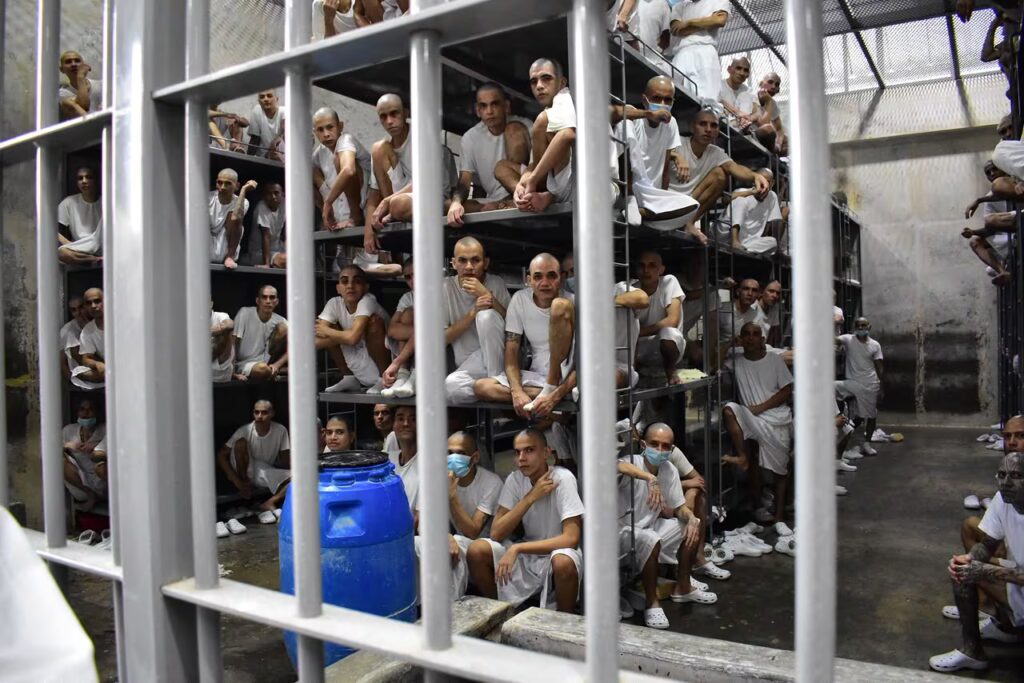
Honduras’ conservative-majority Congress approved a motion to seek funding for a new maximum-security prison modeled on El Salvador’s Cecot, aiming to confront a surge of violence that has left more than 1,000 people dead in just over ten months.
According to reports from the National Penitentiary Institute, the plan is to concentrate all inmates belonging to the Mara Salvatrucha (MS-13) and Barrio 18 gangs in a single module, as El Salvador’s President Nayib Bukele has done.
The proposal would rely on borrowing to finance the construction, and it follows a visit by a congressional delegation to El Salvador’s Terrorism Confinement Center (Cecot).
RELATED: Honduras Approves Sweeping Anti-Gang, Prison Security Law
“The approval of the motion to build a new maximum-security prison is part of the measures to strengthen prison security and confront crime firmly,” Congress President Tomás Zambrano said on social media. He added that the aim is not to carry out an identical replica but to “identify those successful models” and build a system adapted to local reality.
The motion came after a parliamentary delegation visited El Salvador’s Terrorism Confinement Center, known as Cecot. The experience shaped what lawmakers now want to build at home, though the backers insist the goal is adaptation rather than imitation.
“The approval of the motion to build a new maximum-security prison is part of the measures to strengthen penitentiary security and confront crime firmly,” said Tomás Zambrano, president of the legislature. He stressed the intention is not an identical replica but an effort to “identify those successful models” and build a system fitted to local conditions.
🏦🇭🇳FONDOS PARA CÁRCEL EN HONDURAS
El Congreso Nacional aprobó gestionar recursos para planificar una nueva cárcel de máxima seguridad. Instituciones evaluarán costos, terrenos y opciones de financiamiento como bonos o préstamos internacionales.#Honduras #Internacional pic.twitter.com/DSWXl5jczY
— Pulso Digital SV (@SVPulsoDigital) October 20, 2026
Text reads: “Prision funds in Honduras: The National Congress approved managing resources to plan a new maximum security prison. Institutions will assess costs, land and financing options such as international bonds or loans.”
Debt and Doubts Loom
The proposal relies on public debt to finance the infrastructure. That choice has drawn concern, as has the logistical question of transplanting a model from El Salvador, a country whose territory is comparable to a single Honduran department, into a nation of more than 10 million people with far more complex territorial dynamics.
The final location will depend on the technical judgment of the National Penitentiary Institute and defense institutions. To define the technical and financial route, the legislature’s leadership convened a working group bringing together party heads, legislative commissions, the Security and Finance secretariats, the National Police, the Armed Forces and the National Agency against Organized Crime.
The motion had the support of the Libertad y Refundación (Libre) bloc, whose lawmakers nevertheless accused the National Party of applying a double standard. They recalled that Congress rejected a similar proposal from former president Xiomara Castro (2022-2026) to build a maximum-security prison far from urban areas, citing environmental impact and possible human rights violations.
Honduras reduced its homicide rate between 2024 and 2025, but extortion, drug trafficking, assaults and territorial control by organized bands persist. More than 25 massacres, roughly 240 femicides and over 1,000 violent deaths were recorded during the current administration of the right-wing President Nasry Asfura.
¡Antes rechazaban la cárcel de máxima seguridad y ahora la venden como solución! El diputado @SergioC11938796 señaló la contradicción del Partido Nacional: se opuso al penal en Islas del Cisne y ahora impulsa otro en Santa Bárbara, además advirtió que construir más cárceles no… pic.twitter.com/4I0a4GScHL
— Bancada Libre (@BancadaLibre) October 20, 2026
Text reads: “They used to reject the maximum security prison and now sell it as a solution! The deputy
@SergioC11938796 pointed out the contradiction of the National Party: it opposed the penal in Cisne Islands and now promotes another one in Santa Bárbara, also warned that building more prisons does not guarantee to solve the insecurity in Honduras.”
The final location will depend on the technical judgment of the National Penitentiary Institute and defense institutions. To define the technical and financial route, the leadership of Congress convened a working group with bloc leaders, legislative committees, the Security and Finance ministries, the National Police, the Armed Forces and the National Agency Against Organized Crime.
El Salvador’s model has been criticized for human rights violations,masss incarceration and the detention of thousands of people who were jailed without proven links to gangs. Whether a Honduran version can deliver the promised security without repeating those costs is the question the working group must now answer.
From teleSUR English via This RSS Feed.