

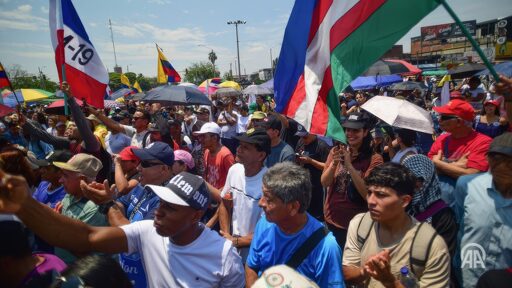

On October 14, tens of thousands of Colombians took to the streets to protest against the government of far-right leader Abelardo de la Espriella, who has been in office for just two months.
The protests demonstrated the opposition’s clear ability to mobilize its base and fill the streets of several Colombian cities, even though the new government is still in its early days.
Protesters – including members of labor unions, Indigenous organizations, opposition parties, and students – marched through the streets of the capital, Bogotá, as well as other major cities across the country, such as Cali, Medellín, Bucaramanga, Riohacha, and Pereira.
In an address to the nation, De la Espriella stated that 98% of the protests were peaceful, though he also warned the demonstrators: “From the very first day of my administration, I have issued a directive that leaves no room for interpretation: peaceful protest is respected, protected, and guaranteed. But violence, vandalism, and any attempt to violate the rights of others will have no place under my administration.”
He also added: “Here there is a state, here there is authority, and here there is a government that respects freedoms, enforces the law, and protects the millions of Colombians who get up early every day to work and build our nation.”
Criticism
The main criticisms leveled against the government focused on the executive branch’s neoliberal agenda and its security policy. According to the protesters, De la Espriella is failing to address the difficult labor, educational, economic, and territorial conditions faced by Colombians; on the contrary, his political agenda is making these circumstances worse.
Specifically, the protesters complained about cuts and adjustments to the budgets of public institutions, the lack of greater public investment in education, and the fear among several indigenous organizations that the government’s new measures will prevent them from freely exercising their right to protest.
In fact, one of the main catalysts for the protests has been the signing of a presidential decree that empowers state agents to intervene more directly against protesters – a move that has been criticized, according to the protesters, for its anti-democratic intent.
On this point, social organizations, such as the Cauca Regional Indigenous Council assert that, fearing a popular backlash like the one Iván Duque faced (which turned into what some called a “rebellion” by young people that lasted several weeks in 2021), De la Espriella signed Decree 1525, which modifies law enforcement protocols to give state forces greater leeway when dealing with protesters.
Among other measures, law enforcement can now take direct action in response to protests without the need for exhaustive dialogue, as previously required by the regulation. Several human rights organizations have expressed concern about the decree, stating that it could increase the risk of abuses and reduce mediation as the primary course of action, which already was barely used. During the 2021 national strike in Colombia, 46 people were killed in the context of the heavy police repression of the strike.
One of the people attending the demonstrations last week was former President Gustavo Petro, who optimistically stated that the protests reflect a popular response to the executive branch’s decisions: “The people can organize themselves, and two months into the start of a tyrannical and imposed government, this is the best wake-up call. The time has come for a Latin American day of popular mobilization.”
Petro, who has just resumed leadership of the Pacto Histórico – a coalition of movements that supported his political project – also said: “This is how we respond to adversity with dignity, with the determination to win again, without fear. Life is our companion, not death. The people won’t give up, damn it.”
From BT News via This RSS Feed.