

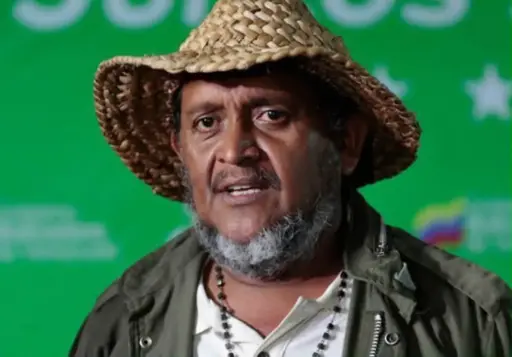
Caracas (OrinocoTribune.com)—On Sunday, Venezuelan campesino leader Jesús Osorio passed away. A farmer from Portuguesa state and spokesperson for the Campesino Struggle Platform, Osorio helped organize the Admirable Campesino March of 2018 and defended rural workers against landowners, forced evictions, and abuses by officials responsible for implementing Venezuela’s agrarian policies.
His activism combined a commitment to the Bolivarian Revolution with public denunciations of corruption and the reversal of land redistribution. He demanded that institutions uphold the rights campesinos had secured under President Hugo Chávez, confronting officials whose actions, he argued, favored large landowners.
From Portuguesa to Miraflores
In July 2018, campesinos began walking from Portuguesa toward Caracas to demand protection from rural violence, access to agricultural supplies, and an end to evictions and the criminalization of struggles for land. After approximately 20 days, the march reached the capital on August 1.
The mobilization faced attempts to discredit it. A retrospective published by Utopix documented accusations that the march had been infiltrated or manipulated by the right wing. Police and National Guard personnel initially blocked its advance toward Miraflores Palace. Nevertheless, President Nicolás Maduro received its representatives the following day in a nationally televised meeting.
Osorio, alongside fellow spokespersons Arbonio Ortega and Nieves Ríos, presented demands that were collectively formulated by the movement. These included restructuring agricultural institutions, investigating corruption, reviewing prosecutions against campesinos, returning disputed lands, and investigating killings attributed to hired gunmen and landowners.
President Maduro permitted the return of some lands previously allocated under President Chávez and instructed then Vice President Delcy Rodríguez and Constituent Assembly President Diosdado Cabello to coordinate responses to the movement’s demands. He also called for investigations into killings and judicial persecution.
During the meeting, Osorio explicitly reaffirmed his loyalty to the Bolivarian Revolution while denouncing influence peddling, corruption in the National Land Institute (INTI), and persecution through local courts. His intervention challenged the conduct of officials who, he maintained, were undermining the very agrarian policies they were responsible for carrying out.
Confronting officials and defending Hugo Chávez’s agrarian reforms
The presidential meeting did not end the conflict. In an October 4, 2018, statement, Osorio complained that campesino organizations were still awaiting fulfillment of the commitments that were announced. He also reported that security personnel had interrupted an attempt to address the press in Caracas.
Addressing PSUV leaders Maduro, Cabello, and Rodríguez, he rejected efforts to portray the campesino movement as “terrorist” or aligned with the right wing. He accused public officials of turning lands recovered under President Chávez into opportunities for private enrichment.
By June 2019, campesinos had occupied INTI’s Caracas headquarters to demand action on unresolved land disputes. In a July interview published by the Observatory of Political Ecology of Venezuela and reproduced by Biodiversidad en América Latina, Osorio condemned what he described as systematic harassment intended to dispossess campesinos of lands allocated during Chávez’s presidency.
He accused former INTI president José Ávila Bello’s administration of facilitating ownership claims benefiting landowners. He also criticized the fact that agricultural investment is concentrated among large economic groups while small producers struggle to obtain financing and supplies during planting season.
In a recorded address during an August 6, 2019, mobilization, Osorio again criticized the failure to implement Maduro’s instructions. He reported that only 28 of 211 land cases addressed in the negotiations had been resolved.
“We will not allow a band of unworthy officials to hijack the Bolivarian Revolution,” he declared. The movement’s statement simultaneously condemned imperialist intervention and the economic blockade, supported President Maduro, and demanded accountability from Venezuelan institutions.
Osorio continued organizing in 2020. At a January assembly in Santa Bárbara del Zulia, he challenged campesino organizations to secure agricultural supplies, defend disputed lands, and prepare production plans. He urged them to defend Venezuela’s Bolivarian Revolution while confronting officials accused of reaching agreements with landowners at rural communities’ expense.
Tributes recognize his struggle
Following his death, the Venezuelan Presidential Press Office recognized Osorio’s dedication to rural workers, describing his life as an example of dignity, organization, and commitment. Últimas Noticias and Diario Vea reported on the tribute.
Content creator Oswaldo Rivero, known as @mangozurda, also recalled the attacks Osorio had faced. In a social media post, Rivero said he met the campesino leader after his crops had been burned and he had survived an attack that Rivero attributed to landowners.
Free Men and Liberated Land: Defending Chávez’s Legacy in the Venezuelan Countryside
Rivero remembered Osorio’s subsequent leadership in the march from Portuguesa to Miraflores and the hostility he encountered across political sectors: “Government and opposition demonized him, but he stood firm. Honor and glory!”
Special for Orinoco Tribune by staff
OT/JRE/SL
From Orinoco Tribune via This RSS Feed.