

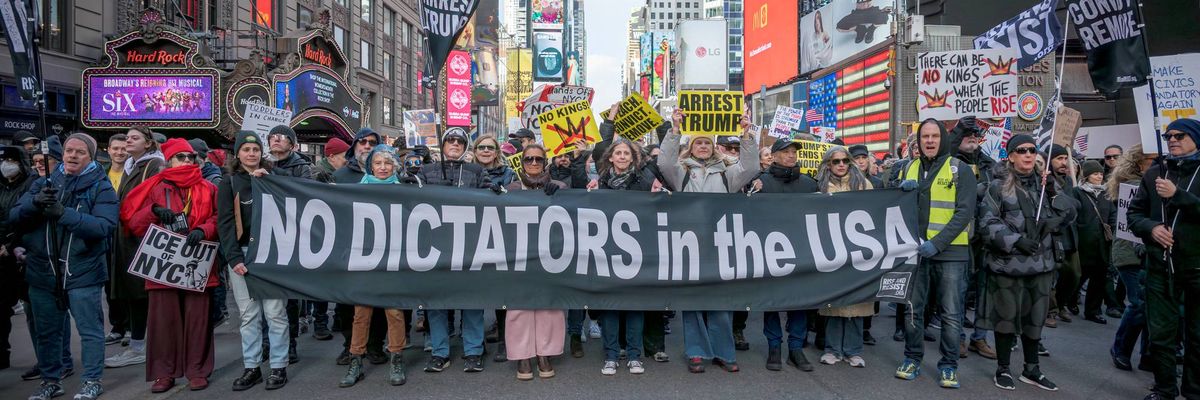
A majority of Americans believe President Donald Trump is a “potentially dangerous dictator” whose power must be checked, a new national survey released Tuesday revealed amid deepening public pessimism about the country’s direction ahead of next month’s midterm elections.
The 2026 American Values Survey, conducted by the nonpartisan Public Religion Research Institute (PRRI) in partnership with the Brookings Institution, found that 58% of Americans agree that “President Trump is a potentially dangerous dictator whose power should be limited before he destroys American democracy.”
That’s up from 52% who said the president is a possibly dangerous dictator in last year’s survey.
Among Democrats, 90% consider Trump a dangerous dictator, while 64% of independents and 20% of Republicans felt the same way.
Two-thirds (68%) of respondents said their opinion of Trump has mostly worsened over the last two years, including in communities that had been among his core supporters. Trump’s favorability among Hispanic Protestants has dropped from 51% in 2024 to 31%, and Hispanic Trump voters were twice as likely as white Trump voters to say they regret supporting the president.
“The coalition that put Donald Trump back in the White House is breaking apart, with 76% of Americans saying the economy is on the wrong track,” PRRI CEO Melissa Deckman said in a statement. “His 2024 gains are clearly not a long-term realignment, as we see Black, Hispanic, and young male voters moving back to Democrats.”
Meanwhile, just 37% of those surveyed agreed with the statement that Trump is “a strong leader who should be given the power he needs to restore America’s greatness.”
Regarding one of those powers—the ability to set immigration policy—a majority of Republicans (62%) and white evangelicals (53%) said they support locking up undocumented immigrants in “internment camps,” a policy backed by 16% of Democrats and 28% of independents.
Nearly half of those surveyed (48%) said the Make America Great Again movement “poses a serious threat to the country,” compared with 36% who said the same of the Democratic Socialists of America. More than 8 in 10 Democrats (82%) see MAGA as a serious threat, while 7 in 10 Republicans (72%) said the same of the DSA.
The survey showed that only about half (52%) of respondents have confidence in US elections, and that 82% of Republicans believe that the biggest problem in the nation’s elections is “ineligible people casting votes,” while 80% of Democrats said the biggest problem is “eligible voters being denied the right to vote.”
More than one-third (35%) of respondents said that “if there are serious concerns about voter fraud in a local voting location, the president should order federal agents to seize the ballots and take over the vote counting,” with 6 in 10 Republicans agreeing with the statement.
A slim majority (51%) of respondents were more likely to agree with the statement, “Socialism is best understood as a system in which the government provides benefits such as health insurance, retirement support, and access to free higher education” than with the statement, “Socialism is best understood as a system in which the government controls major parts of the economy, such as utilities, transportation, communications, and banks," with which 43% concurred.
Four in ten Americans (41%) agree that capitalism is no longer working for average Americans and the country should consider adopting some aspects of socialism – including nearly half of Americans ages 18-29 (48%).
[image or embed]
— PRRI (@prri.org) October 20, 2026 at 5:43 AM
The survey showed growing dissatisfaction regarding the country’s trajectory. Seven in 10 respondents (71%) said the United States is headed in the wrong direction, while 76% said the same of the economy. Both figures have risen substantially since last year.
The survey also found that an “empathy gap”—the level of belief in the importance of empathy—is growing between white conservatives and other Americans. While two-thirds of Americans, including 84% of Democrats and 70% of independents, said they believe that “empathy is a foundational moral value that helps build a healthy society," only 54% of Republicans and 48% of white evangelical Protestants agreed.
Fifty-four percent of white evangelical Protestants said they believe the opposite: that “empathy can become dangerous when it leads people away from building a society guided by God’s truth.”
“As Christian nationalist leaders attack the sentiment of empathy, a disturbing ‘empathy gap’ has opened, separating Republicans and white evangelicals from most other Americans,” PRRI president and founder Robert P. Jones said in a statement. “Such orchestrated attacks are typical of violent authoritarian movements and should be disturbing to all who care about the moral foundations of our pluralistic democracy.”
From Common Dreams via This RSS Feed.
The word “potentially” seems out of place
