



Ted Eytan // Creative Commons
In the leadup to the 2026 election, EITM’s groundbreaking journalism could use your support. Become a subscriber today.
In the first few weeks of October, three national pollsters asked three different questions about transgender issues, and all three landed in the same place from different angles: the anti-transgender ads this year may be backfiring on Republican strategists. Navigator Research, AP-NORC and ABC News/Washington Post/Ipsos polls collectively found that voters trust Democrats on transgender issues and rank those issues as not very important to their vote, and that Republican and independent voters were less likely than Democrats to prioritize them. When the polls are contrasted with the massive amount of ad spend on transgender issues, there are signs, first seen in the Virginia gubernatorial election last year, that the high concentration of ads may turn voters off and could fuel, rather than suppress, a Democratic wave election in 2026.
The first poll to come out was the Navigator Research poll. In this poll, voters were asked to list up to five top issues, giving it a stronger signal than prior polls that only required voters to list their top issue. Even when voters were asked to list five, transgender issues ranked dead last among all 20 issues on the list. And Democratic voters were the most likely group to rank transgender issues a top issue, meaning many of those who did are likely voting to protect transgender rights, not to restrict those rights. Prior polls from Gallup have found similar results, although this poll is most notable due to its top-five format.
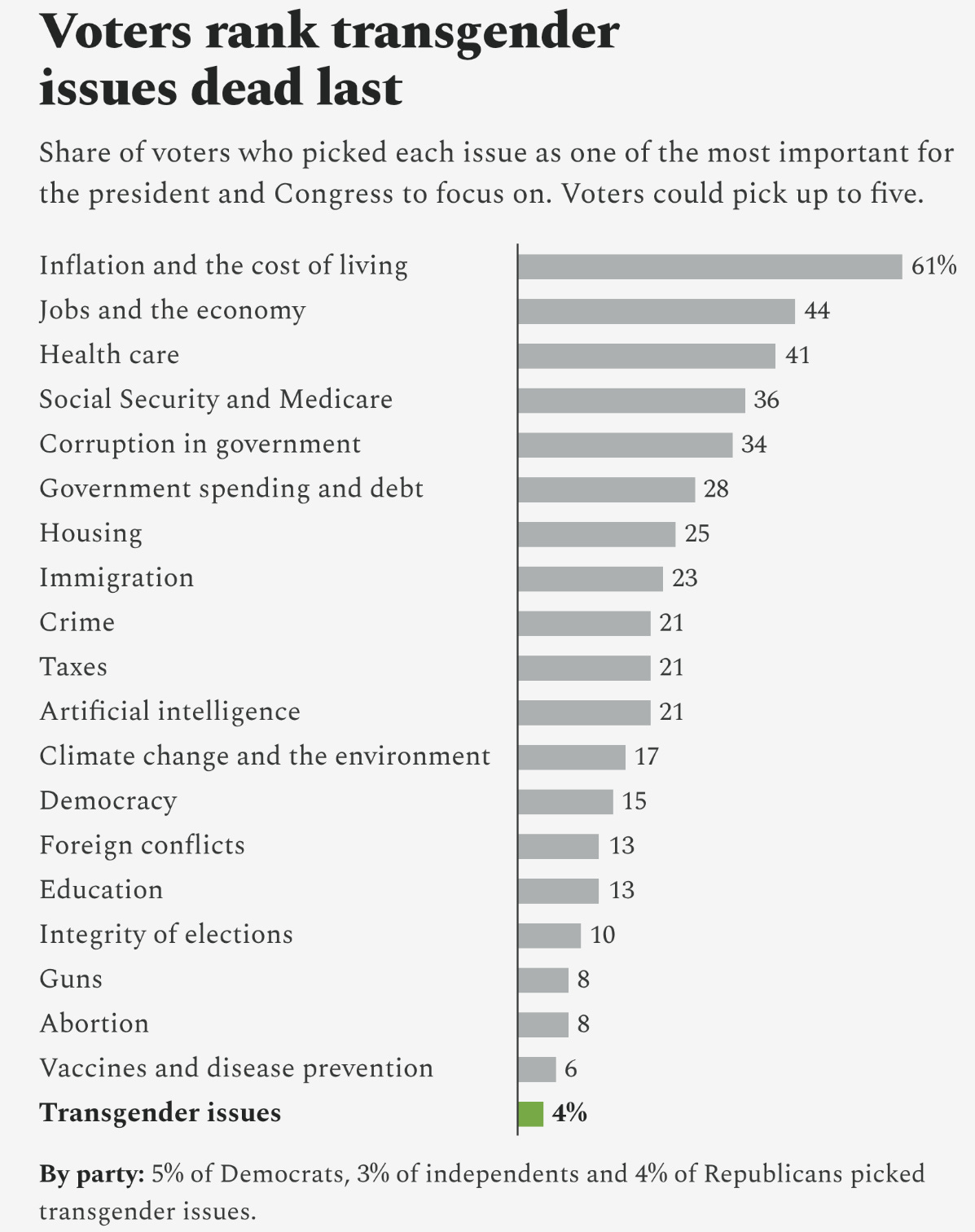
Navigator Poll
Then, another poll came out: AP-NORC asked Americans on a per-issue basis how important each issue was to their own vote. Whereas most issues asked about were considered “one of the most important,” such as the economy and the war with Iran, only 11% of respondents named transgender issues one of the most important to their vote. Furthermore, 51% of respondents said that transgender issues were “not an important issue” at all, the only issue to score higher than the teens on that question. And as we know from prior polling, Democrats are much more likely to answer that transgender issues are important to them.
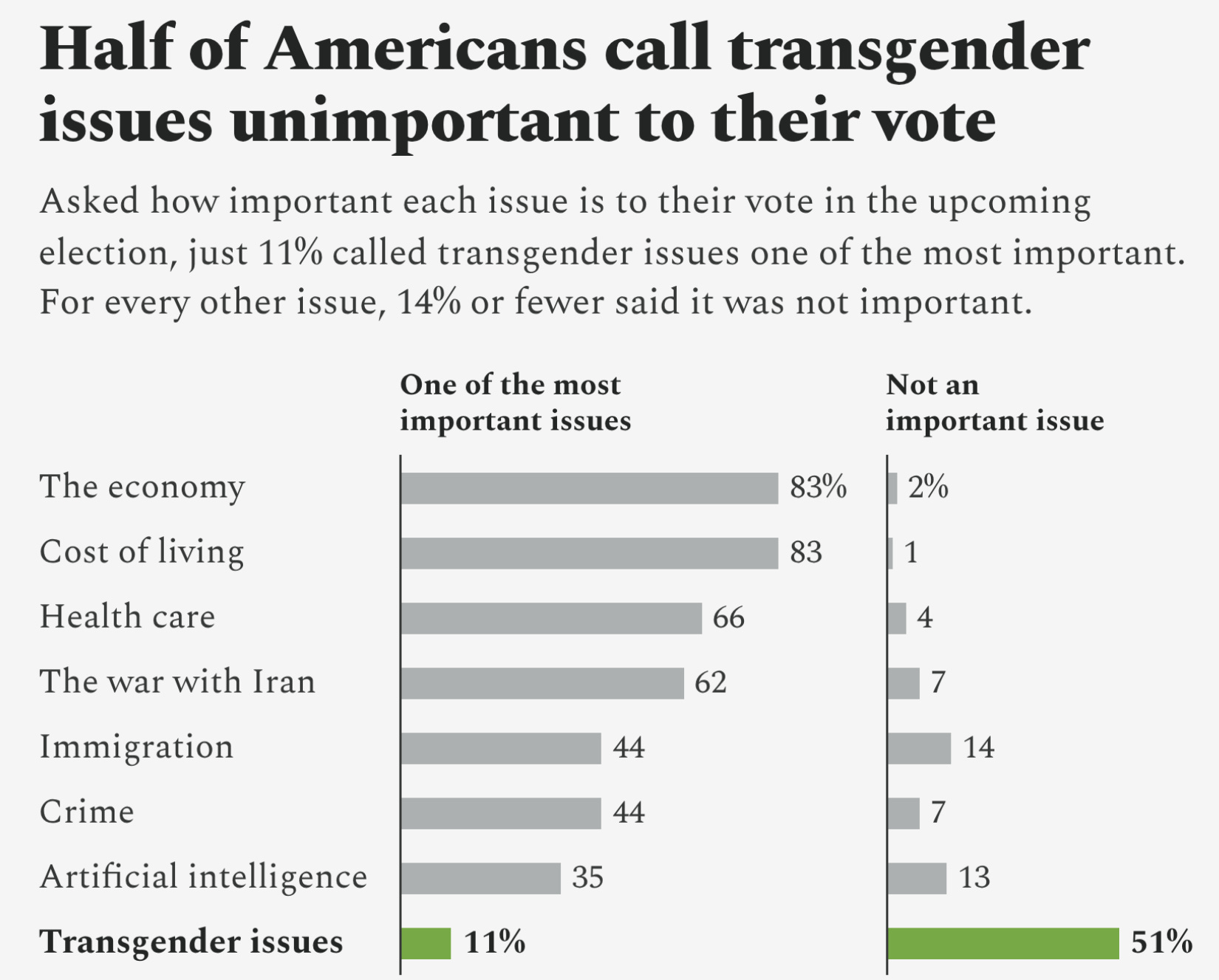
AP NORC poll
Lastly, an ABC/Post/Ipsos poll has been released that outright asks Americans which party they trust to do a better job on transgender issues. Of those asked, 38% of Americans say they trust Democrats on transgender issues when compared to 29% who say they trust Republicans, a 9-point Democratic edge. Notably, Americans trust Democrats on a whole host of issues that the survey asks about, ranging from health care to the economy. Only on crime do respondents trust Republicans more than Democrats, a poor sign for the Republican Party in the lead-up to the 2026 elections.
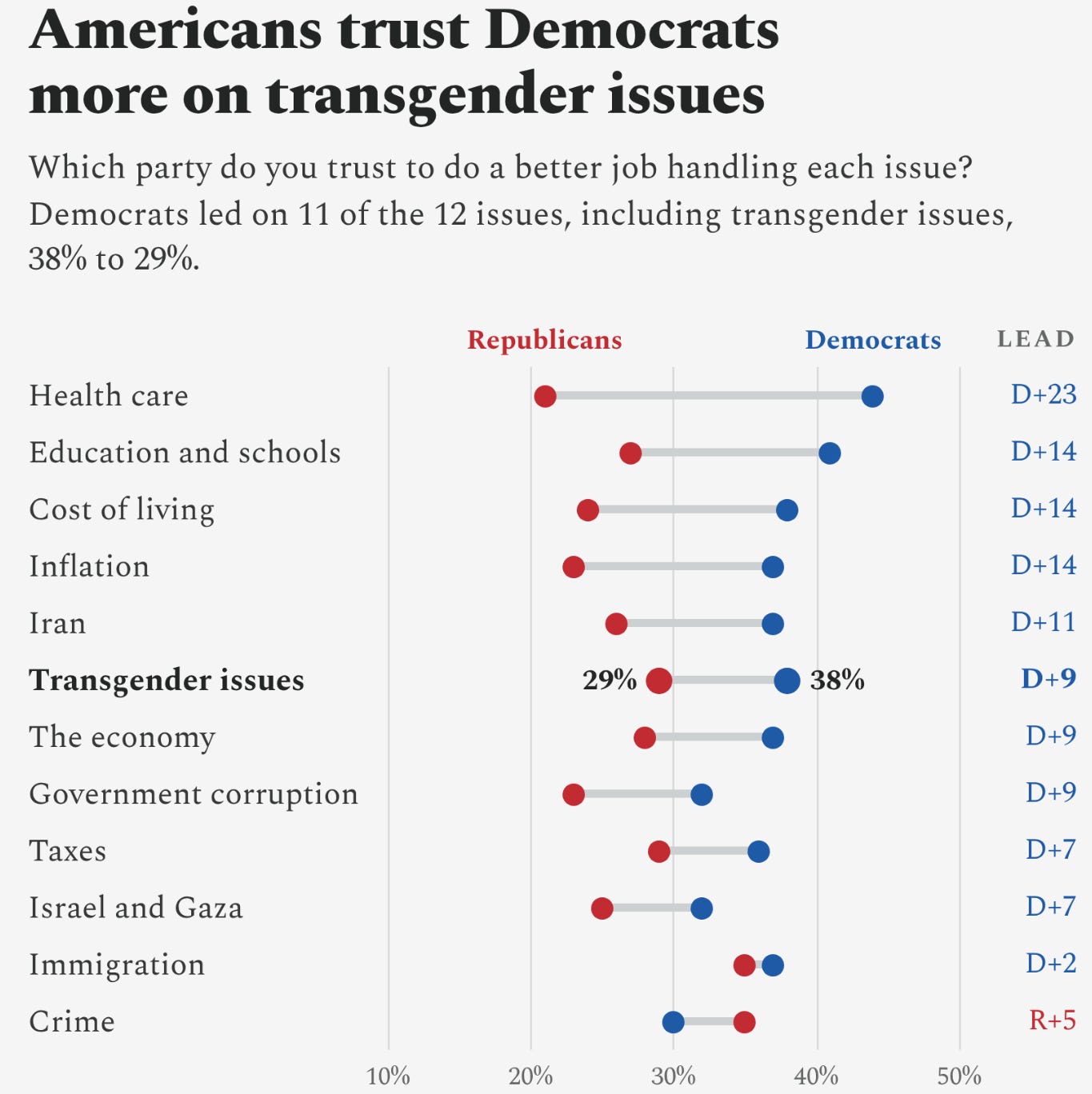
ABC/Post/Ipsos Poll
These results are heavily contrasted by the money being spent on anti-transgender ads. According to AdImpact data, more than $100 million has been spent since Aug. 1 on more than 200 ads that use the phrase “sex change.” Meanwhile, Elon Musk’s America PAC has committed $100 million to a midterm push heavy on anti-transgender ads aimed at Democrats. EITM has received reports of mailers in several races ranging from state legislative to congressional campaigns that such data has no way of capturing, and many political pundits have pointed out that the anti-trans ad focus seems to be a defining issue in the 2026 midterms.
Republicans are starting to sound the alarm that the anti-trans ads are not working. The American Principles Project, one of the progenitors of anti-transgender ads, has admitted that such ads “may not be sufficient” on their own this election cycle for Republicans to win the midterms. And former Texas House Speaker Dade Phelan, a Republican, said last week that the ads are just “not resonating” with Texas voters. Now, these polls confirm the fears of Republican strategists about the effectiveness of the ads.
If all of this sounds familiar to EITM readers, it is because similar dynamics played out around the same time in 2025 in Virginia’s gubernatorial and House of Delegates elections. Voters, when asked who would better handle transgender issues, named Abigail Spanberger, the Democratic candidate for governor, over Winsome Earle-Sears, the Republican. Despite this, Earle-Sears kept pouring more and more money into anti-trans ads, with such ads making up a whopping 57% of Republican ad spending in the race. Even though polls showed a closer race, Spanberger took the contest by 15 points and Democrats scored a 64 seat historic majority in the House of Delegates. Not only did anti-transgender ads not work, but the sheer volume of them may have turned off voters who ultimately trusted Democrats over Republicans to handle such issues.
Could we see similar results in the 2026 elections? The signs are there. Polling shows Democrats running ahead, and forecasters favor them to win both the House and the Senate this year, while races in states normally far out of reach for Democrats appear to be floating into their grasp. Republicans, meanwhile, keep pouring money into targeting transgender people, perhaps unable to run on much else, even as their own strategists warn it may not be enough. This could be the year the gambit fails on a national scale. Voters will deliver their verdict on Election Day, Nov. 3.
In the leadup to the 2026 election, EITM’s groundbreaking journalism could use your support. Become a subscriber today.
From Erin In The Morning via This RSS Feed.