

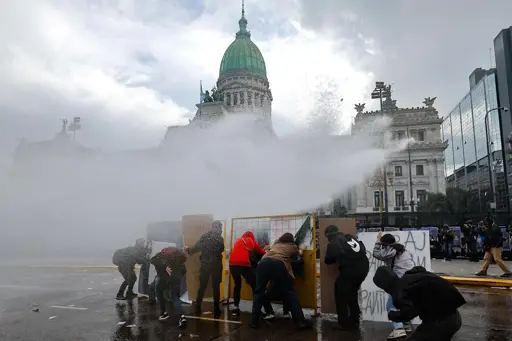
Argentina’s Provincial Commission for Memory (CPM, in Spanish) filed a criminal complaint Monday against national government officials over the police operation that left more than 550 people injured during the fifth federal university march in Buenos Aires.
The complaint, submitted to the Federal Court led by Judge Sebastián Ramos, calls for an investigation into both the officers who took part in the operation and the political authorities who ordered the security deployment during the day of protest.
A report prepared by the autonomous body found that the police intervention stretched on for more than three hours.
Security forces fired rubber bullets horizontally at the bodies of demonstrators, deployed water cannons at high pressure and launched more than 120 tear gas grenades in what the report described as a disproportionate use of force.
The formal filing also stated that the attacks reached medical assistance teams, press workers and human rights observers. At the same time, the National Committee for the Prevention of Torture monitored the street actions and warned of an abusive use of force that led to the detention of four adults and two teenagers.
View this post on Instagram
Over 550 injured
The figure of more than 550 people affected or injured gives the operation a scale recorded in Argentine protests. The Argentine Provincial Commission for Memory report documented the trajectory of the rubber bullets, the intensity of the water cannons and the volume of chemical agents deployed against a crowd that included students, teachers and ordinary citizens.
The fifth federal university march brought thousands of people into the streets across the country to demand that President Javier Milei enforce the University Financing Law. The legislation, approved by the National Congress and reaffirmed after being vetoed by the executive branch, has the backing of the judiciary to guarantee the budget of the public education system.
Human rights organizations demanded the urgent delimitation of criminal and institutional responsibilities in the face of the reported escalation of violence. Torture prevention bodies stressed that the use of less lethal weapons requires strict protocols to protect the integrity of those exercising their constitutional right to protest.
View this post on Instagram
Judicial action advances
The advance of the legal actions keeps the conduct of the Ministry of Security and the management of social conflict in the Argentine capital at the center of national debate. The complaint before Judge Ramos seeks to establish who ordered the deployment and who allowed the operation to continue for hours despite the growing number of injuries.
University communities announced that they will maintain institutional and street actions to demand the budget allocation that the law grants to higher education institutions. The protest movement shows no sign of retreat, even as the judicial process begins to examine the events of the march.
Argentina Signs Defense Memorandum With ‘Israel’, Deepening Strategic Ties
The Provincial Commission for Memory (CPM, in Spanish), an autonomous body with a long record of documenting state violence, placed the operation within a broader pattern of concern. Its report argues that the use of force crossed the line separating legitimate public order maintenance from punishment aimed at those who dissent.
The case now rests with the Federal Court, which must decide whether to summon the security agents and the political officials identified in the filing. The outcome will shape how Argentina addresses the use of force against social protest, a question that has divided the country since the march left its toll of injured demonstrators on the streets of the capital.
(Telesur)
From Orinoco Tribune via This RSS Feed.