

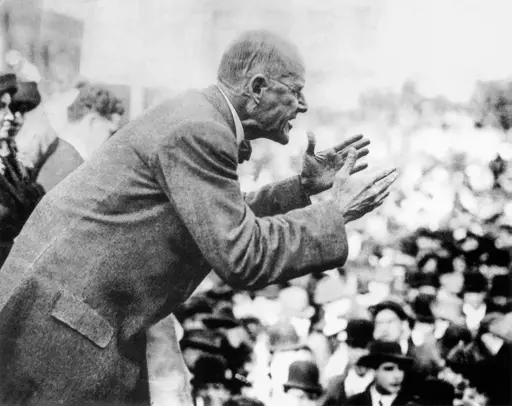
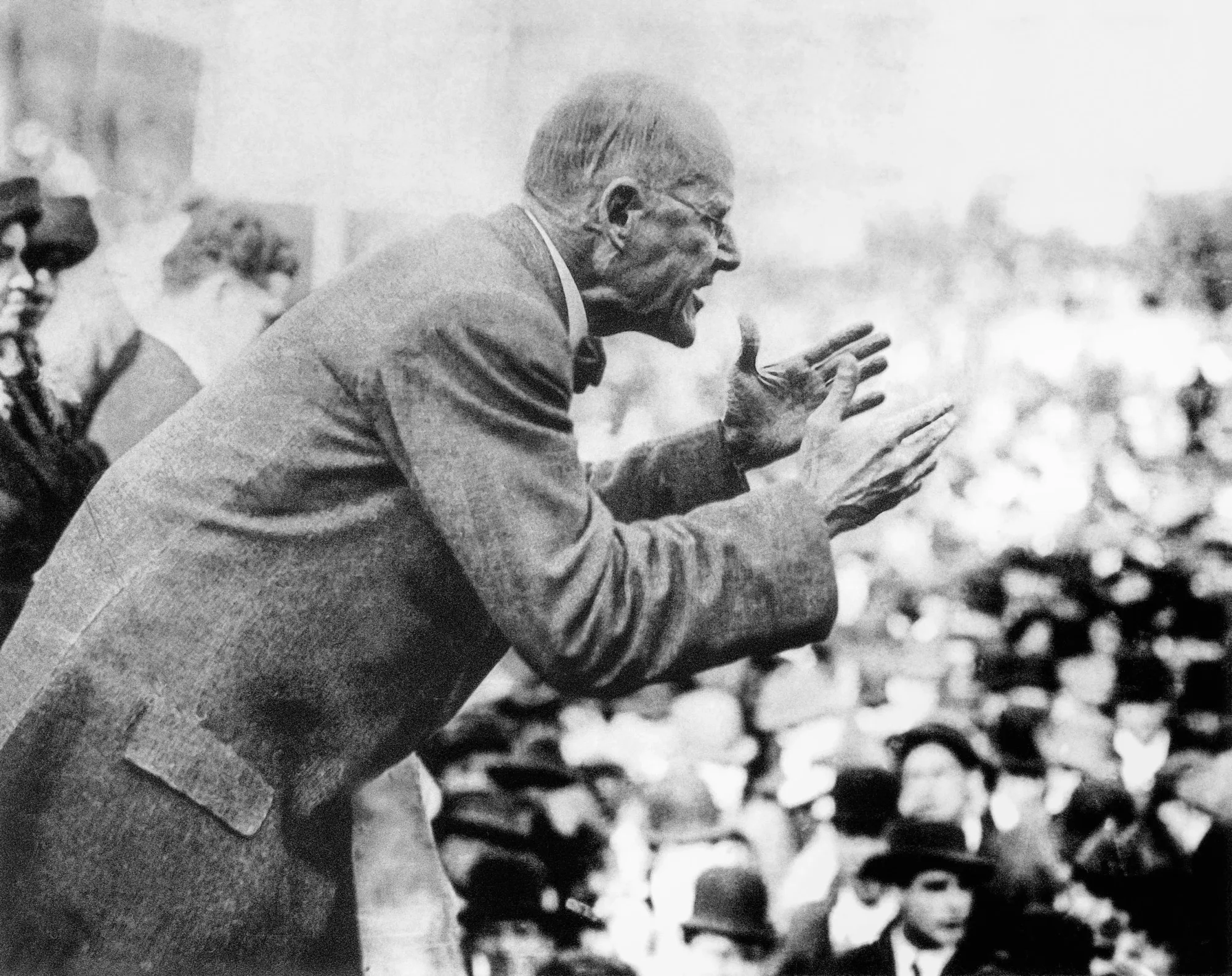
Eugene V. Debs died one hundred years ago today. As president of the American Railway Union, five-time Socialist nominee for president, and an anti-imperialist political prisoner, Debs was a heroic figure for generations of socialists and radical workers. When he died, his body lay in state in the Labor Temple of Terre Haute, Indiana, where delegations of thousands from across the country paid their respects as if attending a state funeral for the president of an American workers’ republic that never was.
Our historical memory of Debs and the party that made him has been obscured by the intervening century. In the early post-World War II years, when the Socialist Party was effectively dead and corporatist welfare capitalism was ascendant globally, historians regarded Debs as a footnote from a romantic age of American politics, notable mainly for filling an ideological niche the New Deal had made obsolete. Later historians like Nick Salvatore, writing at a time when the New Left was making sense of its own defeat amidst the conservative onslaught of the Reagan era, took “Debsian socialism” more seriously. But this revisionist generation went to great lengths to historicize Debs as a “native son,” setting his memory at odds with foreign strains of radicalism that supposedly marginalized American socialism from the mainstream of working-class life. Debs deserves to be rescued from this historical fog.
First things first: the socialist party-movement to which Debs owed his political life was not as marginal as historical consensus takes for granted. In its peak years, it boasted locals in every state in the country, hundreds of state and local electeds, two members of Congress, a sizable footprint in the American Federation of Labor, and a robust ecosystem of newspapers with a combined circulation in the low millions. Over 125,000 people were card-carrying Socialists in early 1912, making the party proportionally three or four times larger than DSA is today. The SPA was dwarfed by some of its sister parties in the Second International, but it was no sect.
Reflecting the complexity of the working class, the SPA was wildly politically diverse. Though Debs was initially a Democrat and Populist who came to socialism through his relationship with the “evolutionary socialist” Victor Berger, by the 1910s he generally fell in with the center-left of the party that embraced revolutionary social democracy in the tradition of Karl Kautsky and August Bebel. For Debs, this meant that the ballot was a powerful weapon in the proletariat’s hands, and it was not just acceptable but imperative for socialists to participate in elections under capitalism. But under a profoundly undemocratic state that privileged the interests of the capitalist minority, it also meant that socialists could not expect to gradually legislate capitalism into socialism.
Debs criticized both comrades who watered down socialism’s revolutionary horizons to hasten getting into government and those who rejected the importance of elections altogether. He argued that the purpose of socialist electoral action was to grow the party and popularize its program. Of course the party should run to win—there was no substitute for victory—but socialists should send members to office to raise hell and raise expectations, not bargain for reforms. For Debs, the point was always to build a majority mandate for a political and social revolution. Rather than reassuring the political class that he could be trusted to helm the state, he used his five presidential campaigns to name, indict, and antagonize the enemies of working-class freedom at every opportunity.
This “tribune” style of campaigning electrified the American working class and paid dividends for the Socialist Party. Some half-million people flocked to hear Debs speak during his famous “Red Special” tour in 1908, more than double the cumulative turnout for Bernie Sanders’ “Fight the Oligarchy” tour over a century later. Tens of thousands of these supporters became card-carrying Socialists. Debs won a million votes in 1912, with the greatest increases in turnout in states where left-wing Socialist branches shared his rough-and-tumble class-struggle approach to elections. In an era when well over half of the working class was disenfranchised, those million votes certainly belied a considerably larger base of support. Some estimates claimed a single day of pre-election rallies in 1912 drew over two million participants, making them as massive a social phenomenon at the time as any of the “No Kings” rallies are today.
Unfortunately, the constituency surging behind Debs never had the chance to seize power. The red wave crested in 1912. While the SPA continued to win real victories, the remainder of the 1910s saw it wracked by turmoil. Confusion about its relationship with middle-class progressives as the latter came to power under Woodrow Wilson, controversy over World War I, devastating wartime repression, and zero-sum factional fights culminated in the disastrous split of 1919. During these fractious years, Debs’ relentless agitation against the war landed him in prison, where he famously won another million votes from behind bars. When he reemerged in 1921, he found the party he had given his life to reduced to a pale imitation of its former self.
While generations of revolutionaries since Debs have waged heroic struggles that changed the course of history, something special died with the fall of the SPA: the promise of a mass democratic socialist party. That promise did not return to American political life until DSA’s rebirth in the wake of the 2016 Bernie Sanders campaign.
Since the lack of a socialist standard-bearer to succeed Sanders bore disastrous fruit in 2024, it has become clear that the resurgent democratic socialist movement must once again dare to challenge the presidency. When this happens, we not only deserve a modern Eugene Debs to champion our program and the historic mission it represents—we need one. Ours is an era that demands a politics of righteous outrage and all-conquering hope. To measure up to the moment, socialism needs fighters who will name the system and convince millions of people of their own power to overthrow it.
Is there a Eugene Debs waiting in the wings for 2028? Probably not. Debs was not just a well-spoken rank-and-file socialist when he first ran for President. He was already a sensational figure, nationally revered by workers and reviled by elites since earning his first stint in prison for leading the great Pullman Strike that shut down the country’s railroads in 1894. When Debs was released in 1895, a mass of one hundred thousand cheering workers greeted him in Chicago. By his first campaign in 1900, his reputation as a working people’s champion preceded him across the length and breadth of the country. Self-described socialists with anything approaching that appeal are few and far between in modern America. The only one who might plausibly run in 2028, Alexandria Ocasio-Cortez, will certainly not run as a Debs-style tribune.
Regardless of what happens in the presidential race, our task in 2028 is to prepare the ground to run a twenty-first-century Debs in 2032. One important step will be building a bench of tribunes in the halls of Congress by running DSA members for House seats with the understanding that they will campaign as a unified slate, emphasize DSA and our program on the campaign trail, and use their offices to sharpen the class struggle in close collaboration with DSA.
Eugene Debs has been dead a century today, but we have the power to make the dream he embodied for millions of people come alive again.
Light & Air / Marxist Unity Group
Liked what you read? Subscribe to stay plugged in.
From Marxist Unity Group via This RSS Feed.