

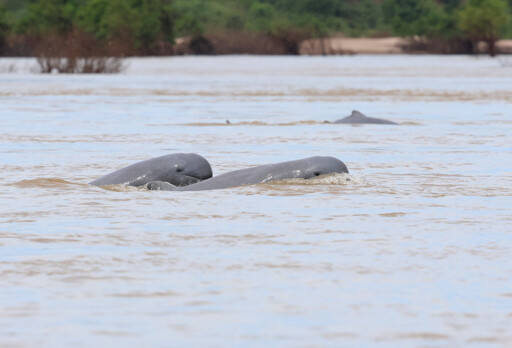
Cambodia’s population of critically endangered Irrawaddy dolphins has increased to an estimated 118 individuals since the confirmed birth of six calves this year. They were born along a 120-kilometer (75-mile) stretch of the river in Kratie and Stung Treng provinces, in the country’s northeast. Conservation officials say the births are a strong sign that the river’s sole cetaceans can recover if severe environmental threats are curbed, reports contributor Eung Sea for Mongabay. In Cambodia and Laos, Irrawaddy dolphins (Orcaella brevirostris) are regarded as sacred animals representing the ancestral spirit of the river. They also generate vital ecotourism revenue for riverside communities. “Irrawaddy dolphins are very important for our community,” said Heang Koeurn, a boat driver at the Kampi dolphin pool, a 60-meter-deep (nearly 200-foot) stretch of the Mekong that serves as a protected habitat for some 20 Irrawaddy dolphins in Kratie. “People here can make more income from tourists by driving them to see the beauty of Irrawaddy dolphins.” “They are a source of Cambodian national and local pride,” said Ian Baird, a professor of geography at the University of Wisconsin–Madison in the U.S. “They may also inspire people to protect the river and its tributaries from the impacts of more dams in the future.” Yet the Irrawaddy dolphin population in Cambodia’s section of the Mekong remains far below late-1990s estimates of roughly 200 individuals. The steep decline is largely from electrofishing, habitat degradation, and gillnet entanglement, which is especially deadly for calves, Sea reported. Additionally, more than 160 dams…This article was originally published on Mongabay
From Conservation news via This RSS Feed.