

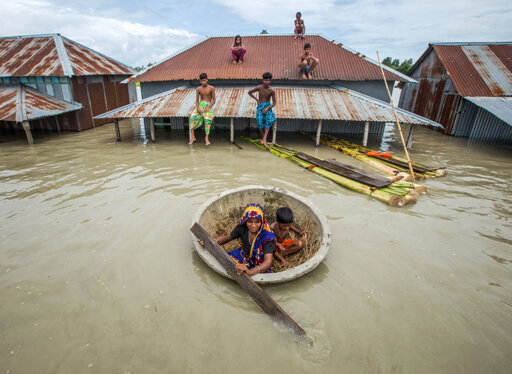
For 34-year-old Saiful Gazi — a resident of Ramjannagar Union in Shyamnagar, Satkhira, an area highly vulnerable to climate change — securing institutional financing is a major struggle. Gazi, who supports a family of four, endured the devastating Cyclone Aila on May 25, 2009. Cyclone Aila claimed 190 lives and affected approximately 3.9 million people in Bangladesh. Despite living in a disaster-prone region, he ventured into the fish business in 2022. Although he recently applied for a loan from a private bank to expand his operations, his application was rejected due to a lack of collateral and the necessary documentation. He was compelled to take out a high-interest loan from a local NGO to keep his business running. Across Bangladesh, some of the regions most exposed to cyclones, floods, salinity and river erosion continue to receive only a small share of the country’s bank credit, raising questions about whether formal financing is reaching communities that need it in order to adapt to a changing climate. In Bangladesh, there are eight divisions named after the major regional cities: Barishal, Chattogram, Dhaka, Khulna, Rajshahi, Rangpur, Mymensingh and Sylhet. These divisions are the highest administrative unit in the country. Bangladesh Bank data show that lending remains heavily concentrated in Dhaka and Chattogram divisions, the country’s main commercial and industrial centers. Together, the two divisions accounted for about three-quarters of total bank loans and advances in the April-June quarter of 2026. The concentration is particularly striking in climate-vulnerable areas. Barishal, Khulna, Sylhet and Mymensingh…This article was originally published on Mongabay
From Conservation news via This RSS Feed.