

Last month, Nikole Hannah-Jones, Pulitzer Prize winner for the 1619 Project, published a piece titled “In Fighting for Every Black Child, Did I Betray My Own?” in which she recounts her daughter Najya’s terrible — and all-too-common — experience in Brooklyn public schools which left her with deficits in foundational academic skills. Her daughter’s frustration with her education forces Hannah-Jones to grapple with the possibility that the decision to enroll her in a predominantly Black and underfunded public school to challenge New York City’s segregated and unequal school system amounted to failing her own child.
The article has sparked an important conversation among educators and families about public education, anti-Black racism, school choice, and what it means to fight for Black children in a deeply segregated and unequal school system. It has even prompted a town hall on school integration that Hannah-Jones and Chancellor Kamar Samuels will participate in on Tuesday night.
Hannah-Jones shines a light on the daily injustices that Black students face in New York City’s deeply racist and segregated school system, so much so that Mayor Zohran Mamdani went on the Brian Lehrer Show to acknowledge the “systemic nature of the way that the public school system in our city failed her child.”
The city’s “public school choice” system — which allows families to apply to public schools across the city rather than being strictly restricted to a single neighborhood school — maintains a widening gap between the well-funded, selective public schools and the schools that serve the most marginalized and oppressed. In reality, most working-class Black families are funneled into underresourced public schools, while families with resources have to weigh sending their children to predominantly white or elitist environments that carry their own psychological and emotional harm.
Especially in a city so steeped in educational injustice and so rich in struggle against it, the question underlying Hannah-Jones’s story is: why are Black families forced to fight so hard to access meaningful and high-quality education in the first place?
Education in a Country Built on Racial Capitalism
Nikole Hannah-Jones is intimately familiar with the structural inequalities of education in the United States. Her reporting — from Ferguson, Missouri to Tuscaloosa, Alabama to New York City — has exposed the racial segregation and economic inequality that shape who gets access to educational opportunities.
Najya’s experience is a microcosm of a much larger story about public education in a country built on slavery and racial capitalism. These mutually reinforcing systems of hyperexploitation and racial oppression — which have been cemented in class — have never been eradicated but have simply changed shape.
The stratified school system is not simply the result of unequal access to resources; it is bound up with the role that education under capitalism plays in reproducing class society. The Black and immigrant working class is disproportionately pushed into the lowest-paid and most precarious jobs, and an unequal education system reproduces these inequalities. Just as a historical thread connects the Civil War to the Civil Rights Movement to Black Lives Matter, there is a throughline between the anti-literacy laws that barred enslaved people from learning to read and write and the racial segregation we see today.
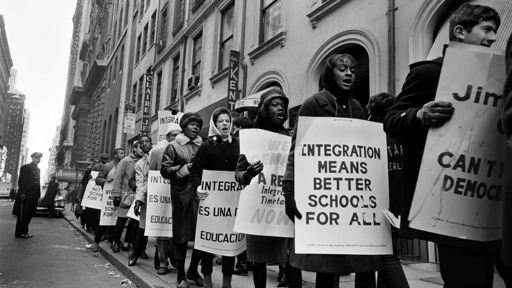
New York City has long been a site of struggle against racism and segregation stretching back to the 1800s. Educational segregation in the city grew in the context of a much larger racist apartheid system based on slavery. It continued through redlining, restrictive covenants, white-only mortgage subsidies, divisive highway construction and “urban renewal” that tore down Black communities. In 1954, the Supreme Court’s Brown v. Board of Education decision challenged the 1896 Plessy v. Ferguson doctrine of “separate but equal,” declaring that “separate educational facilities are inherently unequal.”
While much of the historical narrative focuses on the racist and violent resistance to integration in the Jim Crow South, Northern cities further entrenched already-existing segregation. This sparked massive and inspiring examples of struggle — including school boycotts — led by figures like Mae Mallory and Ella Baker but encompassing hundreds of thousands of predominantly Black and Puerto Rican students and families across the city. While generations of New Yorkers have fought back, the city’s school system remains one of the most segregated in the country.
Today, a foundational example of this persistent racial and economic segregation is the disparity in access to selective specialized high schools. Every year, thousands of students compete for a limited number of seats, and Black and Latine students remain dramatically underrepresented relative to their share of the city’s student population. Meanwhile, private funding mechanisms like Parent-Teacher Associations contribute to these stark inequities.
All of this points to an education system that has long been and is increasingly dualized: one form of education that’s more privileged and well-resourced, and another that’s stripped-down, precarious, and underfunded. Schools serving Black students, immigrants, and other oppressed groups are too often denied the resources that would allow them to develop their interests and creative potential, explore the world around them, and acquire the knowledge, skills, and critical lens to shape their own futures and society.
Instead of providing every student with a meaningful education, the capitalist system rations those opportunities, leaving many students with a stripped-down curriculum that offers little beyond the bare minimum and discourages students from questioning the status quo. This serves a labor market that depends on cheap, precarious labor, while reserving richer educational experiences and greater opportunities for those who can afford them. In this sense, educational inequality is not separate from the racist capitalist system — it helps sustain it.
In What Conditions Are Students Learning?
The low expectations, lack of rigor, and erratic communication described in the article are enraging. Families should be able to trust that students will emerge from public schools as strong readers, writers, mathematicians, and critical thinkers in partnership with their families and communities. Rather, Najya left her middle school feeling somehow both unchallenged and underprepared. These learning conditions are unacceptable and infuriatingly common.
To be sure, there are plenty of ineffective educators who range from exhausted to jaded to outright racist — that should not be glossed over. A teacher has the potential to uplift or crush a student; to make them feel imprisoned or liberated. But the problems extend far beyond the individual.
We need to ask ourselves what produces such destructive conditions that crush educators under competing demands and expect them to address the consequences of problems that extend far beyond the classroom. We need to examine these conditions in the context of the broader, bipartisan attacks on public education and the working class.
It’s worth pausing to consider the material conditions in which so many of New York City’s students are expected to learn. According to the NYC True Cost of Living Measure, 73 percent of children are economically insecure, and nearly one in seven children experienced homelessness during the 2024-25 school year. The Trump administration stripped the status of thousands of Haitian TPS recipients across the city recently lost their ability to legally live and work in the country, and the recent ICE shooting of Oscar Belgal while picking up his five-year-old child from school is proof of the fact ICE is still terrorizing the community and that immigrant students and their families are not safe. And the imperialist attacks on Latin America, Iran, and beyond impact the lives of so many students across the city.
Poverty, housing insecurity, immigration enforcement and family separation, youth mental health crises, hunger, mass incarceration, and countless other injustices — neither students nor educators created these problems, yet they must face them every day.
Yet educators — many of whom have backgrounds that reflect those of their students — are expected to support children through these realities and somehow simultaneously overcome the literacy crisis. All the while, they are being provided dwindling time, staffing, and resources to respond to them. In many schools, class sizes remain untenably large, making it impossible to give students individualized attention.
Meanwhile, the city continues to rely on policing and punishment that disproportionately criminalize Black and brown children. Schools need more counselors, social workers, nurses, and librarians — not more police. Paraprofessionals, who provide essential support to students, including students with disabilities, are routinely underpaid and asked to do more with less — and these positions are disproportionately filled by Black and Brown women.
Yet the structural problems of education are constantly cast as individual failures. If a student is struggling, the teacher needs to differentiate better; if teachers are burned out, they need more professional development; if a school is struggling, families should have the “choice” to leave. The responsibility is constantly pushed downward, while the material conditions produced by those at the top are only getting more dire.
Two years into the second Trump administration, the education system faces an even more explicitly right-wing assault on civil rights protections, affirmative action, bilingual and special education, and the rights of queer students. But the attacks on public education did not start with Trump. For decades, both Democratic and Republican administrations have embraced different versions of policies that treat education increasingly through the logic of the market — competition, choice, standardized testing, and privatization that have starved the public system. Meanwhile, enormous public resources continue to flow toward policing, incarceration, military spending, and corporate subsidies. All of this reinforces the racist system that divides students and the broader working class.
This broader context cannot be an afterthought. Otherwise, we risk offloading our ire onto individual parents, teachers, students for problems that are actually systemic, and expecting them to solve those on their own. Not to mention the importance of recognizing the countless educators of all backgrounds across the city and country who dedicate their lives to doing incredible work in underfunded schools despite all of the obstacles. Understanding the roots of educational injustice must be central to how we fight this racist and unjust system.
How Do We Fight?
The Hannah-Jones family’s experience reveals that the fight against segregation cannot be resolved through individual decisions. The question is how we fight collectively against the anti-Black racism and capitalist logic that U.S. education is so steeped in — and for the meaningful, integrated, liberatory education that students deserve. What strategy can get us there?
On the Brian Lehrer Show, Nikole Hannah-Jones offered several possible solutions, including eliminating middle-school screens and zoning children to schools. “The reason I don’t name solutions,” she explained, “is because we already know what the solutions are. We just don’t have the political will to enact them.”
The solutions she proposes could address some of the sharpest inequalities. But the problem is bigger than a lack of political will; it is rooted in capitalist priorities and the broader crisis of public education in the context of U.S. hegemonic decline. More families are struggling, and young people are being offered a future defined by instability, racist attacks, deportation, and imperialist war.
In this moment of crisis, students and educators are increasingly reckoning with what it means to receive a “good education” in the first place. The school system run by the ruling class continues to sell the myth of meritocracy and the illusion that a “good education” is a finite resource. Students, educators, and families are told to accept austerity while classrooms crumble and families lose health care, their jobs, their homes, and their status. More and more young people are seeing through this farce.
That’s exactly what has inspired the youth protests in France and India, now spreading across the globe, where students are blocking their schools, standing up to the police, arm in arm with their teachers and communities against austerity and militarization. Earlier this year in the Twin Cities, communities organized in schools and on the streets to kick ICE out and defend their immigrant neighbors. The youth taking part in these struggles have grown up in a world shaped by the Black Lives Matter and Palestine movements. These struggles point toward something beyond a demand that the state manage schools more fairly; they are giving those involved a real education through class struggle, showing the possibility of students, educators, and working-class communities organizing together and fighting for a future in which education is a right, and workers and students have the power to decide how society is run.
This points to the need for a strategy that does not rely on the capitalist state or its parties and institutions, which have countless ways to contain and divert our struggles into campaign promises and maybe tepid reforms, without challenging the system at the root.
We should fight for every reform that makes life better for students, families, and school workers. This means fully funded public schools, paid for by cutting military and police budgets and taxing the rich. This could pay for smaller class sizes, librarians and nurses in every school, more guidance counselors and social workers, and dignified wages for underpaid and precarious coworkers, especially paraprofessionals and substitute teachers — with a strong investment in recruiting and retaining educators of color. This must also include protections for immigrant students and staff and against retaliation for fighting for better working conditions, resisting ICE, and protesting the genocide in Palestine and all imperialist attacks. Parents like Nikole Hannah-Jones and the wider community have a crucial role to play in this fight.
But these demands cannot be won by lobbying politicians or relying on pressure campaigns aimed at an ostensibly more sympathetic Mamdani administration. We should make demands on the city and state, but we cannot put our faith in the institutions that have presided over these inequalities to resolve them for us.
Fighting against racism and for fully funded public education will take class struggle built on organized power from below. Educators, school staff, students, parents, and community members need spaces to meet, debate, make collective decisions, and coordinate actions. This could look like school-based committees, mass meetings, rank-and-file networks across schools, and coalitions that can mobilize whole neighborhoods. Importantly, decisions must be driven by those most impacted.
The United Federation of Teachers must finally take up the struggle against racism and segregation. The union should help its members organize democratically and independently of both the Democratic and Republican parties, especially when they claim to represent our interests. The people who keep schools running, alongside the communities they serve, must be able to set the agenda and determine how to fight for it.
Capitalist politicians, including Mamdani, promise to defend public education while presiding over budgets that prioritize billionaires and the racist police over the resources our schools and communities need. A class-independent movement means refusing to subordinate our demands to either major party, and refusing to let politicians turn our struggles into campaign slogans for November. It means relying on our own collective strength — on strikes, protests, walkouts, community organizing, and democratic assemblies — to win immediate improvements while using every struggle as a school to transform the system itself.
We need a horizon that includes schools run democratically by the communities they serve, with committees of educators, school staff, students, and families deciding curriculum and policies, and assemblies where people can collectively make decisions about how schools — and society — are run. Schools and libraries can become hubs for these spaces, places where people gather, learn, organize, and build solidarity across the divisions that the system imposes on us.
There is no lasting exit as long as this rotten system festers. The fight against racism and segregation, and for public education is part of a much larger struggle over who gets to make the decisions that shape our lives. People may say that we’ll never get that power. But as the world becomes more and more irrational, it’s worth resurrecting the slogan of May ’68 that has inspired so many youth in France: be realistic — demand the impossible.
The post Fighting Segregation Means Fighting the System That Produced It appeared first on Left Voice.
From Left Voice via This RSS Feed.