

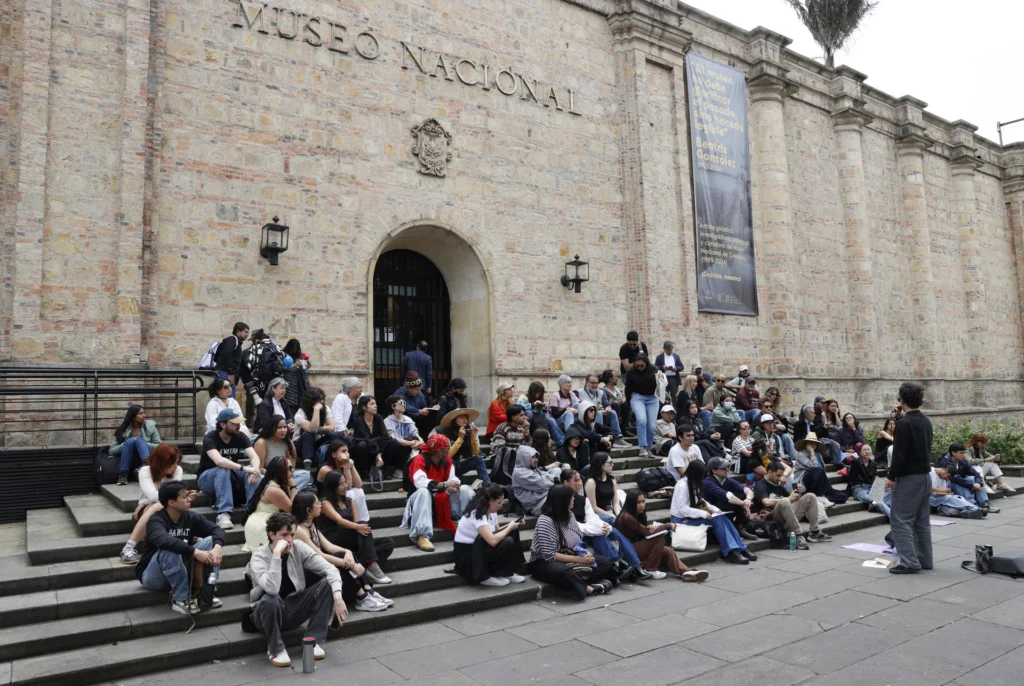
A Bogotá court ordered the National Museum to safeguard nearly 30 removed works as professors protested the government’s decision.
A Bogotá court has ordered Colombia’s National Museum to preserve nearly 30 artworks removed from its exhibitions, prohibiting further alterations or removals without legal authorization amid growing protests over the government’s decision to take down pieces related to the armed conflict, feminism and LGBTQ+ communities.
RELATED: De La Espriella’s Cultural Counterrevolution In Colombia Kicks Off
The 24th Family Court of Bogotá issued the precautionary measures in response to a constitutional protection petition filed by Gabriel Becerra Yáñez, secretary-general of the Unión Patriótica party, and members of the León Zuleta and Revolución en Rosa collectives.
Judge César Enrique Osorio Ortiz ordered the museum to keep the affected works in appropriate conservation conditions and prohibited the institution from moving, destroying, altering, deaccessioning or returning them to third parties. The museum must also preserve all records, exhibition plans, minutes and communications related to the removals.
The court gave the museum’s management 24 hours to submit a detailed report identifying the works’ current locations and conservation conditions, including items removed from exhibition rooms and the Miguel Ángel Díaz memorial garden. The report must also identify the authority responsible for ordering their removal.
🇨🇴 Seis museos de arte moderno de Colombia cuestionaron el retiro de al menos 30 piezas históricas del Museo Nacional en Bogotá. #teleSUR #Colombia #Cultura pic.twitter.com/dsicaHCuPI
— teleSUR TV (@teleSURtv) October 18, 2026
Text Reads: Six modern art museums in Colombia questioned the removal of at least 30 historical pieces from the National Museum in Bogotá.
The dispute began last week after President Abelardo de la Espriella ordered nearly 30 works removed from the museum’s permanent exhibitions. His office characterized the pieces as an “ode to terrorism.” The works address historical memory of Colombia’s armed conflict, feminist demands, LGBTQ+ rights and the 2016 peace agreement with the Revolutionary Armed Forces of Colombia (FARC).
Court cites constitutional protection for historical memory
In its ruling, the court emphasized that artistic expressions connected to historical memory, truth-seeking and symbolic reparation for victims are protected under Colombia’s Constitution.
The decision cited the Constitutional Court’s recognition that such works serve a broader public purpose.
“Artistic expressions associated with processes of historical memory, extrajudicial truth and symbolic reparation for victims are not merely cultural manifestations, but constitutionally protected instruments for building collective memory, dignifying victims and ensuring guarantees of non-repetition,” the ruling stated.
The judge added that these expressions warrant enhanced protection because of their close links to the fundamental rights to truth, historical memory, artistic freedom of expression and symbolic reparation for victims.
The court found reasonable grounds to suspect that these rights had been violated and warned that further harm could occur without immediate conservation measures. It said the precautions were necessary, urgent and proportionate to prevent irreparable damage while the case is considered on its merits.
A post shared by Pacto Histórico Oficial (@pactohistoricooficial)
Text Reads: Historical memory cannot be erased!
The justice system accepted our legal petition and ordered the protection of the works removed from the National Museum, the halting of any further unjustified removals, and the preservation of the garden dedicated to Miguel Ángel Díaz.
The memory of the victims and the rights that have been won must be defended!
The petition names both the Ministry of Cultures, the Arts and Knowledge and the National Museum. Each has one business day to respond, submit evidence and clarify whether administrative decisions authorized the removals, as well as the degree of institutional autonomy between the two bodies.
The proceedings also involve President de la Espriella, Bogotá’s Secretariat for Women, the Sexual Diversity Directorate of the District Planning Secretariat, the Secretariat for Social Integration, the Sí Mujer Foundation and the Colombian Communist Party. These parties were also given one business day to submit evidence.
Professors hold classes outside museum in protest
The legal challenge comes as opposition to the removals has spread beyond the courtroom. On Monday, university professors moved their classes to the steps of the National Museum, holding open-air lectures to discuss the government’s decision and what they described as censorship.
Academics from several disciplines used an amplification system to address the public. The sessions took place under the watch of numerous officers from the National Anti-Riot Unit (Unadi), the same force deployed during large demonstrations outside the museum over the weekend.
A post shared by Pacto Histórico Oficial (@pactohistoricooficial)
Text Reads: ABELARDO DE LA ESPRIELLA SEEKS TO ERASE HISTORICAL MEMORY
The president has ordered the removal of images and references to Carlos Pizarro Leongómez—former M-19 commander and a key figure in the peace process—from government-controlled public spaces. This decision follows the provisional suspension of the designation of his hat as a piece of cultural heritage, and comes amid a visit to the Ministry of Culture, during which he also lashed out against inclusive language.
Arguing that “terrorists” should not occupy public spaces, the government is attempting to dictate which parts of history deserve to be remembered.
Memory cannot be erased by decree. History cannot be rewritten from a position of power.
Catalina Muñoz Rojas, an associate professor in the Department of History and Geography at the University of the Andes and an organizer of the classes, said the removed works were part of exhibitions developed over years to reflect the pluralism and diversity enshrined in Colombia’s 1991 Constitution.
She argued that the president’s intervention disrupted democratic, participatory curatorial processes involving communities from across the country. The professors plan to continue their educational activities throughout the week, engaging members of the public and the officers stationed outside the museum. Organizers urged the officers to respect the peaceful, academic nature of the protest.
Ana López, a resident of Colombia who attended the demonstrations, described the government’s decision as arbitrary and authoritarian, warning of the risk of more sweeping censorship aimed at silencing the country’s cultural and social diversity.
The removals have also prompted public criticism from Colombia’s modern art museums and the Colombian committee of the International Council of Museums (ICOM Colombia), alongside protests outside the institution.
The court’s precautionary measures will remain in force while it considers the petition’s merits. The proceedings will address the legal basis for the removals and allegations that the decision violated rights related to historical memory, artistic expression and symbolic reparation.
From teleSUR English via This RSS Feed.