

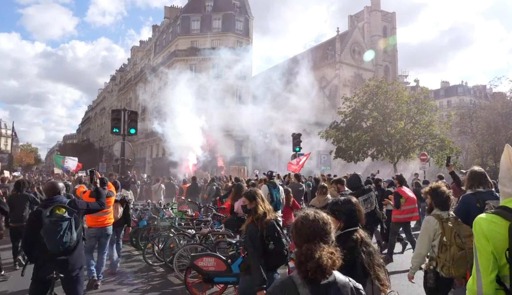
The demonstrations in France on October 17 already mark a major political victory. The high school students’ revolt has succeeded in uniting with other working-class sectors and giving a common voice to demands that, until now, seemed separate. From Paris to Toulouse, from Marseille to Rennes and Besançon, the demonstrations were the scene of a convergence of anger, where young people fighting for better education conditions marched alongside workers suffocating under rising prices, parents worried about their children, and the Yellow Vests — who are rallying once again.
The call for October 17, which circulated on social media around the rejection of the high cost of living, met with a force already engaged in struggle: the high school revolt. This revolt played a decisive role in giving substance to and energizing the day’s events. For more than two weeks, young people have shown that it is possible to resist the deterioration of their living conditions and to take on the government. It is their role as a rallying point and their ability to extend the mobilization beyond their own ranks that gave this day such immense significance.
Wages, Education, Quality of Life: a Shared Anger in the Streets
Testimonials gathered at various protest sites offer insight into the situation. Near Rouen, a warehouse worker on a rotating shift explains that he cannot get to work without his car and describes how rising gas prices are cutting into his family’s income. A municipal employee recounts how her salary, which used to be higher than the minimum wage, has now become comparable to it. In Besançon, a medical secretary and her unemployed sister-in-law are taking part in a protest for the first time, as grocery shopping and covering basic living expenses force them to make constant budget cuts.
All these situations help us understand the link between the anger of high school students and that of workers. Endless days, exhausting commutes, insufficient wages, and a shortage of teachers are all part of the shared experience of an increasingly difficult daily life, with fewer and fewer resources to study, work, and live with dignity. In Toulouse, a young person looking for a job relates to the high school students’ refusal to work from 8 a.m. to 6 p.m. He draws a parallel between this demand and the hours wasted in the workplace, where people are forced to stay even when it makes no sense. Thus, the questions raised by young people already go beyond the confines of schools: what time does this system leave us to live?
Similarly, in Rennes, students from Mayotte speak of water shortages, commutes that begin before dawn, and vandalized classrooms. Their presence highlights the inequalities that the government imposes on the populations of the overseas territories. In Besançon, a future teacher draws a connection between her situation as a student teacher and the difficulties faced by her mother, who works as a support specialist for students with disabilities, her younger sister’s future, and her fear of the rise of the Far Right. The wide range of demands reflects the depth of a social crisis affecting different generations and could form the basis for a common struggle — one that demands resources for education and public services, higher wages and pensions, protection against rising prices, time to live, and the defense of democratic freedoms. It is around these needs that lasting unity can be built and act as a counterweight to the racist divisions on which the Far Right thrives.
The presence of the Yellow Vests adds another dimension to this day. In Dinan, a retired cook puts on his vest again for the first time since 2019. In Toulouse, young people who were ten years old in 2018 are taking up the cause today. These encounters pass on a legacy of struggle — that of the roundabouts, of solidarity, and of confrontation with the authorities — but also the challenges of sustaining and expanding this movement. For high school students who have been mobilized for weeks, seeing other generations join them can shift their perception of their own strength. Their struggle echoes concerns shared across families, neighborhoods, and workplaces. For workers who were still hesitant, the young people’s determination can make collective action a viable option once again. The convergence of these experiences thus constitutes one of the most significant political outcomes of October 17. It can restore confidence to sectors that had been shaken by previous defeats. The government was banking on isolating the youth, wearing them down, and the approach of the holidays; the broadening of the protest movement across society provides a foothold to thwart this strategy and expand the struggle.
Growing Protests Pose a Crisis for the Police
The Yellow Vests had already shown that a resolute mobilization could overwhelm the police response. The events of October 17 once again posed this problem for the government. The intimidation campaign of the previous days failed to prevent mobilizations or to break the determination to protest. And the massive presence of young people — particularly in major cities — along with their mobility and their speed in regrouping in the face of police interventions, made it difficult to control the streets.
At Place de la République, a crowd retreated from tear gas canisters only to charge forward again; chants resumed amid the explosions, and the demonstrators maintained their presence on the square. This ability to resist and regroup puts a system designed to disperse and discourage them to the test. In Bordeaux, protesters spoke out about the cost of their determination to mobilize despite the repression: they denounced the use of tear gas and a police force that forces them to choose between endangering their physical safety and exercising their right to protest. As a symbol of this dilemma, in Saint-Étienne, a protester had his hand torn off by a grenade.
The intensity of the clashes must be understood within this context, where bans on gatherings, checkpoints, arrests, and the closure of strategic locations in Paris were intended to limit the very possibility of occupying public space. However, the scale of the mobilization and the refusal to be deprived of the right to protest thwarted the attempt to clear the streets. The government was able to deploy its forces and strike at the demonstrators, but it struggled to disperse the crowd and regain political control of the day. This resistance carries significance that extends beyond the immediate confrontation. Young people and workers refuse to be terrorized and are overwhelmingly denouncing the repression. In Rennes, a carpenter — a former “Yellow Vest” protester injured in 2018 — expressed his outrage at police violence, which is now targeting young people. The shared experience of police crackdowns and the struggle for decent living conditions is bringing together generations and sectors that the government seeks to keep apart.
The scenes of confrontation evoke a sort of “night of the barricades” on a national scale. The challenge is to transform the determination being expressed into a lasting force and to extend this anger to all workers. To achieve this, the mobilization must be able to rely on forms of organization that allow for collective decision-making on the next steps, by anchoring the struggle in schools, workplaces, and neighborhoods; organizing it through assemblies; and mobilizing the power of workers through strikes.
The Châtillon Strike and the Labor Movement
The strike at the SNCF (France’s national railway company) technical center in Châtillon this Saturday is one of the first examples of the labor movement entering this struggle through a strike. Its significance lies precisely in this breakthrough: workers putting their productive power on the line and transforming their workplace into a meeting point with mobilized youth. On Saturday morning, hundreds of people gathered there to answer the call of the site’s workers: railroad workers from various facilities, students from art schools and universities, high school students, union members from the energy sector, and RATP (public transportation) workers.
A union activist from ATM (formerly RATP) in Malakoff emphasized the importance of uniting struggles, a concept to which this gathering gave concrete form. Young people are reaching out to workers where they are organizing and going on strike. Workers from different sectors are discussing the obstacles to mobilization and the initiatives needed to overcome them. Meeting, debating, preparing delegations, and agreeing on joint actions creates the conditions for new sectors to join the struggle — an exemplary cross-sectoral strategy that must be continued.
We must expand this type of initiative. Delegations of high school and college students can propose discussions with union teams and workers at neighboring companies. Workers can participate in youth assemblies, offer their solidarity, and discuss common demands. At every workplace, assemblies should discuss how to join the movement, what demands to advance, and how to prepare for the strike.
Waiting until November 5 — when France’s major labor unions have called a national day of protest — would mean letting the opportunity presented by this day slip away. Starting now, we must ensure the movement’s continuity, maintain connections during high school breaks, and promote cross-sector meetings to decide on joint initiatives — as the students and staff at Mirail did when they voted over the weekend to organize a cross-sector assembly at the university in the coming days. The experience in Châtillon offers a concrete example and a foothold for transforming solidarity with the youth into a working-class force capable of broadening the confrontation with the government.
Self-organize to Launch a Counteroffensive
Such a strategy requires democratic spaces. General assemblies in high schools, universities, and workplaces must allow those who are fighting to decide on their demands, their actions, and their representatives. Mandated and recallable delegates can set up coordinating bodies that are accountable to these assemblies.
Interprofessional meetings must extend this practice. Their effectiveness will be measured by their ability to bring together effectively mobilized collectives, to integrate new sectors, and to make decisions that yield concrete results: tours of workplaces, joint assemblies, support for strikers, solidarity in the face of repression, and preparation for upcoming actions. They can ensure the continuity of the connections established today and enable collective discussion of a plan of struggle.
October 17 opens up a possibility: transforming the momentum generated by the youth into a counteroffensive involving the entire labor movement. To widen the breach that has opened up in the struggle against Macron’s Bonapartism, those who gathered in the streets today must organize in their schools and workplaces. Multiplying experiences like the one in Châtillon, expanding the strikes, and forcing union leadership to adopt a battle plan are key to building a force capable of paralyzing the economy and defeating the government’s austerity-driven, anti-worker policies.
This piece was initially published in Révolution Permanente on October 17.
Translated and adapted by Adrien Masson.
The post The Labor Movement in France Must Join the Fight as It Did in 1968 appeared first on Left Voice.
From Left Voice via This RSS Feed.