

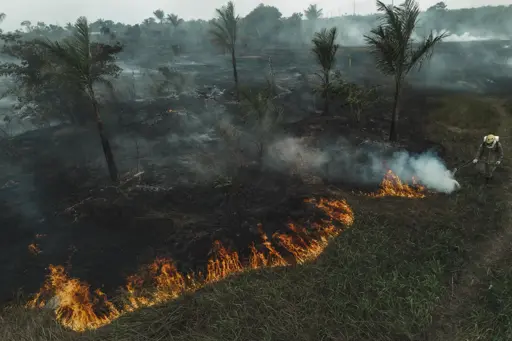
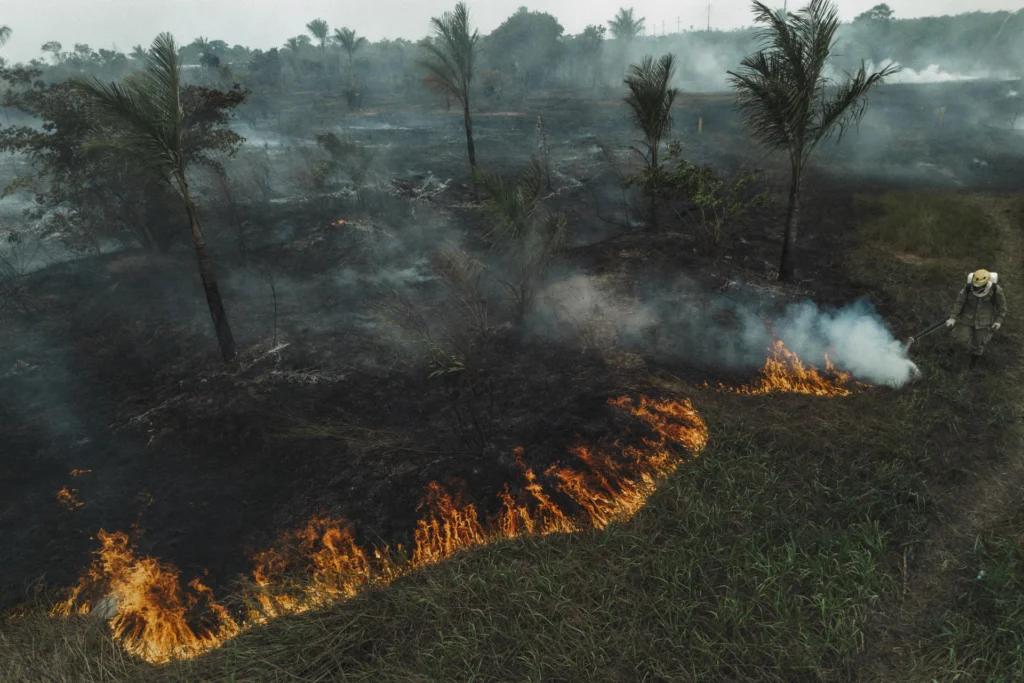
Wildfires in Brazil’s Amazon region have driven air pollution to dangerous levels in cities such as Santarém and Manaus, prompting the federal government to deploy a joint armed forces command, more water-bombing aircraft and emergency funds.
A wave of forest fires is consuming the western zone of Brazil’s Pará state, where authorities have counted 922 active outbreaks. The dense smoke has left the city of Santarém under air pollution levels described as very unhealthy for the local population.
Figures released by the Queimadas platform, which operates under the National Institute for Space Research, place Pará at the top of the national registry of environmental disasters.
RELATED: Brazil Faces Increased Wildfires Due to Super El Niño Phenomenon
The neighboring state of Amazonas reports 90 active fire points after having surpassed one thousand outbreaks in recent weeks.
Conditions grew especially dire in Santarém, where the air quality index climbed to 260 points, according to measurements from the international monitoring platform IQAir. Scientific stations detected concentrations of fine particles reaching 185 micrograms per cubic meter.
That reading exceeds the limit allowed by Brazilian environmental law by an enormous margin. The permitted daily average stands at 32 micrograms per cubic meter. Experts note that these microscopic particles penetrate deep into the respiratory tract and pose a severe threat to public health.
In Manaus, the capital of Amazonas state, the picture remains critical as well. The persistent dispersion of toxic gases pushed the air quality index to 153 units during the early hours of the day, consolidating a harmful atmosphere across the urban centers of the rainforest.
The fires arrive during the dry season, when large stretches of forest are cleared by intentional burns. The flames spread through drought-stricken vegetation, and the resulting smoke drifts over populated areas with no immediate relief in sight.
Manaus respira 12 vezes mais veneno que o limite da OMS — e o pior horário ainda está por virhttps://t.co/9Gd6YlfkL3
Instagram: https://t.co/5ljysPP0H9 pic.twitter.com/OxWcgJCI4Y
— Portal do Holanda (@portaldoholanda) October 18, 2026
Text reads: “Manaus breathes 12 times more poison than the W.H.O. limit – and worst time is yet to com.”
Military Response Activated
Faced with the environmental collapse, Brazil’s federal government ordered an extraordinary operational deployment. Defense Minister José Múcio Monteiro confirmed the activation of a Joint General Staff of the Armed Forces based in Manaus to coordinate ground and air containment efforts.
The response added five aircraft, raising the military fleet fighting the flames in the northern region to 16 water-bombing planes. The Ministry of Integration and Regional Development transferred 14 million reais, about 2.8 million dollars, to the Amazonas state government to mitigate the emergency.
Health authorities announced the installation of a base of the National Force of the Unified Health System. Its main task will be to provide direct medical care to the thousands of residents affected by respiratory illnesses caused by the pollution.
Environmental organizations warn that the scale of the fires exposes the structural vulnerability of the world’s largest tropical rainforest. The combination of prolonged drought, deforestation and insufficient fire control threatens the ecological stability of the Amazonia and the integrity of native communities.
The local government has declared a state of emergency in Autazes as suspected arson fires, aggravated by El Niño, rip through the Brazilian Amazon and trigger health alerts in Manaus🇧🇷🔥 #Amazonas #BrazilFires pic.twitter.com/u9I1i0Ocpd
— SG News (@SGNews123) October 14, 2026
The crisis reflects the devastating consequences of climate change and agricultural pressure on the biome. During the dry season, extensive areas of jungle are razed by intentional burns meant to open land for cattle ranching and large-scale farming.
With 922 active outbreaks in Pará and the fires still spreading, the emergency response faces a race against deteriorating air quality. The health base and the expanded air fleet mark the government’s immediate answer to a crisis that shows no sign of easing.
From teleSUR English via This RSS Feed.