

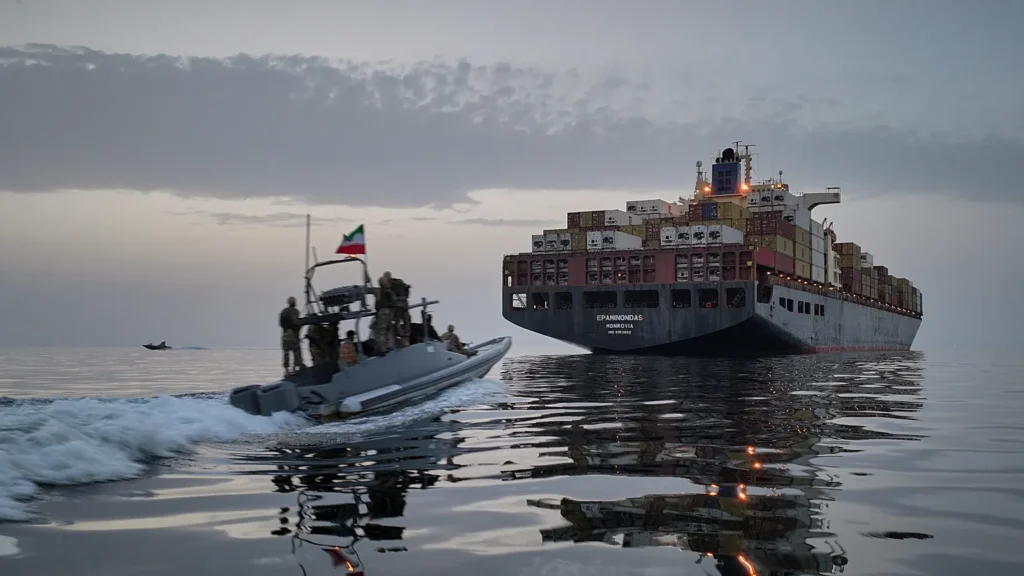
Iran’s Islamic Revolutionary Guard Corps (IRGC) Navy warned Monday it will take firm measures, including sanctions, against any vessel sailing through the Strait of Hormuz with its identification systems deliberately switched off, after an oil tanker struck a naval mine and caught fire.
The naval force reported that the tanker sustained a powerful explosion and fire in its engine room, according to a communiqué released October 19. The blast occurred in the southern sector of the strait as the ship tried to leave the area while keeping its positioning and navigation equipment turned off from the very start of its journey.
RELATED: Gulf Countries Urge U.S.-Iran Dialogue, Restoration of Navigation in Strait of Hormuz
Iranian authorities said the vessel was attempting to cross an unauthorized maritime route without observing the international transit regulations in force along the corridor. The military institution stressed that severe and firm measures will be applied against any ship or supertanker navigating the Strait of Hormuz or the Persian Gulf with electronic identification gear intentionally deactivated.
Ships commonly use automatic identification systems, known as AIS, to broadcast their position, and switching them off is a practice often associated with efforts to avoid detection.
The Strait of Hormuz links the Persian Gulf with the open sea and ranks among the world’s most critical corridors for energy shipments. Disruptions along this route echo quickly through global oil markets, which explains the attention the mine blast drew from the naval command and from traders tracking the waterway.
BREAKING: Iran announces an oil tanker has hit a naval mine while exiting the Strait of Hormuz through the US-backed southern Omani corridor, with a massive fire in the engine room. pic.twitter.com/kzMnoJr4Q0
— The Hormuz Letter (@HormuzLetter) October 18, 2026
A Tanker in Flames
The explosion and the fire that followed inflicted serious damage on the tanker. Naval rescue teams remain deployed near the site of the incident to prevent further risks to navigation and to guard against possible spills that could harm the marine ecosystem.
In recent weeks, several other vessels have recorded considerable damage while attempting to cross through passages that are not authorized south of the strategic corridor controlled by Iranian forces. Officials tied the pattern of incidents to deliberate breaches of transit protocols by ships seeking to move without being detected.
The warning issued Monday signals that Tehran intends to enforce those rules with greater severity. The IRGC’s statement made clear that no vessel, whatever its size or flag, will be permitted to traverse the waterway with identification systems switched off.
Closure and Oil Markets
The escalation unfolds against the backdrop of Tehran’s decision to restore the closure of the strait, a measure presented as a response to the sanctions and maritime blockades imposed on Iranian ports by the U.S. government.
The shutdown of this vital artery pushed international prices of crude and refined energy products sharply higher, disrupting supply across Western markets. Washington, confronting the resulting instability in commercial transit, has resorted to continuous releases from its strategic petroleum reserves in an effort to contain global economic volatility. The continuous drawdowns from emergency reserves underscore how heavily the closure weighs on the global supply balance.
Tehran had previously arranged the reopening of the corridor after the signing of the Islamabad memorandum of understanding. The Iranian Armed Forces, however, reimposed the restrictive controls after denouncing aggressions and violations of the peace accords, a reversal that left the waterway under tight military supervision once again.
Ver esta publicación en Instagram
Una publicación compartida de teleSUR English (@telesurenglish)
Control over commercial navigation in the Persian Gulf remains a central point of geopolitical confrontation in the region. Iranian authorities reiterated that full compliance with transit regulations is indispensable to guarantee the operational safety of merchant vessels moving through the strategic passage. The naval command said the area remains under close observation.
From teleSUR English via This RSS Feed.