

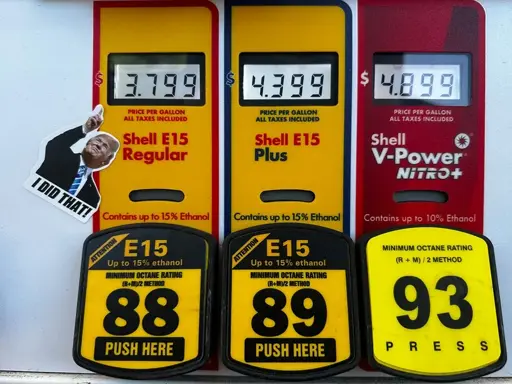
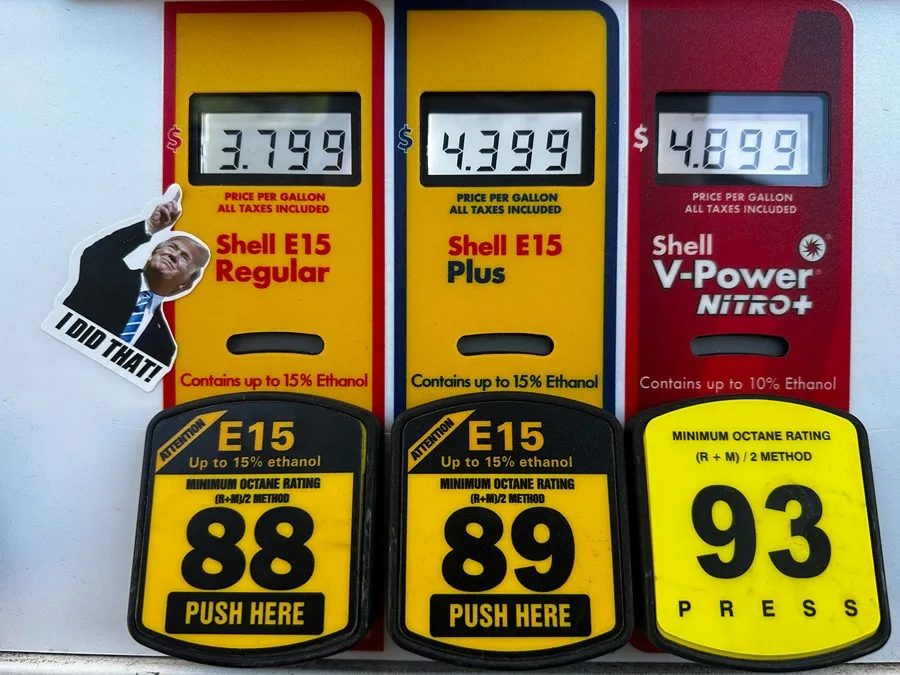
Two weeks before the midterm elections, Trump’s approval rating has hit a two-term low. The war with Iran has driven up the cost of a tank of gas and a cart of groceries, millennials have turned away from him faster than the rest of the country, and part of his base plans to stay home.
Donald Trump’s name is not on any ballot on Nov. 3, yet much of the U.S. electorate will head to the polls with him in mind.
A national poll released Sunday, Oct. 18, and conducted Oct. 9-13, puts his approval rating at 33%, the lowest the series has recorded in either of his terms. Two in three adults disapprove of his performance, 52% strongly, and the same survey had him at 37% in both April and July.
RELATED: Trump Approval Falls to New Low of 33% Two Weeks Before Midterms
The poll also asked whether the next Congress should act as a check on the president or support his agenda. Fifty-eight percent preferred a Democratic-controlled Congress as a check on him, compared with 39% who want a Republican Congress aligned with the White House, a gap nearly twice as wide as a year ago. Neither party is calling this election a referendum, but the answer brings it close to one.
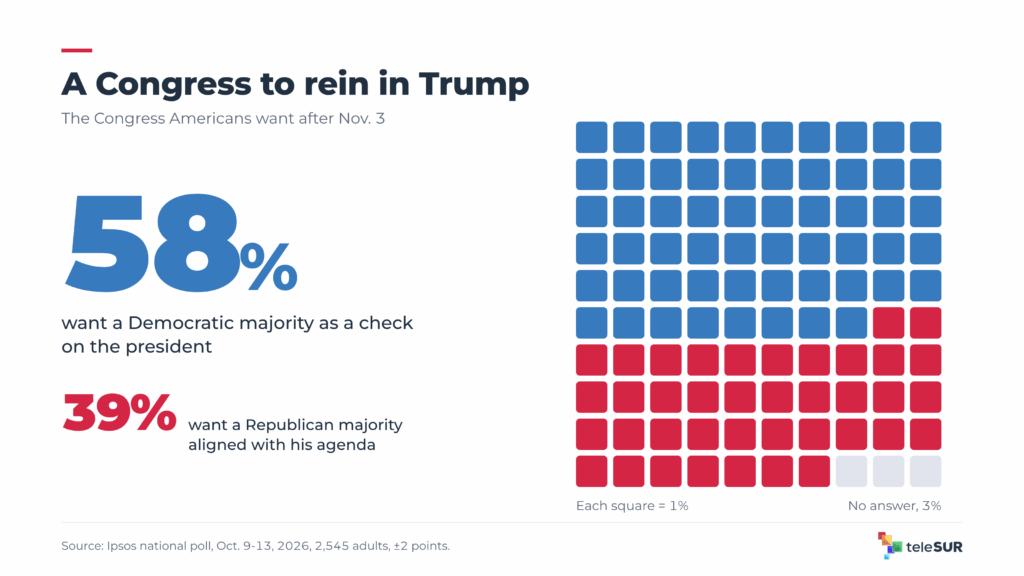
Almost six out of ten U.S. citizens want the next Congress to counterbalance Trump, a gap that has nearly doubled in one year. Graph: teleSUR
In the race for the House of Representatives, Democrats lead Republicans 52% to 44% among likely voters. Among registered voters the gap holds at eight points; in July it was three.
Other surveys tell the same story. An earlier Ipsos poll put him at 32% in September, and the Pew Research Center had him at 30% in early October. The slide deepened after February, when the war with Iran began.
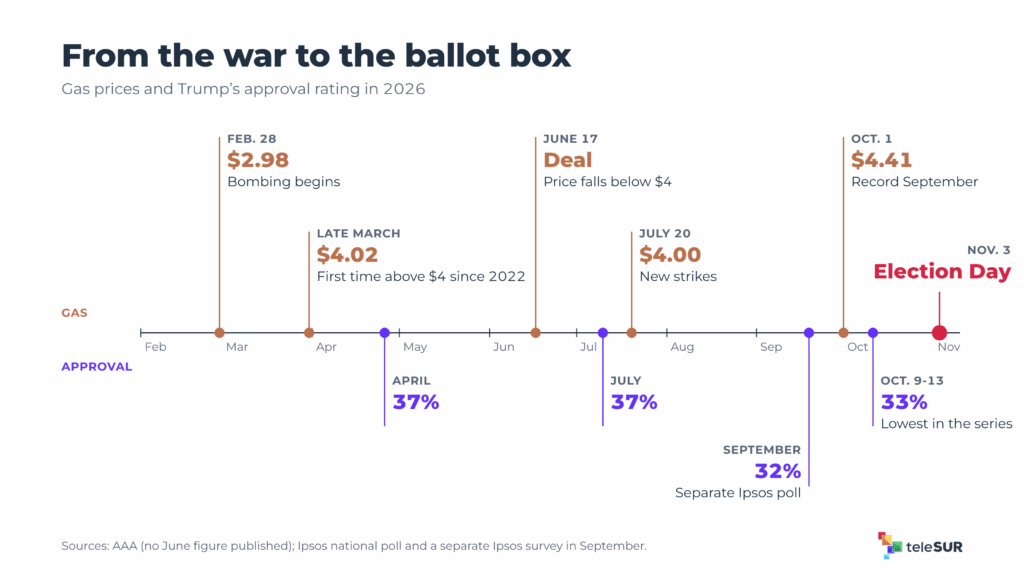
Between the first bombings on Iran and the election, gasoline soared above 4 dollars and Trump’s approval rating plummeted. Graph: teleSUR
From Hormuz to the Gas Tank
The United States and Israel began bombing Iran in February, when a gallon of regular gasoline cost an average of $2.98, according to AAA. By late March it had topped $4 for the first time since 2022, and each new round of strikes pushed it back up. On Oct. 1, the national average hit $4.41.
At those prices, filling a 15-gallon tank costs about $21 more than before the war.
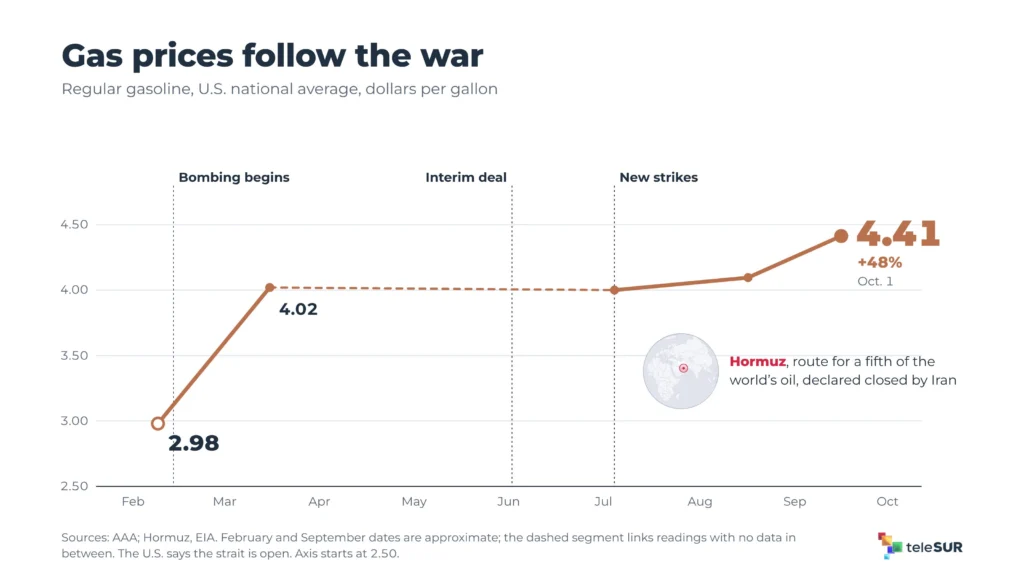
With Ormuz declared closed by Iran and no oil pipelines capable of replacing it, the gallon rose 48% in the US even with record crude production. Graph: teleSUR
In February, 7 in 10 U.S. citizens considered gasoline affordable. Eight months later, the same share says the opposite.
About a fifth of the oil the world consumes passes through the Strait of Hormuz. According to the official price index for September, consumer prices rose 3.7% over the year, energy 20.4% and gasoline 34.2%, while inflation excluding food and energy stood at 2.6%. Today, 65% of U.S. citizens believe attacking Iran was a mistake.
Tehran declared the strait closed in March and has reaffirmed that stance several times since. In October, Rear Adm. Habibollah Sayyari, chief of staff of Iran’s army, told the official IRNA news agency that the waterway remains closed and that all transit must be coordinated with the armed forces, and he blamed the closure for the rise in U.S. gasoline prices.
Washington says otherwise. On Oct. 7, Secretary of State Marco Rubio said that **“**the Straits of Hormuz are open,” that as much oil is flowing out now “as there was before this conflict began” and that Iran has “lost complete control of the straits.” Overland routes cannot replace the strait either. Before the war, the EIA estimated that the Saudi and Emirati pipelines that bypass Hormuz had only about 2.6 million barrels a day of spare capacity to divert crude, compared with the 20 million barrels a day that moved through the strait.
Ten days later, Vice President JD Vance revealed another side of the same administration. “I recognize that gas prices are too high right now,” he said Saturday night at a televised town hall. Asked why the war had not ended in a clear victory, he said that “in some ways we have won decisively,” though “the enemy gets a vote.” And he repeated that Iran, “the largest state sponsor of terrorism in the world,” cannot have a nuclear weapon.
On the campaign trail, the fix being sold in Washington points elsewhere. In a poll of 1,000 likely voters taken in early October, four in five agreed that increasing U.S. energy production “can help make everyday life more affordable,” and 67% backed a proposal whose wording already promised the result, “updating federal permitting laws to reduce delays and lower costs.” It is the same reform the oil industry pitches as the key to affordability.
The government’s own energy agency supplies the missing piece. The United States has been the world’s largest crude oil producer since 2018 and is on track for a record of about 13.7 million barrels a day this year, while 84% of the crude that crossed Hormuz was bound for Asia. With output at record highs, gasoline has risen 48% since the bombing began. Crude is priced on a global market, and this year’s price spikes followed the calendar of the war, not the permitting calendar.
The price shock reached much of the world, and Latin American economies that import refined fuels absorbed it without having had any say in the decision to go to war. For those countries, the permitting fight in Washington is a distant concern; the price of their diesel depends on what happens in Hormuz. How much room Washington has to keep waging the war without congressional oversight will also be decided on Nov. 3.
For Latin American families living in the United States, the most visible face of the second term is immigration policy. At the start, half the country approved of it; now about 60% disapprove, and 56% say deportations have gone too far, eight points more than in April 2025. At the same town hall, Vance acknowledged that his rhetoric about immigrants had been “imperfect” and took the blame. “That’s on me,” he said. His goal, he insisted, is not “to dehumanize any immigrant.” “In fact, I love a number of immigrants,” he added.
An Economy Judged by Team Colors
The president’s approval on the economy has fallen to 28%, its lowest mark across his two presidencies. Forty-eight percent feel worse off than when Trump returned to the White House in 2025, the highest share in a series dating back to 1986, and for the first time in more than a decade, registered voters trust Democrats more to handle the economy, 40% to 33%. Before the 2022 midterms, the same series gave Republicans a double-digit edge on the issue.
That year, with Joe Biden in the White House, each party’s verdict on the economy was the mirror image of today’s, almost point for point, and independents stood at 16% in both surveys.
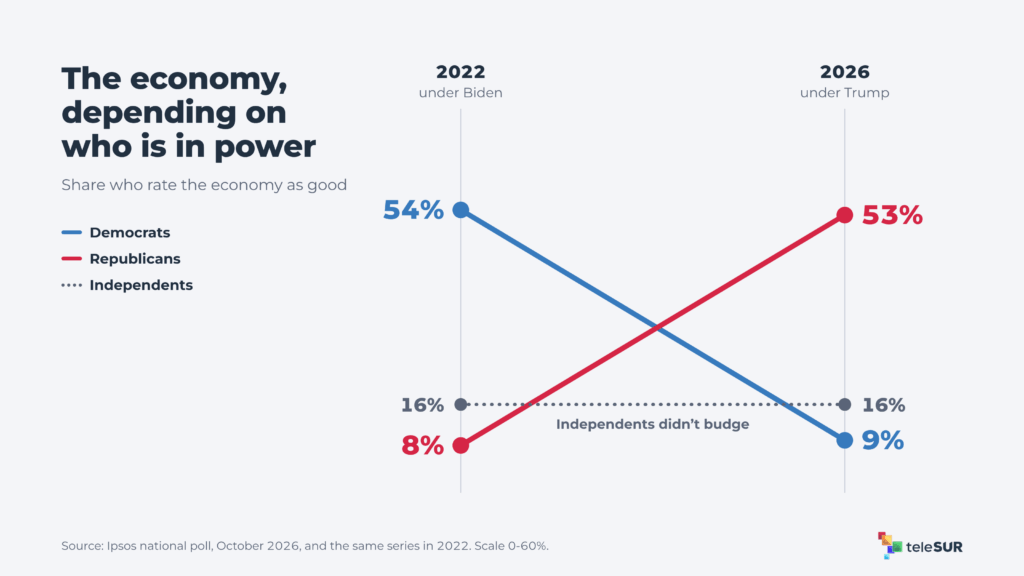
Democrats and Republicans reversed their judgment of the economy by changing government, meanwhile only independents stayed where they were. Graph: teleSUR
Voters who wear no team colors are moved by their wallets. In the October survey of likely voters, 37% said a candidate’s stance on affordability will decide their vote for Congress, more than double the 15% who put immigration first, an issue central to Trump’s 2024 campaign. That priority is shared by 43% of Democrats, 36% of independents and 32% of Republicans.
Among those who say they are worse off than in 2025, 78% lean toward Democrats, as do 71% of independents in that group.
The Generation that Turned Away Fastest
Millennials, born between 1981 and 1996, are now 30 to 45 years old and make up the largest adult generation in the country. In 2024 they split almost evenly on Trump; exit polls showed voters ages 30 to 44 backing Kamala Harris over him 51% to 47%.
A YouGov poll conducted Aug. 28-31 found 27% approval and 70% disapproval in that age group, the group’s worst showing in the series. Its net rating went from minus 1 in January 2025 to minus 43 in August, a 42-point drop, compared with 30 points nationally.
The Economist makes the opposite case. It argues that millennials have turned their fortunes around and now earn more than any recent generation did at the same age, while narrowing the gap in homeownership. The magazine credits the recovery to markets rather than to a state-funded rescue. October’s polls show what that narrative leaves out.
In the House race, the Pew Research Center found voters ages 30 to 49 favoring the Democratic candidate 43% to 31%, with one in five still undecided.
October’s affordability survey, broken down by age, points in the same direction. Affordability will decide the vote of 45% of voters in their 30s and 44% of those in their 40s, above the 37% average. This is the cohort that entered the job market in the 2008 crisis, pays rent or a mortgage, raises children and fills the tank every day to get to work, and the tank is precisely where prices have climbed the most this year.
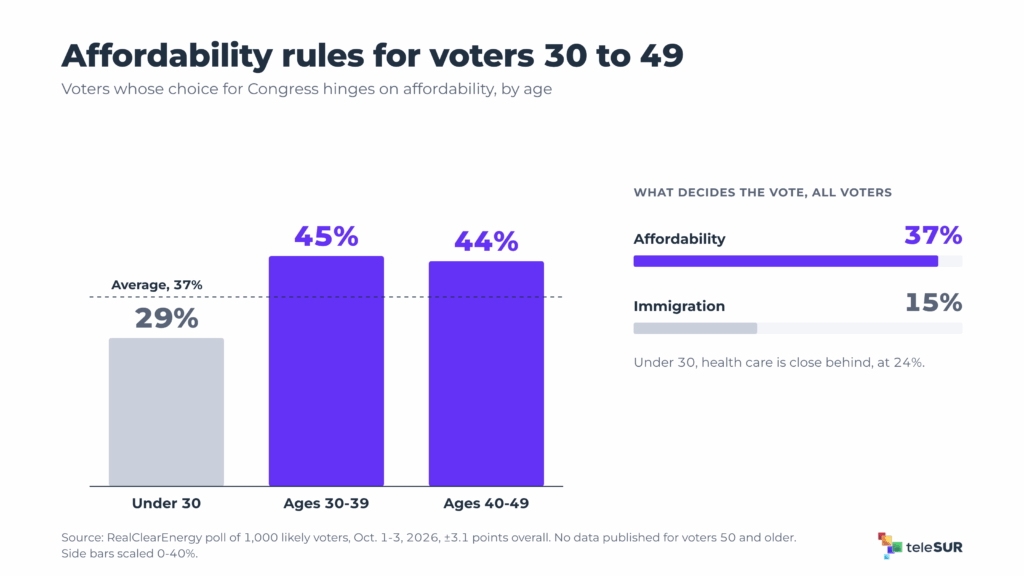
The cost of living defines the vote of almost half of voters aged 30-49, above the national average of 37%. Graph: teleSUR
The figures come from surveys with different age brackets and do not prove a single cause. Read together, though, they show the country’s largest generation turning away from Trump faster than everyone else, with the cost of living at the top of its priorities.
RELATED: U.S. Retail Sales Up in September Amid Surging Gas Prices
The Ones Who Stay Home
Among those who voted for Trump in 2024, 23% now disapprove of his performance and 38% reject his handling of inflation. Most of them still prefer Republicans for Congress, so the erosion does not take the form of a switch to the other party. What they have lost is the certainty that they will vote.
Seventy-five percent of registered Democrats say they are certain to vote, compared with 67% of Republicans. Within the Republican Party, certainty reaches 75% among supporters of the MAGA movement and falls to 57% among those who do not identify with it, and more than a quarter of the latter want Democrats to control the next Congress.
Only 39% of Republicans strongly approve of the president, down from 63% in February 2025.
How many of the 77 million people who voted for Trump in 2024 will return to the polls without his name on the ballot is a question no one can answer yet. Turnout models based on 2022 and 2024 favor Republicans; votes already cast or locked in, by contrast, favor Democrats.
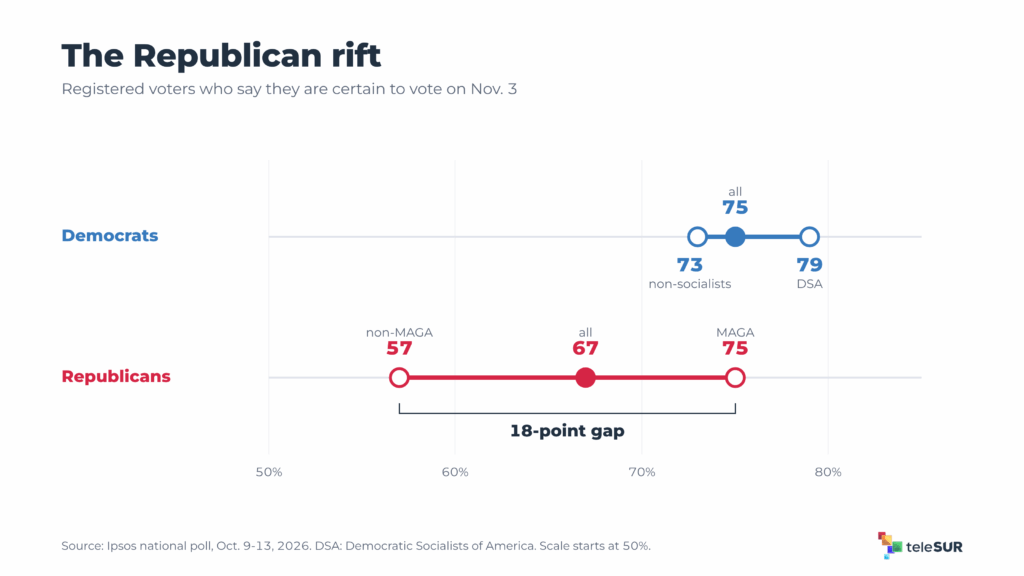
The risk for Republicans is at home. Their MAGA-unaffiliated voters are the least confident of going to the polls. Graph: teleSUR
What is at Stake in the Senate
With the slim House majority Republicans are defending, losing a handful of seats would be enough to hand over control, and presidential approval is among the best predictors of midterm results. Even so, 58% of likely voters who “somewhat” disapprove of Trump still prefer the Republican in their district.
The Senate is split 53-47 in Republicans’ favor, and Democrats need a net gain of four seats to win back the majority. Of the 35 seats on the ballot, seven are rated toss-ups, and six of them — in Alaska, Iowa, Kansas, Maine, Ohio and Texas — are held by Republicans. North Carolina, a Republican seat, is already rated as likely to go Democratic.
The seven states that decided the last presidential election — Arizona, Georgia, Michigan, Nevada, North Carolina, Pennsylvania and Wisconsin — offer an early clue about 2028. Trump carried all seven in 2024, and today his net approval is negative in every one of them, between 15 and 25 points underwater among registered voters, according to the Civiqs tracker. He cannot run in 2028, and those numbers measure a president, not his successor, but they map the terrain his party will inherit.
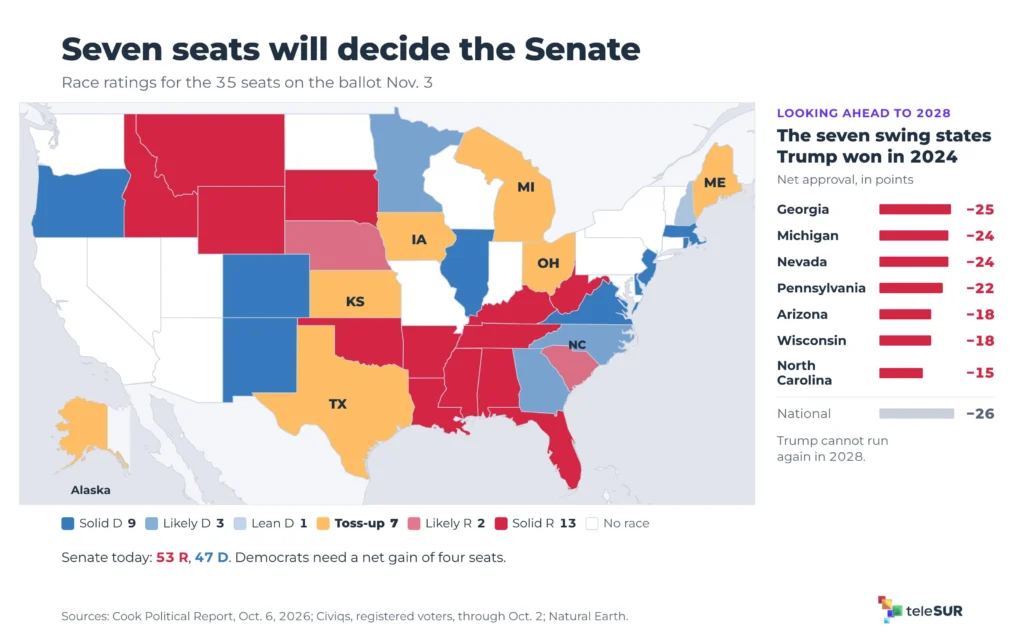
Six of the seven open Senate races are played in Republican seats, while their approval is now negative in the seven states that gave the White House to Trump in 2024. Graph: teleSUR
On Nov. 3, Trump’s name will still be missing from the ballot. The outcome will depend less on votes that switch parties than on the votes that are never cast, among them those of a generation that split almost evenly on him two years ago and in August disapproved of him by more than two to one.
The Arch and the Gas Pump
On Wednesday, Oct. 14, 20 days before the election, the new Air Force One flew low over the airport in Bullhead City, in the Arizona desert. It is the Boeing 747 that Qatar’s royal family gave Trump, now painted red, white, blue and gold. “When they give you a 747, you say two words, thank you,” he told supporters.
Arizona is one of the swing states that change hands from one presidential election to the next. Joe Biden won it in 2020 by about 10,500 votes, Trump took it back in 2024, and today his approval there is 18 points underwater. The state has no Senate race this year, but it does elect a governor and all nine of its House members. The president chose Mohave County, where he won more than 77% of the vote two years ago, with early voting already a week underway. He went looking for his base, the voters he needs at the polls, not at home.
From the plane he moved on to people who leak military information. “In my opinion, leakers should be shot,” he said, and he called the journalists covering him “almost as bad as a leaker.” He touted the ballroom he is building at the White House and the triumphal arch he plans for the capital. On Iran, whose leaders, he said, “are gone,” he let slip a confession. “I might have gone too far. I don’t know who the hell to deal with.” And he promised that once the war ends, “your gasoline is going to go down to even lower than it was before it started.”
He was addressing a country that fills its tank at wartime prices and pays rents 2.8% higher than a year ago, according to the official price index. Three days later, his vice president admitted on television what the gas pump was already saying. Trump, in Arizona, had preferred to talk about monuments.
The planned arch would stand 76 meters (250 feet) tall, about 26 meters (85 feet) taller than the Arc de Triomphe in Paris, and would rise at the foot of the bridge leading to Arlington National Cemetery, as part of the celebrations for the 250th anniversary of U.S. independence.
Napoleon commissioned the Paris arch in 1806, after his victory at Austerlitz, to honor his armies. Construction dragged on for three decades. When it was inaugurated in 1836, the emperor had been dead in exile for 15 years, and he passed beneath the arch only once, in 1840, inside the coffin that brought his remains back to France.
From teleSUR English via This RSS Feed.
It always comes down to the damn gas pump. Its why they want EVs to not catch on because you can’t control electrons with war. If we can self power our cars we have less reason to care what happens in the oil belt and those countries have less pull on our elections.
That’s cool and all, but where did you find gas that cheap?
