

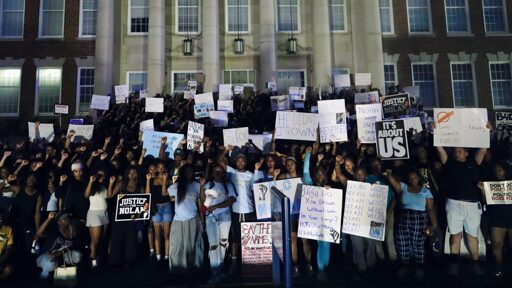

Calls for justice and for the reopening of Nolan Wells’ case are mounting after a grand jury declined to bring criminal charges, despite the question of Wells’ cause of death remaining unanswered.
Wells, a young Black student at Southwest Mississippi Community College, went on a boating trip on July 4 to Horn Island, just off the coast of Mississippi, with several white friends. He never returned.
His friends, who returned to the mainland with Wells’ cell phone but without him, claimed he chose to stay behind. Wells’ body was found in the water near Horn Island two days later.
A state medical examiner declared the 18-year-old’s cause of death “undetermined.” The grand jury, however, claimed that the conditions of his death were “consistent with drowning.” When the autopsy reports were publicly released after the grand jury decision, they revealed that there were two contusions on the back of Wells’ head. The family’s attorney and others have described these injuries as blunt-force trauma, insisting that they do not believe Nolan drowned.
The autopsy also reported a lack of fluid or debris in his airways, and that his stomach was empty.
Read more: Nolan Wells, disputed Black deaths, and the legacy of racial violence in the US
The suspicion and confusion surrounding his death has only been amplified by recently released text messages between various friends of Wells.
Newly released messages between Wells’ friends fuel suspicions and calls for justice
A 292-page report of cell phone messages between Nolan Wells’ friends was released on October 15. In one group chat, the friends that returned to the mainland without Wells appear to be discussing the investigation by authorities.
“Don’t speculate about s— yall.” “Because they can try to get your a–.” “If you talk more,” said one user.
As information about the case became public, sparking calls for answers about Wells’ death, the messages appear to express frustration at the increasing suspicion toward this friend group.
One user said, “small minded individuals who are so full of hate towards themselves that they can’t help but try and push it onto other people.”
Another said, “lay low” “and pray I love yall but we don’t needa be texting ab this.”
In a different groupchat, presumably of several Black friends of Wells, users expressed suspicion toward the group of white friends that came back from Horn Island without Nolan.
“Ts weird af,” said one friend.
“Dem white n—- mane.”
“They did sum wit bra,” said another.
“i lowkey feel like they drugged his ahh assum icl,” said one friend.
“All them white —— was lying ——- was crying otw last night while we was just asking questions,” said another user.
“wtf,” responded another.
Returning to the majority-white group chat of friends that were with Wells on July 4, one user said:
“We need to go to Nolan’s funeral and get with all our other black friends to prove a statement for the media.”
“It would shut everyone down.”
The conversation then turned toward the Wells’ family attorney, Ben Crump, and the Wells’ funeral.
“Whoever paid for the funeral wants it to be some huge thing,” said one friend.
“it’s almost like their brainwashing Nolan’s parents and taking advantage of them while their overwhelmed with grief.” “it’s so evil.”
The group continued to exchange messages expressing frustration at what they described as “racism” being directed towards them by the public as questions around Wells’ death mounted.
An online fundraiser was reportedly set up on behalf of Wells’ white friends, titled “Stand With Nolan Wells’ Targeted Friends,” and included messages like, “Thank you for Standing with The Boys!” The fundraiser received over two hundred thousand dollars to “prosecute cases of defamation” so that “these Boys” can win lawsuits against “fanatical opponents who have unlimited resources.”
As more information comes out about the case, the unanswered questions are boiling over into anger and demands for accountability. A spontaneous movement is now demanding Wells’ case be reopened and investigated thoroughly until justice is served.
Movement for Nolan Wells surges across HBCUs
Following the grand jury decision, spontaneous student walkouts were seen across dozens of historically Black colleges and universities across the South.
“It was clear to us living here seeing the rage around the Nolan Wells case start to come to a boil,” said North Carolina-based organizer with the Party for Socialism and Liberation Prince Williams, speaking to BreakThrough News.
There was a walkout at Atlanta University Center on October 1, another at North Carolina Central October 6, and Prairie View A&M University on October 7.
After these spontaneous walkouts, students at Jackson State University called a Southern Day of Action on October 15, demanding justice for Nolan Wells. Specifically, they called for the investigation into the death of Nolan Wells to be reopened immediately.
“The call spread like wildfire, especially in North Carolina,” said Williams. “Six schools called walkouts and demonstrations.”
In total, about a dozen schools across five states in the South answered the call from students in Jackson, he said.
From an institutional perspective, the case is a settled matter after the grand jury decision. But organizers on the ground say the institutional legacy of racism, white supremacy, and Jim Crow, have not been forgotten. And neither has the historical tradition of Black resistance.
Generations of resistance in the US South
“There has never been a moment in the history of the US where Black Americans could rely on the government to get justice for us,” said Williams.
Instead, he pointed to the countless ancestors who, through relentless struggle, freed themselves from slavery and broke the back of Jim Crow.
“That reality has created a generational responsibility for us to see our own power when we come together on one accord to find justice for ourselves.”
As suspicious deaths of young Black Americans are on the rise, Williams says there is little trust in law enforcement. “About 7 in 10 Black adults say prisons, policing, and the court system were designed to hold Black people back.” The recognition of a highly racist system enforced by these very institutions is widespread, he added. The suspicious deaths we are seeing today are a continuation of a long history, especially in Mississippi, where kidnappings of Black people are “written off as disappearances” and lynchings are ruled “accidental drownings.”
“We must stay vigilant and continue to raise this case in our daily lives with everyone we know.”
National solidarity in the call for justice for Nolan Wells
Organizers urge all students and communities across the United States to support the campaign for justice and accountability.
“Put pressure on local, state, and federal officials to reopen Wells’ case,” said Williams. However, he emphasized that this can’t be done effectively in isolation.
“We need to join organizations of like-minded people that are sustaining these campaigns who can take this movement far beyond the Southern day of Action on October 15.”
From BT News via This RSS Feed.